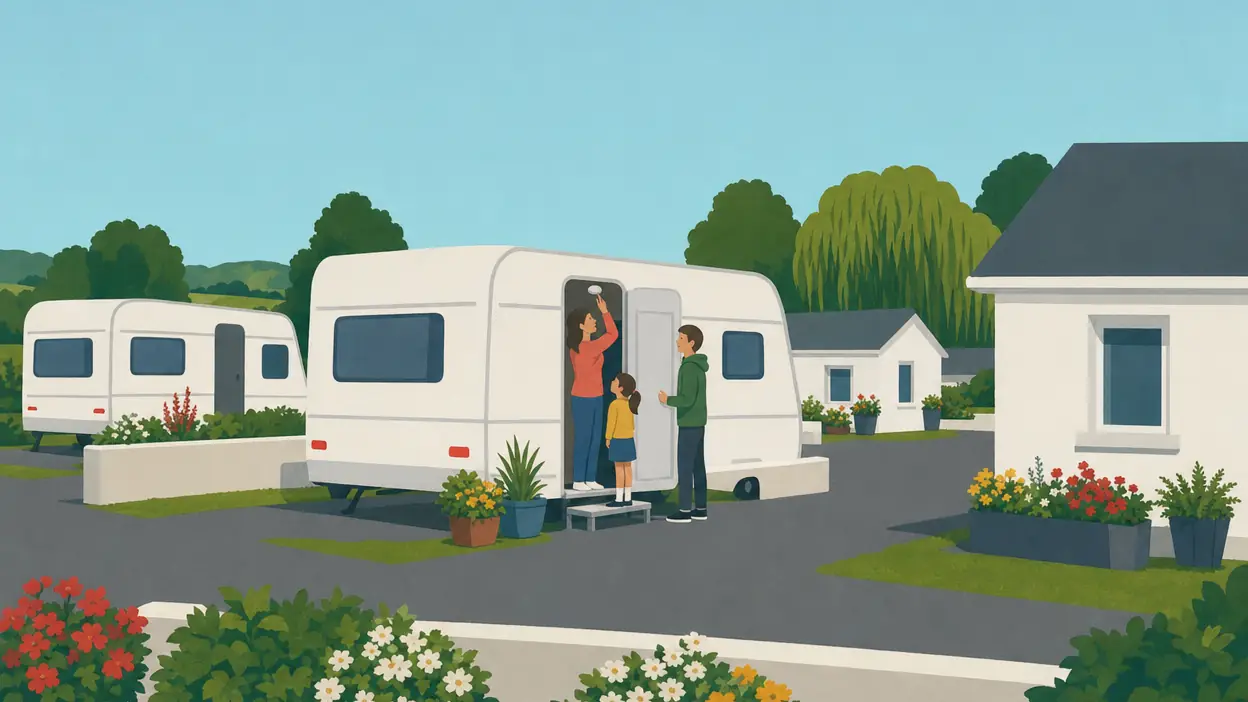
This guide is for Traveller families in a trailer (a caravan), a mobile home, group housing or on the roadside, and for anyone who prints it and passes it on.
We checked every point against what Traveller organisations, the fire service and the HSE publish. If they tell you something different, follow them.
Why the fire guide matters
The national fire safety guide for Traveller accommodation came after the Carrickmines fire in October 2015, in which ten people died.[1]
The guide was written with Traveller organisations. It says the time to escape a trailer fire is “seconds, rather than minutes”.[1]
Keep a fire blanket on the wall near the cooker, keep the way out clear, and keep trailers about 6 metres apart where you can.[1][2] If there is a fire, get everyone out and ring 112 or 999.[1] Before a storm, fill water containers, charge phones and agree who checks on whom. Set up county warnings on the free Met Éireann app: it does not need an address.[3]
Nine tips to stay safe
The Government’s one-page leaflet for the Traveller community gives nine tips. You can print the leaflet and the picture version.[2] Pavee Point carries the same leaflet.[4]
Do not:
- “Do not take electricity from overhead cables”
- “Do not overload sockets”
- “Do not leave chip pans unattended”
Do:
- “Do keep trailers/ mobile homes six metres apart”
- “Do test smoke alarms every week”
- “Do have an escape plan and practice it regularly”
- “Do have a safe place to meet outside in the event of a fire”
- “Do clean your chimney or flue at least once a year”
- “Do have all heating appliances & boilers checked regularly by a certified provider”
Smoke alarms: free first
Ask the fire service for a free alarm. The national guide says: “Smoke alarms are made available by Fire Services as part of Community Fire Safety Awareness campaigns.” Ring your county council and ask for the fire service.[1]
Fit a smoke alarm in every room. The guide recommends optical alarms with a hush button: one near the cooker and one in each other room. Fit them on the ceiling, test them every week and keep them clean.[1]
If children sleep in a different trailer from the adults, the guide suggests linking the alarms. Then an alarm in one trailer sounds in the other.[1] See smoke alarm kit options: Smoke alarm.
A fire blanket, not an extinguisher
The national guide says the best advice is to get everyone out and ring 999 or 112. It recommends only a fire blanket inside a trailer or mobile home, on the wall near the cooker. A blanket is for a small pan fire in its first seconds.[1]
If people on the site want extinguishers, the guide says they should be kept at a Fire Point on the site, not in each trailer. A Fire Point is also the place where everyone meets and is counted. The council should check Fire Points every year.[1]
If there is a fire
- Shout, and get everyone out. Do not go back in.[1]
- Go to your meeting place or the Fire Point, and count heads.[1]
- Ring 112 or 999 and ask for the fire service.[1]
- Give the name of the site, the road and the county. Say if there is a barrier or gate.
The Irish Traveller Movement says that on some sites the caretaker holds the barrier key and is off duty at night.[5] The national guide says arrangements should let fire engines in without delay, for example by the fire service holding keys.[1] Ask your council who has the key at night.
Cannot make a voice call? Text 112.
The emergency text service can be used by "anyone who is not able to make a voice call due to a speech or hearing impairment or other situations where a voice call might not be possible". It works "from any Irish registered mobile phone (either pre-pay or bill pay) on all the Irish Mobile networks". If you can talk, ring instead: a text is slower.
Your text needs four things:
- Which service: Ambulance, Coastguard, Fire or An Garda Síochána.
- What the problem is.
- County you are texting from.
- Where help is needed: town, road, Eircode or a landmark.
Wait for a reply: "an SMS/Text 'Delivery Report' does not mean your message has been received". If no reply comes within 3 minutes, send another message straight away. It does not work from a foreign phone, or from an Irish phone roaming abroad, including in Northern Ireland.
No registration is needed. 112.ie says: "There is no preparation or registration required to use either Emergency SMS, or RTT when contacting the ECAS." If you might need to text one day, you can choose to give the service your address, access details and a next of kin in advance at 112.ie/register. Most smartphones can also use Real-Time Text to type during a call to 112 or 999: turn on RTT in your phone’s accessibility settings.
Source: 112.ie, emergency text service, sending a text to 112, SMS questions and answers, emergency SMS terms and conditions and Real-Time Text pages, checked 1 November 2026.
Carbon monoxide and heating
Carbon monoxide (CO) is a poison gas with no colour and no smell.[1] The national guide says: “All caravans and mobile homes should be fitted with a Carbon Monoxide alarm.”[1] Put one in every room with a gas, oil or solid fuel appliance.[1] The right standard depends on whether your trailer is towed or stays put: see which CO alarm.
CO poisoning can feel like a cold or flu: headaches, feeling sick, dizziness and tiredness. If you feel this when a heater is on, turn it off straight away and get medical advice.[6]
- Never use a cooker to heat the trailer, and never bring a barbecue inside.[6]
- “Paraffin heaters are not recommended for use within caravans.”[1]
- A gas cabinet heater needs a CO alarm, and nothing that can burn above it or close to its heat panel.[1]
- Electric heaters are the safest kind, with the right plug and fuse.[1]
Keep gas cylinders upright and outside, on solid ground. Store empty ones away from the trailer.[1] Take power only from your own hook-up point, never from another trailer, and “Never overload a socket”.[1] For the full gas and electrics advice, see Caravan and mobile home safety.
Crowded sites and sites with no services
Many families have no choice about how close the trailers are. The Irish Traveller Movement writes about the overcrowding that many Travellers “are forced to endure”, and unauthorised sites where it is hard to get water, power and other services.[5][7]
The national guide accepts that trailers on a shared family bay may be closer than 6 metres. It says the fire safety review is not meant to be used “in a negative way”, and that any work should be done “in partnership with the relevant Traveller Community”.[1] Pavee Point says: “Under no circumstances should fire safety be used as a reason for evicting Travellers”.[8]
What you can do on a crowded bay, from the national guide:[1]
- Make sure that when you step out of your door, you can turn your back to a fire next door and walk away.
- Do not face doors straight at each other. Stagger them.
- Park vans and cars at least 3 metres from the trailers, and keep the site road clear for a fire engine.
- Keep petrol and diesel in proper containers, at least 6 metres from the trailer.
Who to ask. On a council site, report repairs and faulty power or water to the caretaker or the council’s Traveller Accommodation Unit.[9] Many councils also have a Traveller Liaison Officer.[10] The national guide says fire services with a large Traveller population should name a liaison officer for the community. They can visit your site and help plan for a fire.[1]
On the roadside or an unauthorised site. Government guidelines say councils could provide “a water supply (piped or a tank)”, portable toilets and washing facilities, and waste collection for families staying a short time.[11] Your local Traveller organisation can help you ask. The Irish Traveller Movement lists free legal help: FLAC on 01 906 10 10 and the Mincéir/Traveller Legal Support Service on 01 234 4471. If you have nowhere to go, ask the council for emergency accommodation.[7]
Storms, power cuts and water
A site often has one water point and one power supply. In a storm you can lose both at once. Do these things when the warning comes, not when the wind arrives:
- Water. Fill clean containers with drinking water. The Government’s emergency booklet says each person needs 2 to 3 litres a day.[12] See water outages and water containers kit options: Water container.
- Power. Charge phones and keep a phone bank kit options: Phone bank charged. A battery radio kit options: Battery radio works when the phones do not.
- Each other. Agree who checks on older people, anyone sick, and anyone on their own.
- Animals. Plan for horses and dogs early. See Pets in an emergency and Farms and livestock.
- Loose things. Tie down or bring in anything the wind can lift.
At Orange, Met Éireann says check your plans and “delay or cancel as appropriate”. At Red, “Take action to protect yourself and your property” and follow what the authorities say.[13] Decide early whether to move to a family member’s house or a solid building, and go before the wind arrives. See Storms.
If a power line comes down, ESB Networks says “DO NOT TOUCH, DO NOT GO NEAR”. Ring 1800 372 999.[14] PowerCheck shows outages in real time at powercheck.esbnetworks.ie.[14]
If someone on the site depends on electrical medical equipment, see Medical equipment in a power cut.
Getting warnings without a fixed address
Most warning services work without a postal address.
- Met Éireann app (free). In the app, “tap the Warnings section, tap My Warnings, then tap Add”. Choose your county. You can add more than one.[3]
- Red warnings by text. On met.ie/warnings you can register with an email address to get Red warnings by text for the counties you pick.[3]
- Text 112. 112.ie says: “There is no preparation or registration required to use either Emergency SMS, or RTT when contacting the ECAS.” It works from any Irish mobile, pre-pay included.[15]
- ESB Networks texts are for planned outages “at your address”.[16] If your bay has its own account, sign up. Someone who needs power for medical equipment can ask their electricity supplier to put them on the vulnerable customer register. ESB Networks says you can name a family member to get the texts for you.[17]
- Uisce Éireann water texts need an Eircode.[18] If your site has one, sign up. If not, ask a relative in a house nearby to sign up and pass on news.
Health
In an emergency, ring 112 or 999.
About 27 Traveller Primary Health Care Projects run around the country. Traveller health workers in them work with families and with health services.[19] Pavee Point co-ordinates the HSE’s Traveller Health Unit in the east.[20] Ask your local Traveller organisation where your nearest project is.
After a fire, flood or eviction, it is normal to feel shaken. Pavee Point runs a Traveller mental health programme and the Young Pavees site for young people.[21] Help is open any time:[22]
- HSE mental health information line: 1800 111 888
- Samaritans: 116 123
- Text HELLO to 50808
Money after a storm or flood
- Emergency Response Payment. If your home is damaged by flooding or a storm, Stage 1 helps with food, clothing and bedding, with no income test. It closes 7 days after the event. Apply through the Community Welfare Service.[23]
- Community Welfare Service: 0818 607080.[24]
- MABS gives free money advice. Helpline: 0818 07 2000.[25]
National Traveller MABS works for financial inclusion for Travellers. It says it “is a policy group and does not provide MABS services”, so ring MABS for advice.[26]
Which situation are you in?
A winter night with five trailers close together and one cylinder store. Test every smoke alarm, agree a meeting place and keep rubbish away from the cylinders.[1][2]
A storm warning when the site’s one water point is outside. Fill containers in daylight, before the wind. Agree who fetches water for older neighbours.
A power cut that stops the pump and the phones. Use stored water, keep one phone switched off to save it, and check PowerCheck when you can.[14]
A flood on a site beside a river. Move people, trailers and animals early, before the water rises. Never walk or drive through floodwater. See Flooding.
A family moved on with nowhere to put the trailer. Contact your local Traveller organisation or the legal services above, and ask the council for emergency accommodation.[7]
Common questions
Can I get a free smoke alarm for my trailer?
Yes, the national guide says fire services give out smoke alarms as part of fire safety campaigns, so ask your county council’s fire service.[1]
Should I keep a fire extinguisher in my trailer?
The national guide recommends only a fire blanket inside a trailer or mobile home, with extinguishers kept at a Fire Point on the site.[1]
How far apart should trailers be?
National guidance asks for at least 6 metres between trailers, or 2 metres where a screen wall at least 2.4 metres high is in place.[1]
How do I get weather warnings without an address?
Use the free Met Éireann app, where you add warnings for your county under My Warnings.[3]
Do I need to register to text 112?
No, 112.ie says no preparation or registration is needed to use Emergency SMS.[15]
Data sources (26), all checked 2026-11-01
Footnotes
-
Department of Housing, Planning and Local Government, Guide to Fire Safety in Existing Traveller Accommodation, 3 June 2019 (publication page). Sections 1.1, 1.2, 1.8, 2.1.1, 2.3 to 2.8 and 3.2 to 3.9; quoted verbatim. Checked 2026-11-01. ↩2 ↩3 ↩4 ↩5 ↩6 ↩7 ↩8 ↩9 ↩10 ↩11 ↩12 ↩13 ↩14 ↩15 ↩16 ↩17 ↩18 ↩19 ↩20 ↩21 ↩22 ↩23 ↩24 ↩25 ↩26 ↩27 ↩28 ↩29
-
Department of Housing, Local Government and Heritage, Fire Safety for the Traveller Community: Traveller Fire Safety, Tips to Stay Safe leaflet, quoted verbatim, and pictograph, developed with Traveller representative groups. Page last updated 20 October 2026. Checked 2026-11-01. ↩ ↩2 ↩3
-
Met Éireann, Weather Warning Alerting Services. App push notifications by county; Red warnings by SMS; quoted verbatim. Checked 2026-11-01. ↩ ↩2 ↩3 ↩4
-
Pavee Point Traveller and Roma Centre, Fire Safety, Tips to Stay Safe, library entry. Checked 2026-11-01. ↩
-
Irish Traveller Movement, 10th Anniversary of the Carrickmines Fire Tragedy, 10 November 2025. Overcrowding, unauthorised sites and night-time barrier keys. Checked 2026-11-01. ↩ ↩2
-
Gas Networks Ireland, Carbon monoxide. Symptoms and safe use of appliances. Checked 2026-11-01. ↩ ↩2
-
Irish Traveller Movement, National Traveller Accommodation Policy. Overcrowding, where to get advice, legal services and emergency accommodation. Checked 2026-11-01. ↩ ↩2 ↩3
-
Pavee Point, Pavee Point calls for new laws for temporary emergency halting sites and Fire safety findings not surprising but lamentable. Checked 2026-11-01. ↩
-
South Dublin County Council, Traveller Accommodation. Repairs on halting sites go to the caretaker or the Traveller Accommodation Unit. Checked 2026-11-01. ↩
-
Tipperary County Council, Traveller Accommodation Support. Traveller Liaison Officer clinics. Checked 2026-11-01. ↩
-
Department of Housing, Local Government and Heritage (current publisher), Guidelines for Accommodating Transient Traveller Families, section 2.12, listed on the Traveller Accommodation page. Checked 2026-11-01. ↩
-
Office of Emergency Planning, Be Emergency Ready booklet, checklist, water. Checked 2026-11-01. ↩
-
Met Éireann, Warning system explained. Orange and Red advice quoted verbatim. Checked 2026-11-01. ↩
-
ESB Networks, Power outages. Emergency number, damaged lines advice quoted verbatim, and PowerCheck. Checked 2026-11-01. ↩ ↩2 ↩3
-
112.ie, Real-Time Text (registration quoted verbatim), Emergency SMS service (pre-pay and bill pay) and SMS questions and answers. Checked 2026-11-01. ↩ ↩2 ↩3
-
ESB Networks, Get planned outage updates. Checked 2026-11-01. ↩
-
ESB Networks, Vulnerable customers. Register through your supplier; a family member can get the texts. Checked 2026-11-01. ↩
-
Uisce Éireann, Get water service updates. Free text alerts need a mobile number and an Eircode. Checked 2026-11-01. ↩
-
Pavee Point, Primary Health Care for Travellers Project. Checked 2026-11-01. ↩
-
Pavee Point, Health. Traveller Health Unit in the Eastern Region. Checked 2026-11-01. ↩
-
Pavee Point, Mental Health Programme and Young Pavees, Mind Your Nuck. Checked 2026-11-01. ↩
-
HSE, Organisations that provide mental health supports and services. Checked 2026-11-01. ↩
-
Department of Social Protection, Emergency Response Payment (formerly the Humanitarian Assistance Scheme). Checked 2026-11-01. ↩
-
Department of Social Protection, How to access Community Welfare Services. Checked 2026-11-01. ↩
-
MABS, Money Advice and Budgeting Service. Checked 2026-11-01. ↩
prepared.ie is independent and is not linked to the Government, the fire service, the HSE or any Traveller organisation. In an emergency, call 112 or 999.[15]