Register with your electricity supplier as a vulnerable customer. Your supplier tells ESB Networks, and you get priority phone support and outage texts, but ESB Networks does not promise to restore your power first.[1][2] Agree a written plan with your equipment supplier and care team, and keep a backup oxygen cylinder if you use a concentrator.[8] Ring 112 or 999 if equipment fails and the backup is not enough.[12][6]
The scene this guide is for
January, 11pm, a Red warning. The lights go out, the house goes quiet, and the oxygen concentrator by your mother’s chair starts to alarm. The torch is in a drawer somewhere. The supplier’s number is on a sticker, on the back of the machine, in the dark.
What you do in the next ten minutes is decided by what you wrote down in October.
How long the power can stay off
Storm Éowyn crossed Ireland on Friday 24 January 2025. It was the largest storm ESB Networks had ever dealt with, and the Red warning covered the whole country.[3]
| When | Homes, farms and businesses still without power |
|---|---|
| Peak, 24 January | 768,000[3] |
| After 3 days | more than 230,000 (see “How we worked this out”) |
| 30 January, day 6 | about 86,000[5] |
| 2 February, day 9 | about 39,000[4] |
| 11 February, day 18 | none: the last customer reconnected[3] |
Most were back within three days. Some waited two and a half weeks, and you cannot know in advance which group you will be in.
Household planning baseline: the Government’s storm review recommends preparing for at least 3 days.[3] Medical equipment needs its own plan agreed with the care team and supplier, including earlier help or a move if necessary. Do not treat three days as a safe medical waiting period.
How we worked this out
The Government review says almost 70% of customers had power back within the first 72 hours.[3] So just over 30% were still off: 30% of 768,000 is about 230,000. The other rows are the counts ESB Networks and the National Emergency Co-ordination Group published on those days.[4][5]
Step 1: register, and know what it gets you
You qualify if someone in the home is critically dependent on electrically powered equipment: the Commission for Regulation of Utilities (CRU) lists life-protecting devices, technology that supports independent living, and medical equipment.[2] You also qualify through advanced age or a physical, sensory, intellectual or mental health need that makes winter disconnection a particular risk.[2]
How: ring your electricity supplier and ask to go on the vulnerable customer register. It must be free and easy.[2] Your supplier passes your details to ESB Networks.[1] Register with your gas supplier too.[2] Separately, open an ESB Networks online account using the same name and mobile number your supplier holds, to get outage notifications.[7]
What registering gets you:[1]
- priority, 24-hour support when you ring the ESB Networks emergency line, 1800 372 999;
- advance notice of planned outages, and text alerts about cuts in your area;
- a text update if your power is expected to stay off overnight;
- the option to name a family member or neighbour to get the alerts too.
In Storm Éowyn, ESB Networks put 80 call agents on direct calls to registered vulnerable customers, and passed details of those still without power to the HSE or Gardaí each day.[3]
There is no guaranteed restoration time. Plan for that with your care team and equipment supplier.[1]
Two extras: for winter 2026/27, the CRU gives critical-services customers full protection from disconnection for unpaid bills.[18] The Solar PV Scheme for Medically Vulnerable Customers offers eligible homeowners free solar panels and battery storage, following its October 2026 expansion.[21] Suppliers contact eligible households; no application is needed. Ask your electricity supplier to confirm your life support registration, eligibility and referral for a home suitability assessment.[17]
Step 2: a written plan with the supplier and care team
ESB Networks asks medical equipment users to have a backup plan agreed with your healthcare team.[1] The HSE’s procedure for children on home care provides planning prompts.[12] It is written for registered nurses providing paediatric homecare, not as instructions for families or an adult protocol. Which of these prompts apply to you? Raise these questions with your care team and equipment supplier, and record the agreed answers:
- How long will each device run on its battery at your prescribed settings? What do the user guide and supplier say about battery age and condition?[12]
- What is the supplier’s power-cut procedure, including for rented equipment and air mattresses?[12]
- For oxygen, what emergency backup cylinder and replenishment plan do you need? The HSE says backup cylinders are for power cuts or equipment failure; its listed suppliers are Air Liquide Healthcare, 1800 240 202, and Vivisol, 1800 350 300.[8]
Review the plan every six months: the National Rehabilitation Hospital suggests doing it when the clocks change.[13]
Home dialysis: the Irish Kidney Association has called on dialysis units to set out and share clear power-cut procedures.[20] Ask your unit for its plan in writing, and put it with yours.
Stairlifts and home lifts: the NRH checklist describes stairlifts running on charged batteries and through-floor lifts with backup power to descend.[13] Confirm with your supplier what your own lift can do during a cut and include it in the care plan. Batteries do not last indefinitely, and neither arrangement replaces a plan for getting someone downstairs.
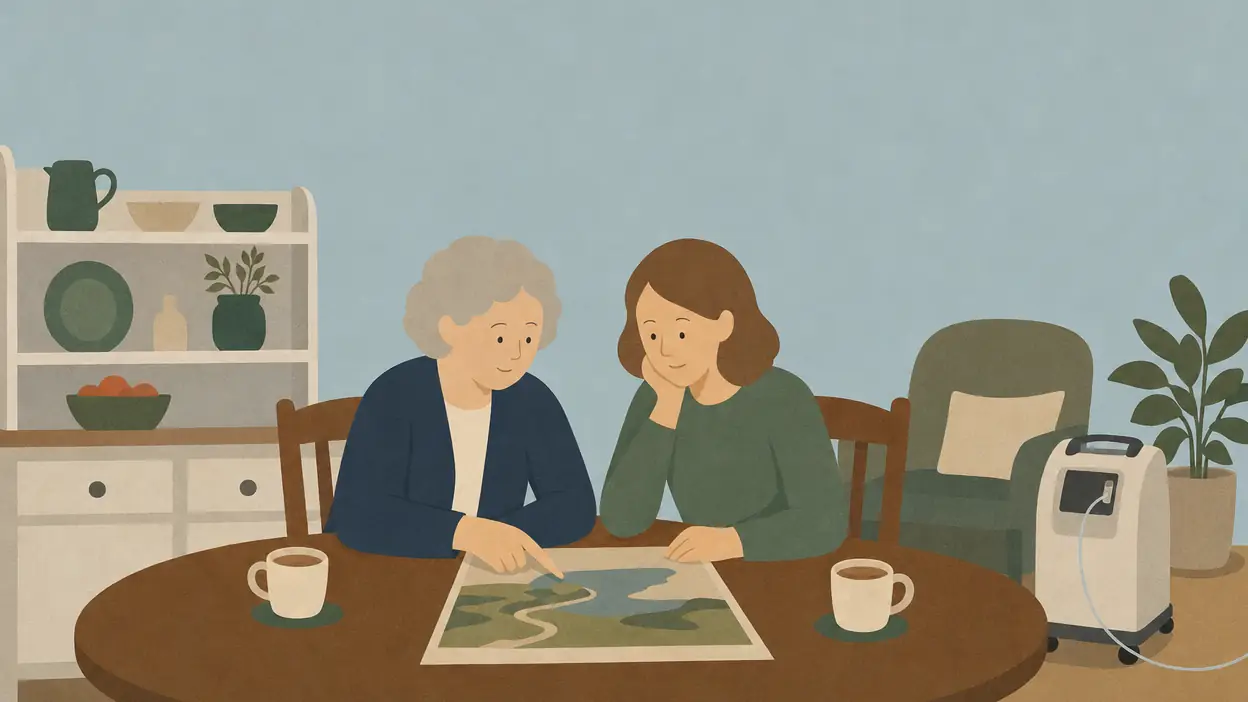
When the power goes
- Check your fuse box and trip switches. If only your house is off, it may be your own electrics.[7]
- Keep the fridge and freezer shut.[12]
- Leave one light switched on, so you know the moment power is back.[12]
Questions to raise with your care team before a cut: if PowerCheck’s estimate is later than your battery time, or there is no estimate, when should your agreed backup and transport plan start? How much battery must remain for the journey, and who should you contact? Agree these answers in advance rather than treating this comparison as a medical instruction.[6][12] But not into danger: during a Red warning, or with trees and wires down on your road, do not drive. Ring 112 or 999 and say a person on medical equipment is running out of battery. Emergency hubs also open in major storms: after Storm Éowyn there were more than 380, with phone charging, hot food, water and showers.[3] The Government’s advice for device users is to go to a relative’s or friend’s home or a community hub to recharge.[6]
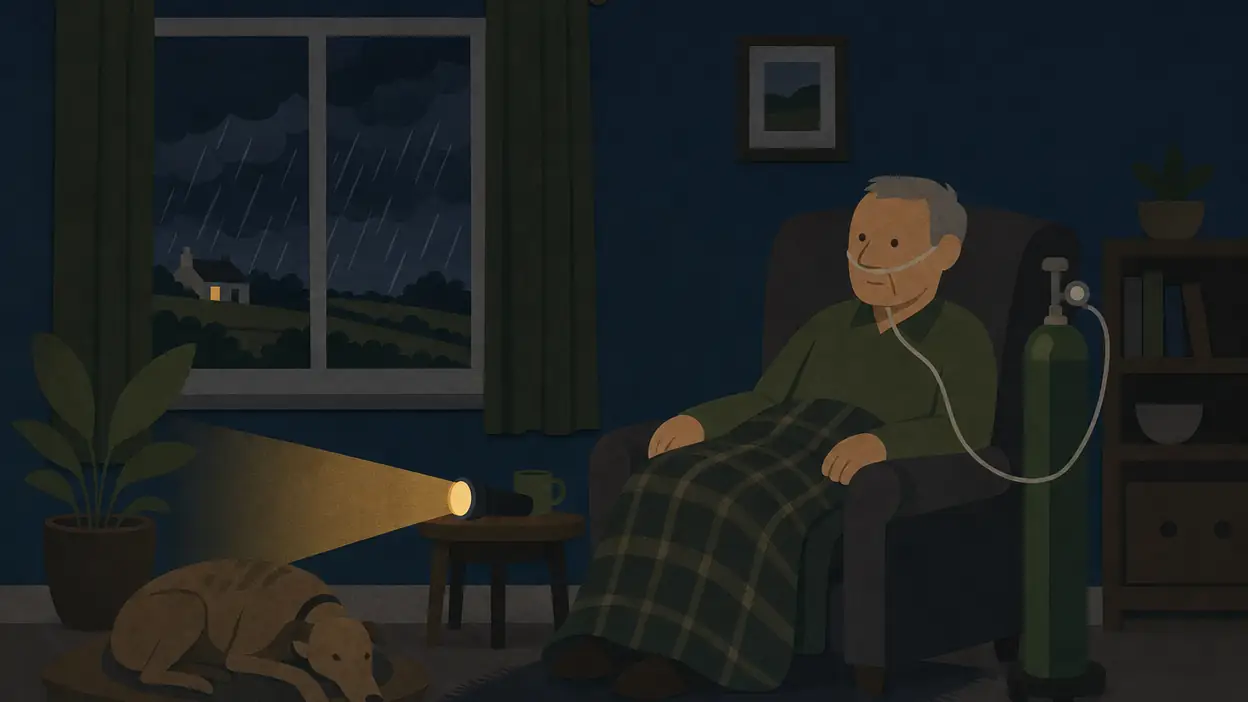
Ring 112 or 999 if
- Someone is unconscious or having difficulty breathing, or you think anyone has carbon monoxide poisoning.[11]
- Someone shows signs of hypothermia: shivering; pale, cold, dry skin or blue lips; slurred speech; slow breathing; tiredness or confusion.[10]
- Call 112Call 999
If you are worried about the effect on treatment but it is not an emergency, ring your GP, the GP out-of-hours service, or go to an emergency department.[6]
For text access to emergency services and its limitations, see Staying in touch when phones and power fail in Ireland.
Medicines that need a fridge
Insulin: check the leaflet for your own insulin first. Ask your pharmacist about its storage limits and what to do after a temperature excursion.[19] Exceptions include different product limits for time out of the fridge, maximum room temperature, and unopened versus in-use insulin; the general example below does not override your leaflet.
As a fallback for general planning, the HSE gives these figures:[9]
- Unopened insulin goes in the fridge, at 2°C to 8°C, away from the ice box.
- Insulin in use can be kept at room temperature (8°C to 25°C) for up to 30 days. Check your own insulin’s leaflet and ask your pharmacist if its storage instructions differ; do not apply a general example to every product.[19]
- Insulin that gets too hot or freezes will not work properly. In a power cut that means: not on a radiator, not beside a hob or stove, and not in a car overnight in winter.
The fridge itself: a closed fridge keeps food cold for about 4 hours.[16] That figure is for food; medicines have their own limits.
Other fridge medicines: follow the storage instructions on the pack.[10][19] We found no Irish official rule for how long they last out of the fridge. If one has been warmer than its leaflet allows, ask your pharmacist before you use it.
Generators and battery packs
Generators make carbon monoxide. The Health and Safety Authority’s advice:[5]
- outdoors only, at least 7 metres from every door, window and vent;
- never in an attached garage, even with the door open;
- exhaust pointing away from the house; carbon monoxide alarms fitted inside;
- switch off and let it cool before refuelling;
- never plug it into a socket or the fuse board. That feeds power back onto the network and endangers repair crews. Any installation work must be done by a competent person.
Carbon monoxide has no smell. Headache, dizziness, nausea, tiredness, confusion or breathlessness can mean poisoning, and the smallest person or pet is affected first.[11] If a carbon monoxide alarm sounds or you suspect a leak: switch appliances off, open doors and windows, get everyone outside, and ring Gas Networks on 1800 20 50 50. Ring 112 or 999 if you think anyone has carbon monoxide poisoning.[11]
Battery packs: Government advice after Storm Éowyn lists a backup battery or battery powerpack as one way to keep a device going.[6] Use only one your equipment supplier says suits that device: read the instructions and ask them about backup options.[13] The home power planner deliberately leaves medical equipment out:
Do not rely on this site to size backup power for medical equipment. Register with your electricity supplier’s vulnerable customer register. Agree a backup plan with your clinician, device supplier or HSE team. Priority restoration is not guaranteed.
Check on a neighbour
ESB Networks asks everyone to check on family, friends and neighbours who have medical needs or are elderly, and to work out now what each of you would do in a long cut.[7] In Storm Éowyn, phone and data outages made vulnerable people hard to reach; postal staff became the direct link in remote areas.[3]
- Agree a time you will knock if the power goes, rather than relying on a phone call.
- Know where their plan is, and their supplier’s number.
- If you have power and they do not, offer a socket and a chair.

When the power comes back
- Follow the agreed restart checks with your care team or supplier. Some devices reset after a power cut; do not change oxygen settings without speaking to your specialist team.[8][13]
- Follow the supplier’s recharging instructions, and contact the oxygen supplier to replenish any backup used.[8][13]
- Write down what went wrong, and change the plan.
Sources (21), all checked 2026-10-29
All checked 2026-10-29. All Irish (all-island for safefood).
- ESB Networks, vulnerable customers.
- CRU, vulnerable customers.
- Government of Ireland, Review of Storm Éowyn (October 2025).
- ESB, power restored to 729,000 customers (2 February 2025).
- National Emergency Co-ordination Group update (30 January 2025).
- National Emergency Co-ordination Group update (2 February 2025).
- ESB Networks, outages safety advice.
- HSE, home oxygen therapy.
- HSE, about insulin.
- HSE, preparing for severe weather.
- HSE, carbon monoxide poisoning.
- HSE, procedure for children receiving a paediatric homecare package during a power outage (2026).
- National Rehabilitation Hospital, emergency power planning checklist (2022).
- Office of Emergency Planning, loss of utilities.
- Office of Emergency Planning, make a plan.
- safefood, food safety in emergencies.
- Department of Climate, Energy and the Environment, extension of Solar PV Scheme for Medically Vulnerable Customers (October 2025).
- CRU, winter protections 2026/27.
- HPRA, taking medicines safely.
- Irish Kidney Association, statement on electricity supply for home dialysis patients (2022).
- SEAI, enhanced grants including solar and battery storage for medically vulnerable customers (29 September 2026).