What V2L actually does
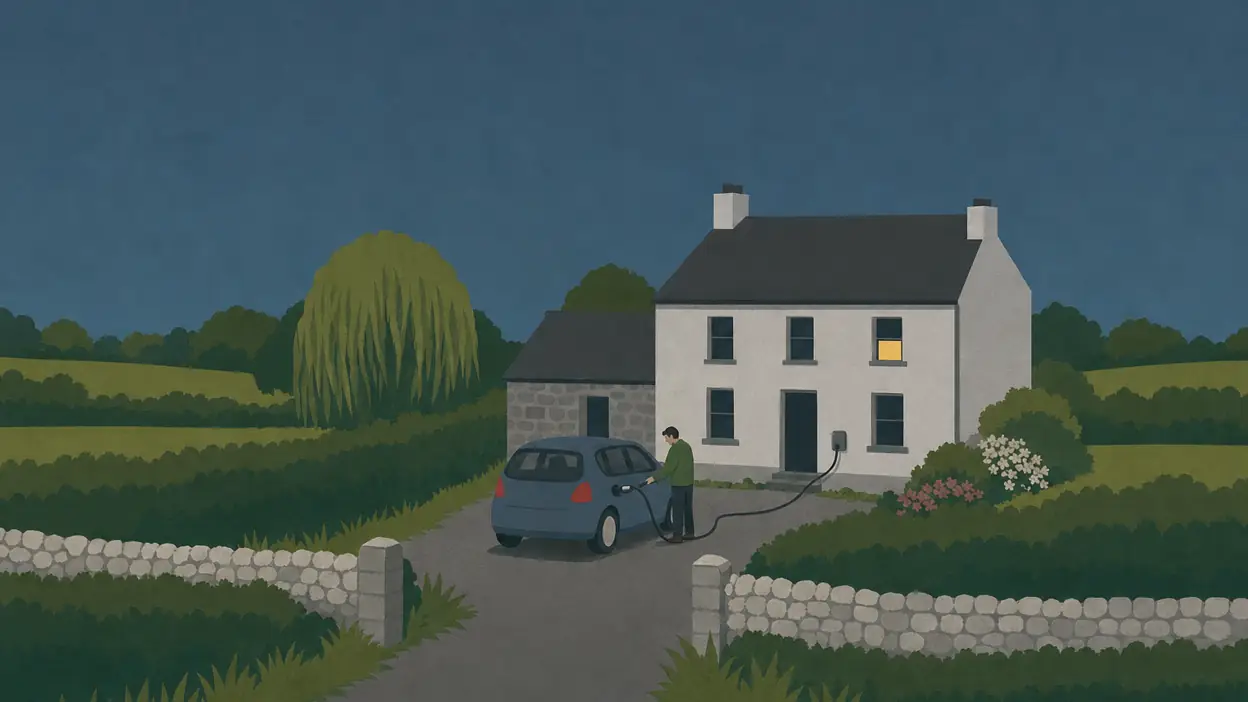
Think of V2L as an appliance socket supplied by your car. Depending on the model, you use an interior socket or a dedicated adapter at the charging port. Hyundai advertises up to 3.6 kW through its compatible adapter; Kia specifies up to 3.68 kW for the EV9. Those are output ceilings, not promises that every appliance will work.[1][3]
Your two questions are: can it start and run this appliance, and how much battery will that use? Check the vehicle manual, adapter rating and appliance requirements together. Motors can have starting demands that exceed their running consumption.[11]
Its battery may keep modest loads running for days, depending on charge, demand and the reserve you keep for driving, as the example below shows. Supplying house wiring requires a professionally installed system that meets ESB Networks requirements.[7]
Which cars sold in Ireland have V2L?
These are verified examples from Irish manufacturer pages and brochures, checked on 28 October 2026. This is not an exhaustive list. Confirm the exact model year, trim, outlet and adapter before buying, particularly for a used import.
| Manufacturer | Models with published Irish V2L support | Important qualification |
|---|---|---|
| Hyundai | IONIQ 5, IONIQ 6, IONIQ 9, INSTER Cross | Current IONIQ 5 brochure says N-Line upwards; IONIQ 6 says Platinum only; INSTER page specifies Cross only. IONIQ 9 page describes interior and exterior supply.[2] |
| Kia | EV3, EV4, EV5, EV6, EV9 | Each Irish model page describes V2L. Confirm trim and whether the external adapter is included.[3] |
| MG | MGS5 EV, MGS6 EV, MG4 EV Urban | Irish equipment tables list vehicle-to-load charging. Confirm the adapter package and output limit.[4] |
| BYD | DOLPHIN, DOLPHIN SURF, SEAL, SEALION 7 | DOLPHIN and SEAL Irish brochures list V2L; SURF and SEALION 7 Irish pages describe it.[5] |
| Renault | 4 E-Tech electric, 5 E-Tech electric | Irish brochures describe V2L through an adapter. Renault 5 availability is version-dependent; Renault 4 requires an accessory adapter.[6] |
An ordinary charging cable is not your V2L adapter. Get the manufacturer-approved accessory for your exact car and Irish three-pin appliances. Ask for a demonstration with your intended load. Hyundai’s Irish accessory listing is an example of a dedicated V2L connector.[1]
See the equipment categories linked at the end of this guide.
How long could it run a fridge and internet connection?
Here is a worked planning example, not a field test. Assume 60 kWh or 80 kWh of usable battery capacity, a starting charge of 80%, and a driving reserve of 30%. That makes half the usable battery available. Allow an illustrative 15% for conversion losses and vehicle overhead; actual losses need measuring.
| Calculation | 60 kWh battery | 80 kWh battery |
|---|---|---|
| Starting energy: capacity × 0.80 | 48 kWh | 64 kWh |
| Driving reserve: capacity × 0.30 | 18 kWh | 24 kWh |
| Energy available before losses | 30 kWh | 40 kWh |
| After assumed losses: available × 0.85 | 25.5 kWh | 34 kWh |
Now choose a daily load:
| Appliance | Assumption | Daily electricity |
|---|---|---|
| Fridge/freezer | Illustrative assumed consumption | 1.00 kWh |
| Satellite internet | 100 W × 24 hours ÷ 1,000 | 2.40 kWh |
| LED lights | 10 W × 5 hours ÷ 1,000 | 0.05 kWh |
| Phone charging | Chosen daily allowance | 0.05 kWh |
| Total | 3.50 kWh |
Only the satellite figure has a manufacturer reference here: Starlink gives 75 to 100 W average for Standard 4, including its router, supply and cables. The other rows are explicit example inputs, not typical-appliance claims.[10]
Divide available energy by daily demand:
- 60 kWh example: 25.5 ÷ 3.5 = 7 days 6 hours (rounded down).
- 80 kWh example: 34 ÷ 3.5 = 9 days 17 hours (rounded down).
These are energy estimates, not guaranteed unattended runtimes. Vehicle shutdown settings and real overhead matter. Set a supported discharge limit and check battery use during a supervised trial.[11] Keep enough reserve for your necessary journeys; 30% is an example, not a recommended driving range.
A hypothetical 2 kW heater used for four hours adds 8 kWh a day. The same batteries would then last about 2 days 5 hours or 2 days 22 hours (rounded down). A 2 kW kettle used for five minutes takes 0.17 kWh. Duration matters as much as wattage, and everything running together must stay within the outlet limit.[1][11]
Record your own consumption during a supervised trial, without treating it as a guarantee for a future outage.
Keep appliance power separate from house wiring
Never connect V2L to house wiring without an installed, approved system. Never feed it into a wall socket. ESB Networks warns that temporary connections can endanger occupants, neighbours and network staff.[7]
For standby supply to circuits, ESB Networks requires a Registered Electrical Contractor to design, install and test the arrangement, comply with National Wiring Rules and provide an appropriate changeover switch preventing parallel connection to the grid. Notify the local ESB Networks Customer Services Supervisor through your contractor.[7]
For direct appliance use, follow the car’s instructions on weather exposure, cables, loading and supervision. Keep connections dry and stop if equipment is damaged or behaves abnormally.[11]
Is V2H available in Ireland?
Vehicle-to-home (V2H) supplies a building; vehicle-to-grid (V2G) can send electricity to the network. A V2L socket alone does not establish either capability. Kia’s Irish EV5 page makes V2H/V2G conditional on market availability, regulations and compatible infrastructure.[3]
As checked on 28 October 2026, ESB Networks has a connection framework, with a Low Carbon Technology register covering V2G chargers. Choose registered equipment; an unlisted device may require additional conformity and type-test documentation. The framework does not prove that a particular car and charger combination is available as a complete Irish installation.[8]
Before ordering, have your contractor confirm compatible equipment, the applicable connection route and outage operation. For qualifying microgeneration, ESB Networks specifies an online application or NC6 notification with a type-test certificate. Other capacities or arrangements need the appropriate process. Grid-connected capability does not remove the separate standby isolation requirements.[7][9]
What about plug-in hybrids?
Some have V2L too: BYD’s Irish SEAL U Super Hybrid page explicitly lists it.[12] Recalculate from that vehicle’s usable battery and reserve; do not reuse the 60 to 80 kWh example. Check its engine-start behaviour in the manual. Never operate a vehicle engine in a garage or enclosed space because of carbon monoxide.[13]
Sources (13), all checked 2026-10-28
All sources checked 2026-10-28.
- Hyundai Ireland, dedicated V2L adapter and output rating.
- Hyundai Ireland: IONIQ 5 brochure, IONIQ 6 brochure, IONIQ 9, INSTER.
- Kia Ireland: EV3, EV4, EV5, including V2H/V2G conditions, EV6, EV9.
- MG Ireland: MGS5 EV brochure, MGS6 EV equipment, MG4 EV Urban equipment.
- BYD Ireland: DOLPHIN brochure, DOLPHIN SURF, SEAL brochure, SEALION 7.
- Renault Ireland: Renault 4 brochure, Renault 5 brochure.
- ESB Networks, standby generators, including EV backup.
- ESB Networks, Low Carbon Technology register.
- ESB Networks, microgeneration connection process.
- Starlink, power requirements.
- Kia, EV6 owner’s manual, V2L operation and precautions. General safety reference; use your own vehicle’s manual.
- BYD Ireland, SEAL U Super Hybrid.
- HSE, carbon monoxide poisoning prevention.