Ask what happens when the grid disappears
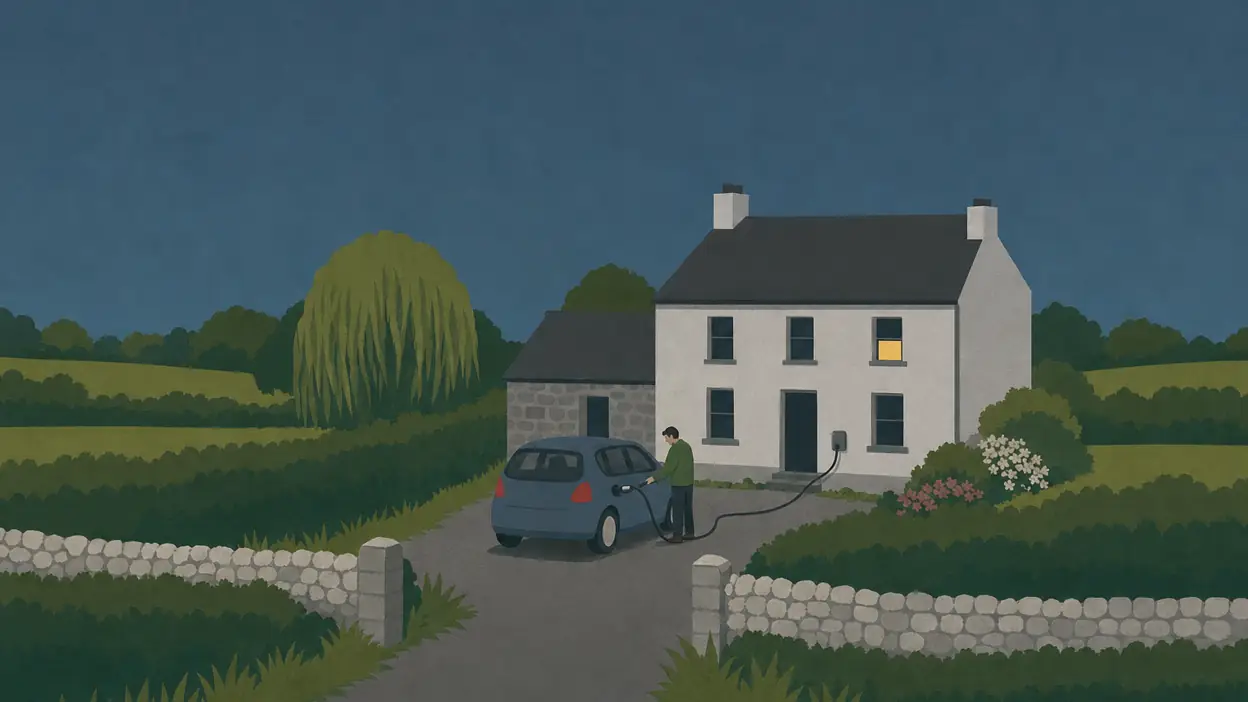
ESB Networks explains that ordinary grid-connected generation switches off when the network supply is disconnected. That protects people and equipment from an unexpectedly live network. Certain systems can operate during a cut, but the premises must be physically isolated, with a changeover arrangement and appropriate wiring.[1]
So a quote saying “solar plus battery” is not enough. Ask for a written answer to this question: Which sockets and appliances will work when the grid fails?
Backup may be described as EPS, emergency power supply, or off-grid output. The name alone does not specify the installation. Manufacturer instructions distinguish limited backup outlets from systems with additional switching hardware.[2]
| Ask the installer | What the answer needs to establish |
|---|---|
| Which circuits are backed up? | A named list, such as selected lights, fridge and communications |
| Is changeover automatic? | What you must do, and whether equipment will restart |
| What are the continuous and starting limits? | Whether motors and simultaneous loads can operate |
| How much energy is usable? | Battery capacity after operating limits and reserve settings |
| Can solar recharge it during an outage? | Confirmation for this exact inverter, battery and wiring |
| What happens when the battery empties? | The documented restart procedure and any limits |
Have a registered Safe Electric electrician handle the electrical design and connection. Do not feed a battery inverter or generator into a wall socket. Safe separation from the network requires the proper installed arrangement.[1]
You need a system designed and installed for backup operation, with safe isolation from the electricity network and clearly identified backup circuits.[1]
Size the essential loads first
Start with your own list. The Irish emergency checklist prioritises lighting, charged phones, warmth and access to information.[3] Decide which jobs need electrical backup and which can be covered with a torch, bedding or a charged power bank.
Here is a worked scenario, not a forecast for your home. Suppose a 5kWh battery is fully charged, you retain 20% as reserve, and conversion delivers 90% of the remainder. Available energy is 5 × 0.80 × 0.90 = 3.6kWh. Actual usable capacity, standby consumption and reserve behaviour are system-specific.[2]
| Assumed average backed-up load | Calculation | Illustrative runtime |
|---|---|---|
| 150W | 3,600Wh ÷ 150W | 24 hours |
| 300W | 3,600Wh ÷ 300W | 12 hours |
| 1,000W | 3,600Wh ÷ 1,000W | 3.6 hours |
Use measured consumption and the installer’s documented limits. A partly charged battery starts with less energy. Do not base your plan on the battery always being full when a storm arrives.
Check SEAI grants and eligibility
Use the SEAI solar grant finder and battery scheme page for current amounts and eligibility. Check the current terms, property requirements, previous funding and approved contractors. Get the grant offer before starting work where the scheme requires it.[4][5]
Ask for backup equipment and wiring as separate lines in the quote. A grant does not establish EPS capability or safe outage operation.[1][5]
Portable solar is a different-sized project
A fold-out panel can recharge a compatible portable power station. Match the panel’s open-circuit voltage, current and connector arrangement to the station’s manual. Do not assume that matching plugs establish compatibility.[6]
Keep the station dry and ventilated, follow its charging-temperature limits and deploy the panel only where conditions permit safe use.[6] This setup powers suitable appliances from the station’s outlets. House-circuit backup is an electrician’s job.[1]
The satisfying part is learning what a modest panel can actually do. Check the station’s input display, record the weather and compare the energy collected over a day. A rated 200W panel is not a promise of 200W throughout daylight: manufacturer ratings use defined test conditions.[7]
What can you expect in an Irish winter?
Met Éireann identifies December as Ireland’s dullest month, averaging roughly one to two hours of bright sunshine a day across the country. Bright-sunshine hours are not the same as hours at a panel’s rated output.[8]
For a reproducible example, the European Commission’s PVGIS model can be run for central Dublin: 53.35°N, 6.26°W, 200W crystalline-silicon array, south-facing, 60° tilt, free-standing, terrain horizon enabled and 14% system losses. The SARAH3 dataset covers 2005 to 2023.[9]
| Month | Modelled average daily PV energy, 200W array |
|---|---|
| November | 360Wh |
| December | 270Wh |
| January | 290Wh |
These are historical monthly averages, not storm-day guarantees. They do not model your garden’s nearby shading, temporary panel placement or the power station’s particular storage losses. At the December average, collecting 1,000Wh takes 1,000 ÷ 270 = 3.7 days, even before those extra losses and ongoing loads.[9]
Charge before the forecast deteriorates. Treat winter solar as replenishment that varies with conditions, and size your stored reserve for the essential jobs you want covered.
Sources (14), all checked 2026-10-28
All checked 2026-10-28. Booklet material used: prioritising lighting, communications and practical household supplies, rewritten.
- ESB Networks, generation during a network outage.
- Fronius, backup power system requirements.
- Office of Emergency Planning, Be Emergency Ready booklet and checklist.
- SEAI, solar electricity grant and enhanced supports.
- SEAI, battery grant and eligibility.
- Manufacturer power-station manual, solar input and safety.
- Manufacturer solar-panel manual, standard test conditions.
- Met Éireann, sunshine and solar radiation.
- European Commission JRC, reproducible PVGIS calculation.
What to buy
- See the equipment categories linked at the end of this guide.
- See the equipment categories linked at the end of this guide.
- See the equipment categories linked at the end of this guide.
- See the equipment categories linked at the end of this guide.
- See the equipment categories linked at the end of this guide.
prepared.ie is an independent site run by a private individual. It is not affiliated with the Government of Ireland, Met Éireann, ESB or any agency. In an emergency call 112 or 999. Official booklet material is credited in the sources above.