Make a warm corner before the lights go out
Pick a room where you can sit comfortably, with bedding, a torch and your charged phone nearby. The official Irish checklist recommends extra bedding and keeping to one room for warmth. Close doors and windows, but leave the ventilation required by fires and heating appliances clear.[1][3]
Warm socks, dry layers and a sleeping bag are useful even when every battery is empty. Put extra blankets on the bed and keep warm night clothes handy.[1][4] Make this a small weekend project: gather what you already have, try the sleeping bag and leave the torch where you can find it in the dark.
Do not assume that a working gas supply means working central heating. Gas Networks Ireland says most gas appliances need mains electricity for pumps, fans or controls.[3] Ask your heating engineer what your particular system needs during a cut.
A heated throw can stretch battery power, as the worked example below shows. Camping stoves and barbecues must stay outdoors because they can cause carbon monoxide poisoning.[2]
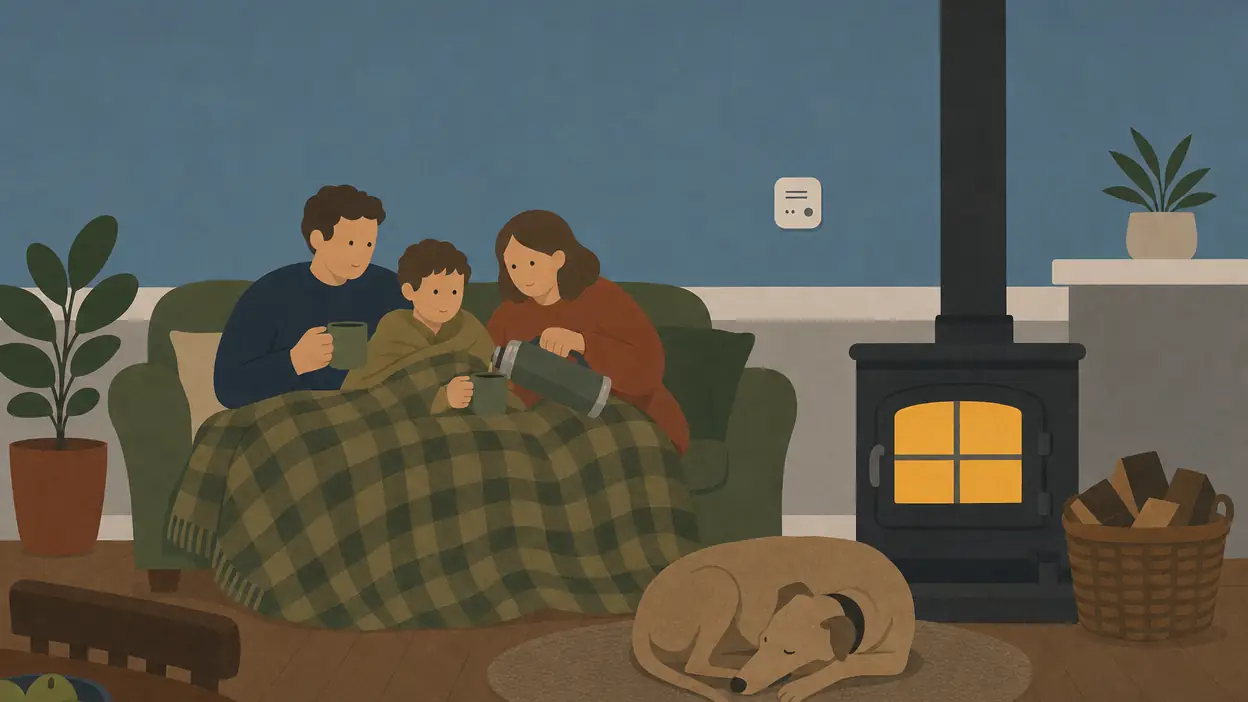
A heated throw can make the battery last
Check the throw’s label and instructions, then check that the power station supports its wattage and required AC supply. Keep the station uncovered and dry, following its manual.[5][6] Do not tuck it under the blanket with you.
Here is an illustrative calculation, not a product test. Assume a 500Wh power station delivers 80% of its labelled energy to the appliance, allowing for losses. That leaves 500 × 0.80 = 400Wh. Actual losses and thermostat cycling vary, so measure your setup.[6]
| Example load | Energy for four hours | Runtime from the assumed 400Wh |
|---|---|---|
| Throw drawing 60W continuously | 60 × 4 = 240Wh | 400 ÷ 60 = 400 minutes (rounded down) |
| Throw drawing 100W continuously | 100 × 4 = 400Wh | 400 ÷ 100 = 4 hours |
| Room heater drawing 2,000W | 2,000 × 4 = 8,000Wh | 400 ÷ 2,000 = 12 minutes |
The heater calculation only applies if the station can supply 2,000W. Battery capacity and maximum output are separate limits.[6] These examples explain why warming yourself can be a more practical battery job than heating a room.
Inspect electric bedding for frayed leads, scorch marks and damage. Follow its instructions, keep it dry and never combine it with a hot-water bottle. Switch a heated throw off before sleeping; it is not a substitute for proper bedding.[5] HSE advises against electric blankets for young children.[7]
Have a meal that needs no flame
Keep food you enjoy that can be eaten without cooking, plus a manual tin opener where needed. Long-life food and a flask prepared before a forecast cut can make the first evening much easier.[1][8] Read the food’s preparation and storage instructions.
If you want an outdoor stove, learn to use that exact appliance on a calm day. Follow its fuel, clearance and operating instructions. Do not use a camping stove, barbecue or patio heater indoors, in a tent, in a garage or under an awning. Outdoor fuel-burning equipment belongs outdoors in a well-ventilated position. An open window or a CO alarm does not make indoor use safe.[2][3][9]
Do not use a hob or oven to heat the room. Do not improvise a gas heater.[2][3] If the weather makes outdoor cooking unsafe, use your no-cook meal. A hot dinner is not worth going outside into dangerous conditions.
Existing fires and stoves need preparation too
Before relying on an open fire, have the chimney swept and checked for blockage. Keep the required ventilation open and use a fireguard. Keep clothes and bedding away from the fire.[3][4]
Use only fuel suitable for the appliance and compliant with Irish solid-fuel rules. Check the current government household fuel guidance for approved fuels, moisture and packaging rules. Do not rely on an older implementation date.[10]
Do not assume every stove works without electricity. Pellet appliances can have powered controls and fans.[11] If a stove or fire has a back boiler, ask its installer to confirm the safe power-cut procedure before relying on it. Do not experiment with a connected heating system during an outage.
Fit alarms and know when to get help
Choose an audible CO alarm complying with EN 50291, with an end-of-life indicator and independent certification. Follow its positioning instructions. The Irish CO campaign advises alarms in rooms with fuel-burning appliances and within five metres of bedrooms. An alarm supplements proper installation, ventilation and servicing.[9]
If the alarm sounds or you suspect CO, get outside into fresh air and do not re-enter until advised it is safe. Call 112 or 999 if you suspect poisoning, or someone is unconscious or struggling to breathe.[2]
Cold can also become an emergency. HSE says to call 112 or 999 for signs of hypothermia, including slurred speech, slow breathing or confusion.[8] Plan a warmer place to go before anyone becomes unwell.
Sources (18), all checked 2026-10-28
All checked 2026-10-28. Booklet material used: bedding, one-room warmth, food, lighting and charged phones, rewritten in our own words.
- Office of Emergency Planning, Be Emergency Ready booklet and checklist.
- HSE, carbon monoxide poisoning.
- Gas Networks Ireland, severe weather advice.
- SEAI, Keeping Well and Warm, clothing and fire safety.
- National Directorate for Fire and Emergency Management, bedroom fire safety.
- Manufacturer manual, power-station output, capacity and safety. Arithmetic uses explicitly assumed loads and efficiency.
- HSE, fire dangers in your home.
- HSE, preparing for severe weather.
- Gas Networks Ireland CO campaign, alarm guidance and causes.
- Government, current solid-fuel rules and S.I. 389/2025, moisture-date amendment.
- Waterford Stanley, pellet-stove manual.
What to buy
Start by checking the cupboard. Fill the gaps that suit your home.
- See the equipment categories linked at the end of this guide.
- See the equipment categories linked at the end of this guide.
- See the equipment categories linked at the end of this guide.
- See the equipment categories linked at the end of this guide.
- See the equipment categories linked at the end of this guide.
- See the equipment categories linked at the end of this guide.
- See the equipment categories linked at the end of this guide.
prepared.ie is an independent site run by a private individual. It is not affiliated with the Government of Ireland, Met Éireann, ESB or any agency. In an emergency call 112 or 999. Official booklet material is credited in the sources above.