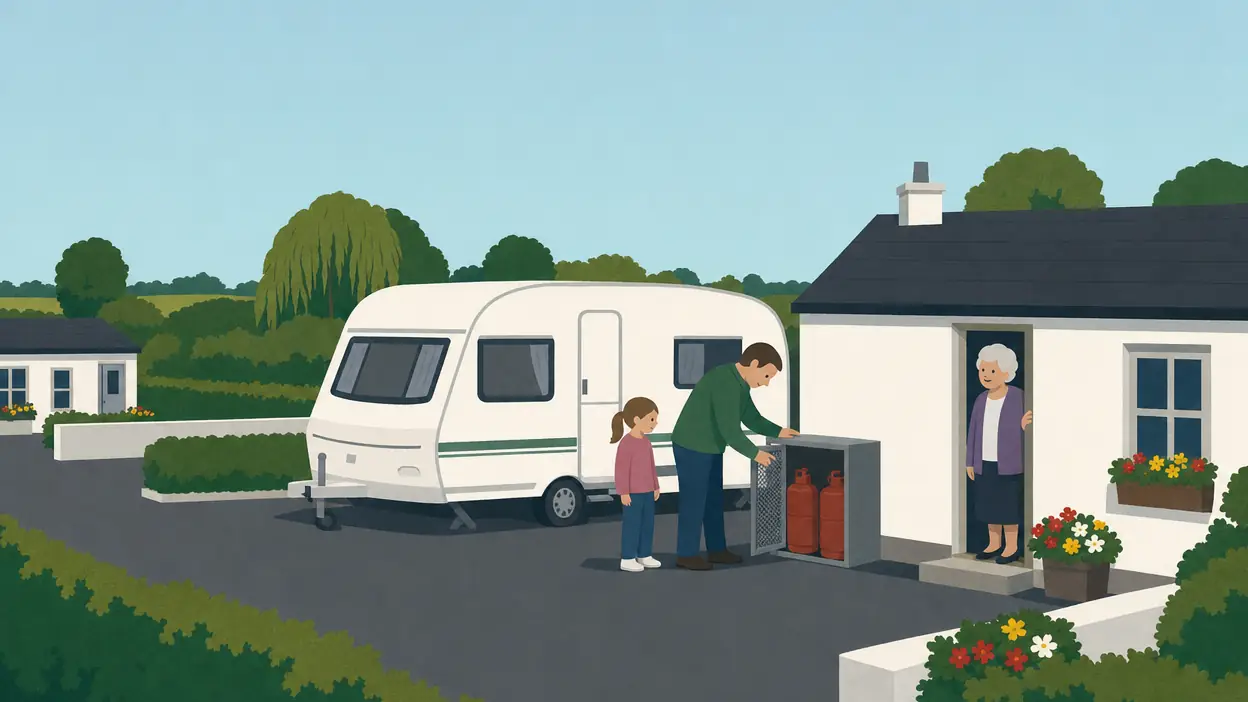
Fit a smoke alarm and a carbon monoxide (CO) alarm, keep a fire blanket in the kitchen area and plan two ways out.[1][2] Have any fixed gas work done by a Registered Gas Installer, keep cylinders outside on solid ground, and never use a paraffin heater or a barbecue inside.[1][2][3][4] National guidance asks for 6 metres between caravans where there is no screen wall.[2] In an Orange or Red wind warning, tie down in good time and decide early whether to move to a solid building.[5][6] On a low-lying site, know the flood history and where you would go.[7]
This guide is for anyone in a caravan or mobile home: a touring van for a week in Kerry, a static on a holiday park, a motorhome, or a mobile home or trailer that is a family’s year-round home.
Why a caravan is different
A fire in a caravan can make it impossible to stay inside, or get out, very quickly. The national fire safety guide for Traveller accommodation, much of which applies to any caravan or mobile home, says: “If people are asleep when a fire starts, they may never wake up or get the chance to escape.”[2]
Free and first: the things that cost nothing
- Ask about a free smoke alarm. The national guide says “Smoke alarms are made available by Fire Services as part of Community Fire Safety Awareness campaigns.” Ring your county council’s fire service and ask.[2]
- Plan two ways out and “Keep your way out clear day and night”. Keep door and window keys nearby.[1]
- Practise. Everyone in the van should know the sound of the alarm and where to meet outside.[1][2]
- Do the night check. Turn off gas appliances, put out candles, put a spark guard in front of any open fire and close all doors.[1]
- Never block an air vent. The fire service leaflet says it “could be fatal”.[1]
Smoke and carbon monoxide alarms
Smoke alarms
The national guide says domestic smoke alarms “should be fitted in every room of every house, caravan, mobile home”. It recommends optical alarms with a hush button, one near the cooking area and one in every other room.[2]
Test them every week and keep them clean.[1][2] If children sleep in a separate van or room from the adults, the guide suggests linking the alarms so one sets off the other.[2] See smoke alarm kit options: Smoke alarm.
Carbon monoxide alarms, and the standard that matters
“All caravans and mobile homes should be fitted with a Carbon Monoxide alarm,” the national guide says.[2] CO has no colour or smell. It comes from gas, oil, solid fuel and charcoal that do not burn properly.[2][3]
Gas Networks Ireland lists the symptoms, which can feel like a cold or flu: drowsiness, unexplained headaches, chest pains or weakness, sickness or diarrhoea, dizziness when standing, and tiredness. It says to suspect CO if the symptoms come on when an appliance is on, if others or pets have them too, or if they ease when you are away.[3] If you suspect CO, turn the appliance off straight away and get medical advice.[3]
Which standard? CO alarms are tested to the European standard EN 50291, and it has two parts.[3][8]
- Part 2, EN 50291-2, covers alarms for “recreational vehicles and similar premises including recreational craft”. That means touring caravans, motorhomes, campervans and boats, which shake, get damp and get moved.[8]
- Part 1, EN 50291-1, is the home standard. The standard itself notes: “For caravan holiday homes EN 50291-1 applies.” So a static caravan holiday home or a mobile home that stays put can use a Part 1 alarm.[8]
Our current CO alarm pick is certified to EN 50291-1 only. It suits a static or a mobile home, but not a touring caravan, motorhome or boat, so we do not link it from this guide. Buy an alarm that says EN 50291-2 for anything that moves.[8]
Fit it where the maker’s instructions say. The national guide’s summary of the fitting standard: in every room with a fuel-burning appliance, between 1 and 3 metres from the appliance, and not above a sink or next to a door, window, vent or extractor.[2] Test it monthly and replace it at the end of its life.[3]
Gas and LPG cylinders
Who may do gas work. The law covers LPG fittings under I.S. EN 1949, the standard for LPG in “Leisure Accommodation Vehicles”.[9] Installing, repairing, servicing or replacing them is gas work, and only a Registered Gas Installer may do it.[9][4] The regulations leave out connecting a flexible hose from a refillable cylinder to the pipework, which is why you can change a cylinder yourself.[9]
For checking an installer and what to do if you smell gas, see Gas work at home.
Check the installer’s RGI card, and report illegal gas work to the RGI scheme.[10] For more on alarms and fire at home, see Carbon monoxide and fire at home.
Cylinders. The national guide says, when LPG is in use, always:[2]
- “Use the right size cylinder for the connection provided”
- “Use the right regulator, check it and replace if faulty”
- Store it upright on solid, level ground, out of direct sunlight and away from heat
- Switch off gas appliances when not in use, and secure the cylinder and its connection
- “Store empty cylinders away from accommodation”
Keep the cylinder outside.[1] Never interfere with a cylinder, and keep rubbish away from it.[2]
If you smell gas, the national guide says:[2]
- “Turn the cooker/ heating off”
- “Open windows fully”
- “Get out of the caravan and turn the main cylinder valve off fully”
- “Do not light naked flames, or turn electrical switches on or off”
- “If in doubt ring 999/112 from a place remote to the caravan in open air”
Heating safely
- Electric heaters are the safest kind when properly installed, the national guide says. Keep things off and away from them, and use the right plug and fuse.[2]
- Cabinet gas heaters with a cylinder in the back need a CO alarm in the room and nothing flammable near the front.[2]
- Paraffin heaters are “not recommended for use within caravans”.[2]
- Solid fuel stoves in caravans are “not recommended”, because the heat can set the walls alight. If you have one, never put it beside the door or straight on the floor.[2]
- Never use a cooker to heat the van, never use a barbecue or outdoor heater inside, and never dry clothes on a heater or cooker.[1][3]
Have chimneys cleaned and heating serviced at least once a year.[1]
Electricity
Take power only from the proper hook-up point on your pitch. The national guide says never to take electricity from another caravan or from overhead wires, never to use indoor extension leads outdoors, and never to overload a socket: “one socket, one plug”.[1][2] Unplug non-essential appliances at night.[2]
New circuits, a new distribution board or rewiring are restricted electrical works. By law they must be done and certified by a Registered Electrical Contractor registered with Safe Electric.[11]
Spacing and the site
The national guide recommends “a minimum of 6 metres separation between each caravan to prevent fire spread”. Where a screen wall at least 2.4 metres high runs the length of the caravan, the gap can come down to 2 metres.[2] The fire service leaflet says the same: “about 6 metres” if there is no solid wall.[1]
- Park cars well clear of caravans, and keep site roads clear for the fire engine.
- Store petrol, paraffin and diesel in proper containers at least 6 metres from the caravan, never underneath it.
- Do not let rubbish build up in or around the van.
- Find out what fire-fighting equipment the site has and how it works.
The national guide accepts that where a site is shared by the next generation of a family, vans may be closer than 6 metres. It says its fire safety reviews are not meant to be used against Traveller accommodation, and that any improvements should be made “in partnership with the relevant Traveller Community”.[2]
Fire blankets and extinguishers
The national guide’s main advice is to get everyone out and ring 112 or 999. For that reason it recommends only a fire blanket inside a caravan or mobile home, on the wall in the cooking area. Where residents want extinguishers, it recommends keeping them at fire points on the site rather than in each caravan.[2] An older fire service leaflet suggests an extinguisher by the door as well.[1] Either way, a blanket is for a small pan fire in its first seconds. If it is any bigger, get out.
When you ring, ask for the fire service and give the site’s address and your county.[1]
Cannot make a voice call? Text 112.
The emergency text service can be used by "anyone who is not able to make a voice call due to a speech or hearing impairment or other situations where a voice call might not be possible". It works "from any Irish registered mobile phone (either pre-pay or bill pay) on all the Irish Mobile networks". If you can talk, ring instead: a text is slower.
Your text needs four things:
- Which service: Ambulance, Coastguard, Fire or An Garda Síochána.
- What the problem is.
- County you are texting from.
- Where help is needed: town, road, Eircode or a landmark.
Wait for a reply: "an SMS/Text 'Delivery Report' does not mean your message has been received". If no reply comes within 3 minutes, send another message straight away. It does not work from a foreign phone, or from an Irish phone roaming abroad, including in Northern Ireland.
No registration is needed. 112.ie says: "There is no preparation or registration required to use either Emergency SMS, or RTT when contacting the ECAS." If you might need to text one day, you can choose to give the service your address, access details and a next of kin in advance at 112.ie/register. Most smartphones can also use Real-Time Text to type during a call to 112 or 999: turn on RTT in your phone’s accessibility settings.
Source: 112.ie, emergency text service, sending a text to 112, SMS questions and answers, emergency SMS terms and conditions and Real-Time Text pages, checked 1 November 2026.
Storms and wind warnings
Clare County Council’s advice before a Red wind warning was that “caravans should be securely tied down” and furniture, parasols and awnings taken indoors or fully secured.[6]
Met Éireann’s advice at Orange is to “delay or cancel as appropriate”, and at Red to “Take action to protect yourself and your property”.[5] Do the work while it is calm:
- Tie down and secure the van the way the maker and site operator advise. We do not recommend straps: the right fixing depends on the van and the pitch.
- Take in awnings, chairs and anything loose.
- Decide where you would go: a friend’s or family member’s house, or a solid building on the site. Go before the wind arrives, not during it.
- Charge phones and find the torch. See Storms and Power cuts.
Met Éireann does not give a wind speed at which to leave a caravan, and nor do we. Follow the warning level and any instruction from the council or Gardaí.[5]
After the storm, keep clear of fallen wires. Assume they are live and ring ESB Networks on 1800 372 999.[12]
Flooding on riverside and coastal sites
Many parks sit beside rivers or the sea. Look up your site on the OPW’s flood maps, ask the operator about past floods, and agree a place to go on higher ground.[7] Do not drive or walk through floodwater. See Flooding.
Towing
On an ordinary car licence (category B) you can tow a trailer or caravan with a maximum authorised mass of up to 750 kg. A heavier one is allowed only if the car and caravan together do not exceed 3,500 kg. Above that you need a BE licence.[13] The towing limit for your car is in the handbook or on the plate inside the door or under the bonnet.[13]
A vehicle towing a caravan or trailer must not go over 80 km/h, even on a motorway.[14] Before driving in a storm, see Driving in storms.
Which situation are you in?
A family’s first week in a static in Wexford. Find both exits, test the smoke and CO alarms on the first evening and ask the operator where the fire point is.[1][2]
A motorhome on a cliff-top site as an Orange wind warning is issued. Move to a sheltered site or solid building before the wind arrives, and stay away from the cliff edge.
A cylinder change in the rain. Switch off the gas appliances, use the right regulator, keep the new cylinder upright on solid ground outside, and put the empty one away from the van.[2]
A heater left on overnight. Do not. Turn off gas appliances at night, and never use paraffin heaters in a caravan.[1][2]
A riverside park after a week of rain. Check Met Éireann’s warnings and the river, and move early if the operator or council says so.[5][7]
A trailer tent on a windy pitch. A tent gives no shelter in a warning. Pack it away in good time and stay somewhere solid until the warning ends.[5]
Common questions
Which carbon monoxide alarm do I need for a caravan?
For a touring caravan, motorhome or boat, choose an alarm to EN 50291-2. The standard says EN 50291-1 applies to a static caravan holiday home.[8]
How far apart should caravans be?
National guidance recommends at least 6 metres between caravans, or 2 metres where a screen wall at least 2.4 metres high is in place.[2]
Can I change a gas cylinder on my caravan myself?
Yes, connecting a flexible hose from a refillable cylinder is excluded from the gas works law, but any other work on the gas system is for a Registered Gas Installer.[9][4]
Is it safe to stay in a caravan during a storm?
Tie it down and decide in good time, because at Orange Met Éireann advises delaying or cancelling activities and at Red taking action to protect yourself.[5]
Can I tow a caravan on a car licence?
Yes, if the caravan’s maximum authorised mass is no more than 750 kg, or the car and caravan together come to no more than 3,500 kg.[13]
Data sources (15), all checked 2026-11-01
Footnotes
-
Department of the Environment, Community and Local Government, Fire safety in caravans leaflet, published by Sligo County Council fire service. Checked 2026-11-01. ↩ ↩2 ↩3 ↩4 ↩5 ↩6 ↩7 ↩8 ↩9 ↩10 ↩11 ↩12 ↩13 ↩14 ↩15 ↩16 ↩17
-
Department of Housing, Planning and Local Government, Guide to Fire Safety in Existing Traveller Accommodation, 3 June 2019 (publication page). Alarms, fire blankets, heating, LPG, electricity, separation; quoted verbatim. Checked 2026-11-01. ↩ ↩2 ↩3 ↩4 ↩5 ↩6 ↩7 ↩8 ↩9 ↩10 ↩11 ↩12 ↩13 ↩14 ↩15 ↩16 ↩17 ↩18 ↩19 ↩20 ↩21 ↩22 ↩23 ↩24 ↩25 ↩26 ↩27 ↩28 ↩29
-
Gas Networks Ireland, Carbon monoxide. Symptoms, alarms, appliance use. Checked 2026-11-01. ↩ ↩2 ↩3 ↩4 ↩5 ↩6 ↩7
-
Gas Networks Ireland, Registered Gas Installers (RGI). Checked 2026-11-01. ↩ ↩2 ↩3
-
Met Éireann, Warning system explained. Warning levels quoted verbatim. Checked 2026-11-01. ↩ ↩2 ↩3 ↩4 ↩5 ↩6
-
Clare County Council, Status Red wind warning for Clare, 12 November 2023. Checked 2026-11-01. ↩ ↩2
-
Office of Public Works, Flood maps. Checked 2026-11-01. ↩ ↩2 ↩3
-
CENELEC, EN 50291-2:2019, carbon monoxide alarms for recreational vehicles and similar premises, scope and note on caravan holiday homes, via the iTeh standards catalogue. Checked 2026-11-01. ↩ ↩2 ↩3 ↩4 ↩5
-
S.I. No. 299 of 2011, Electricity Regulation Act 1999 (Liquefied Petroleum Gas Works) Regulations 2011, regulations 2 to 4. Checked 2026-11-01. ↩ ↩2 ↩3 ↩4
-
RGI scheme, Report an illegal gas installer. Checked 2026-11-01. ↩
-
Safe Electric, Restricted and controlled electrical works. S.I. No. 264 of 2013. Checked 2026-11-01. ↩
-
ESB Networks, Report a fallen wire. Checked 2026-11-01. ↩
-
National Driver Licence Service, Cars and trailers. Licence categories B and BE and towing capacity. Checked 2026-11-01. ↩ ↩2 ↩3
-
Citizens Information, Road traffic speed limits in Ireland. Towing vehicles. Checked 2026-11-01. ↩
-
112.ie, SMS questions and answers. Checked 2026-11-01. ↩
prepared.ie is independent and is not affiliated with the Government of Ireland, the fire services, Gas Networks Ireland, Safe Electric or any agency. In an emergency, call 112 or 999.[15]