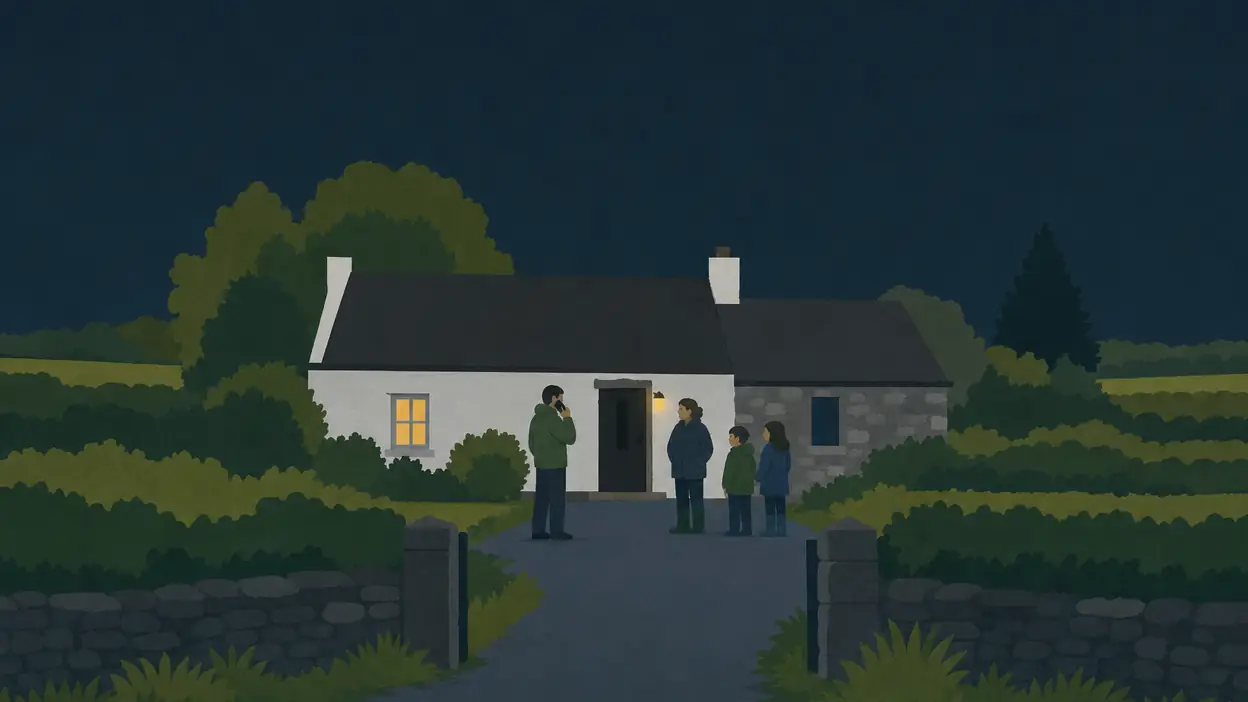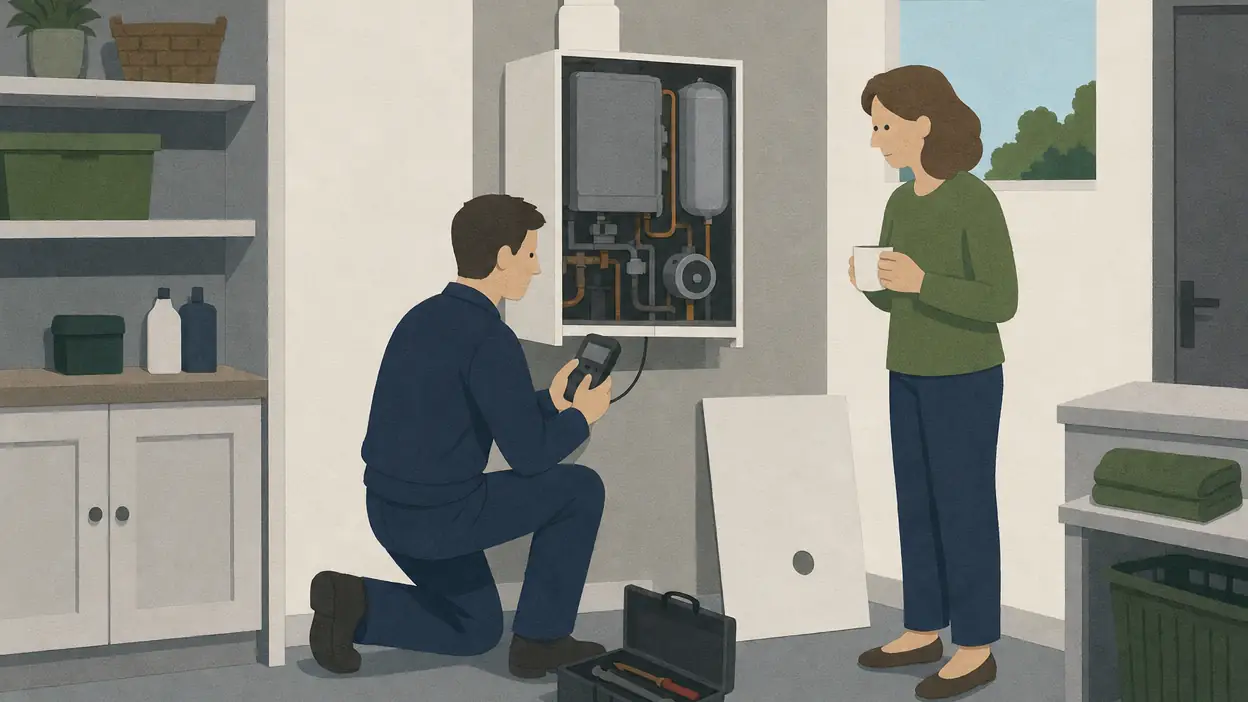
By law, only a Registered Gas Installer may carry out gas work on a domestic natural gas or LPG installation in Ireland, and the Commission for Regulation of Utilities (CRU) prosecutes people who do it illegally.[1][2] What you can do yourself: if you smell gas, follow Gas Networks Ireland’s steps and ring 1800 20 50 50 from outside or a neighbour’s phone.[3] Fit and test a carbon monoxide alarm, have the boiler serviced once a year by a Registered Gas Installer, and check the installer’s ID card before work starts.[4][5][6]
If you smell gas
These are Gas Networks Ireland’s steps, word for word:[3]
- “Ensure gas appliances are turned off and have not been left on and unlit”
- “Don’t smoke, vape or use a naked flame”
- “Don’t unplug or switch anything electrical on or off”
- “Open windows and doors”
- “If the smell persists turn off the gas at the meter”
- “Call our 24 hour Emergency Line on 1800 20 50 50 no matter who your gas supplier is.”
- “If you can’t get through, dial 999 / 112”
- “Don’t use a phone in the immediate area of the leak, use a neighbour’s or call from outside.”
Gas Networks Ireland also says: “Don’t assume somebody else has reported the smell.” If you smell gas on the street, ring 1800 20 50 50 straight away.[3]
Cannot make a voice call? Text 112.
The emergency text service can be used by "anyone who is not able to make a voice call due to a speech or hearing impairment or other situations where a voice call might not be possible". It works "from any Irish registered mobile phone (either pre-pay or bill pay) on all the Irish Mobile networks". If you can talk, ring instead: a text is slower.
Your text needs four things:
- Which service: Ambulance, Coastguard, Fire or An Garda Síochána.
- What the problem is.
- County you are texting from.
- Where help is needed: town, road, Eircode or a landmark.
Wait for a reply: "an SMS/Text 'Delivery Report' does not mean your message has been received". If no reply comes within 3 minutes, send another message straight away. It does not work from a foreign phone, or from an Irish phone roaming abroad, including in Northern Ireland.
No registration is needed. 112.ie says: "There is no preparation or registration required to use either Emergency SMS, or RTT when contacting the ECAS." If you might need to text one day, you can choose to give the service your address, access details and a next of kin in advance at 112.ie/register. Most smartphones can also use Real-Time Text to type during a call to 112 or 999: turn on RTT in your phone’s accessibility settings.
Source: 112.ie, emergency text service, sending a text to 112, SMS questions and answers, emergency SMS terms and conditions and Real-Time Text pages, checked 1 November 2026.
Find your gas meter and its handle now, in daylight, so you know where it is. Gas Networks Ireland asks you to keep the meter “unobstructed and freely accessible”.[3]
What the law says
Section 9G of the Electricity Regulation Act 1999 says: “A person shall not carry out works which are gas works unless that person is (a) a registered gas installer”, or a network operator or officer named in the Act.[1]
For homes, the regulations define gas works as “the installation, removal, repair, servicing, maintenance or replacement” of a gas fitting used by a domestic customer.[7][8]
Gas Networks Ireland puts it plainly: “It is a legal requirement that any work carried out on domestic gas installations must only be carried out by a Registered Gas Installer.” It adds: “if you’re having a natural gas appliance or pipework installed, serviced, repaired or removed always use a Registered Gas Installer.”[9]
So a new boiler, a cooker, a hob, a gas fire or a change to the pipework is a job for a Registered Gas Installer. There is no exception for your own house.
What the courts have done
Doing gas work without being registered is a criminal offence: up to €5,000 and/or 6 months in prison in the District Court, or up to €15,000 and/or 3 years on indictment. Falsely claiming to be a Registered Gas Installer carries up to €50,000 and/or 3 years on indictment.[1]
- September 2025, Dublin. A man who falsely claimed to be registered pleaded guilty to 23 offences at nine homes. The judge said one house had been left like “a ticking time bomb”.[2]
- December 2024, Bray. An unregistered person who replaced a boiler in a family home was fined and ordered to pay €4,000 towards the repair.[10]
LPG and bottled gas
The law covers LPG fittings under I.S. 813 and I.S. EN 1949, the standard for LPG in caravans, motorhomes and other leisure vehicles.[8] So fixed LPG in a house, or in a caravan you live in, is a job for a Registered Gas Installer. The regulations leave out some everyday jobs, in these words:[8]
- “work that is specifically designed to be effected by a person without the use of a tool”;
- “the connection or replacement of a flexible connector connecting a refillable LPG storage cylinder to installation pipework”;
- “work on a single LPG installation (excluding repair or maintenance) without fixed pipework, achieved by a flexible connector from an adjacent LPG storage cylinder”.
In our reading, the last of these is why you may change the cylinder on a portable appliance with no fixed pipework, such as a barbecue or patio heater, yourself. Follow the instructions from your gas supplier and the appliance maker. Repairs, and anything with fixed pipework, are for a Registered Gas Installer.
What you can safely do yourself
Fit a carbon monoxide alarm. Gas Networks Ireland says to choose an audible one that “Complies with European Standard EN 50291”, with “an alarm in every room that has a fuel-burning appliance and one within 5 m (16 ft) of every bedroom”. Test it monthly.[4] See Carbon monoxide and fire at home.
Get the boiler serviced every year. The RGI scheme says: “Get your boiler serviced once a year by a Registered Gas Installer (RGI).”[5] You can ask for a safety inspection at the same time.[5]
Stop using an appliance you suspect. The RGI scheme says: “Stop using appliances immediately if you suspect they might be faulty.”[11]
Checking an installer
Every Registered Gas Installer carries an ID card that is renewed each year. The RGI scheme says the card has an ID number in the format R followed by four digits, a photo of the installer, a blue background with the current year, and a QR code linking to the RGI website.[6] If you are in doubt, it asks you to ring 091 480 974.[6]
You can also search the register at rgi.ie.[6]
When the work is done, ask for the Declaration of Conformance. Gas Networks Ireland calls it “the customer’s assurance that the installation is safe to use and conforms with the requirements of I.S 813”. Keep it somewhere safe.[9]
Electrical work has its own register and rules: see what electrical work you may do yourself. For gas in a caravan or mobile home, see Caravan and mobile home safety.
Which situation are you in?
A new kitchen with a gas hob. Check the card of whoever connects the hob, and ask for the Declaration of Conformance.[9][6]
A boiler that keeps cutting out. Stop using it if you think it is faulty and call a Registered Gas Installer.[11] Do not open the casing yourself.
A cheap quote from “a lad who does gas”. Ask for the ID card. If he is not registered, it is an offence for him to do the work.[1][6]
A cylinder swap for the barbecue. You can do this yourself, following the supplier’s and maker’s instructions.[8] Never use a barbecue indoors.[4]
A gas hob that came with the house and nobody has looked at it. Ask a Registered Gas Installer for a safety inspection. If you rent, your landlord must keep the gas installation “in good repair and safe working order”.[12]
Reporting illegal gas work
Use the RGI scheme’s report an illegal gas installer form. Reports go to the CRU, and the scheme warns of “a significant delay in terms of several months” before an inspector starts.[13] If the work is dangerous now, turn off the gas at the meter and get a Registered Gas Installer to make it safe.
Common questions
What should I do if I smell gas?
Open windows and doors, don’t switch anything electrical on or off, turn off the gas at the meter if the smell persists, and ring Gas Networks Ireland on 1800 20 50 50 from outside or a neighbour’s phone.[3]
Can I connect a gas cooker myself?
No: Gas Networks Ireland says any work on domestic gas installations must only be carried out by a Registered Gas Installer, including installing an appliance.[9]
How do I know a gas installer is registered?
Ask to see their RGI ID card, which is renewed every year and has their photo, the current year and a QR code, and check the register at rgi.ie.[6]
Can I change a gas cylinder myself?
Yes, for a portable appliance with no fixed pipework: the LPG regulations exclude work on a single LPG installation without fixed pipework, supplied by a flexible connector from a cylinder beside it, other than repair or maintenance. Follow your supplier’s instructions.[8]
Data sources (14), all checked 2026-11-01
Footnotes
-
Electricity Regulation Act 1999, section 9G, gas works, as inserted by the Energy (Miscellaneous Provisions) Act 2006. Revised Act, Law Reform Commission, updated to 31 December 2025. Penalties for unregistered gas works in section 9G(4); falsely claiming to be registered in section 9F(25). Checked 2026-11-01. ↩ ↩2 ↩3 ↩4
-
Commission for Regulation of Utilities, CRU secures prosecution for carrying out of illegal gas works, 4 September 2025. Checked 2026-11-01. ↩ ↩2
-
Gas Networks Ireland, What to do if you smell gas. Steps quoted verbatim. Checked 2026-11-01. ↩ ↩2 ↩3 ↩4 ↩5
-
Gas Networks Ireland, Carbon monoxide. Alarm standard, placement and warning signs. Checked 2026-11-01. ↩ ↩2 ↩3
-
RGI scheme, Gas safety at home. Checked 2026-11-01. ↩ ↩2 ↩3
-
RGI scheme, Registered Gas Installers (RGIs). ID card description quoted. Checked 2026-11-01. ↩ ↩2 ↩3 ↩4 ↩5 ↩6 ↩7
-
S.I. No. 225 of 2009, Electricity Regulation Act 1999 (Gas Works) Regulations 2009, regulations 3 and 4. Natural gas. Checked 2026-11-01. ↩
-
S.I. No. 299 of 2011, Electricity Regulation Act 1999 (Liquefied Petroleum Gas Works) Regulations 2011, regulations 3 and 4. Exclusions quoted verbatim. Checked 2026-11-01. ↩ ↩2 ↩3 ↩4 ↩5
-
Gas Networks Ireland, Registered Gas Installers (RGI). Legal requirement and Declaration of Conformance quoted verbatim. Checked 2026-11-01. ↩ ↩2 ↩3 ↩4
-
RGI scheme, CRU secures criminal conviction and fines for undertaking potentially dangerous and illegal gas works in a family home, December 2024 case. Checked 2026-11-01. ↩
-
RGI scheme, Carbon monoxide. Checked 2026-11-01. ↩ ↩2
-
RGI scheme, Renting: tenants and landlords, citing S.I. No. 534 of 2008. Checked 2026-11-01. ↩
-
RGI scheme, Report an illegal gas installer. Checked 2026-11-01. ↩
-
112.ie, SMS questions and answers. Checked 2026-11-01. ↩
prepared.ie is independent and is not affiliated with the Government of Ireland, Gas Networks Ireland, the CRU, the RGI scheme or any agency. In an emergency, call 112 or 999.[14]