Carbon monoxide alarm: get everyone outside into fresh air and stay out. Switch off appliances and open doors and windows only if that does not delay you. Call 112 or 999 if you think anyone has poisoning, or someone is unconscious or struggling to breathe. The HSE also says to report it to Gas Networks Ireland, 1800 20 50 50.[1] Fire: get out, stay out, call 112 or 999.[10][14]
The scene this guide is for
The power has been off since teatime. A candle lights the kitchen, the stove is going harder than usual, and someone suggests bringing the camping cooker in from the shed. Your partner has a headache. The child on the sofa seems unusually sleepy.
Do not try to decide whether it is tiredness or a virus while staying beside the fire. The HSE lists headache, dizziness, sickness, confusion and breathlessness among the signs of carbon monoxide poisoning.[1]
What the Irish figures say
- Carbon monoxide kills on average 6 people in Ireland every year, according to the national awareness campaign run by Gas Networks Ireland, which does not give the years behind that average.[4]
- Fire killed 115 people in Ireland in the five years 2021 to 2025. More than half were over 65.[17]
- Chimney fires were the leading known cause of house fires over those five years.[17]
- Fire Ireland reports that 82% of fires resulting in fatalities had no working smoke alarm; its page does not state the years covered.[13]
So the two cheapest protections in this guide, a working smoke alarm and a working carbon monoxide alarm, address the two things that actually kill people at home.
What carbon monoxide changes
Carbon monoxide is a poisonous gas you cannot see, smell or taste. Gas, oil, coal, turf and wood all produce it when they do not burn fully.[1][4] An oil-heated house with no gas connection still needs protection.
The HSE says household appliances cause most accidental exposure, usually because they were badly installed, maintained or ventilated. Blocked chimneys and flues add to the risk.[1] A flue is the passage carrying fumes outside. Closing a vent to make a room warmer can starve an appliance of the air it needs.[4]
Use these clues to decide to leave and seek help:[1][6]
- Several people feel ill in the same building.
- Symptoms ease away from home and return inside, or come on when one appliance is running.
- A pet becomes ill too. The smaller the person or animal, the faster they are affected.
- The appliance looks wrong: soot or brown staining around it, or a yellow or orange flame on a gas appliance that is normally blue.
- An alarm sounds, even if nobody feels ill.
These are warning signs, not a home diagnosis. Carbon monoxide does not cause a fever, which is one way it differs from flu. Fresh air alone does not treat poisoning.[1]
If the alarm sounds or you suspect poisoning
The HSE’s sequence is: stop using appliances, ventilate, get outside, report it, and do not go back in.[1]
- Get everyone out. Call others as you leave.
- Turn appliances off and open doors or windows only if it is quick. Do not search the house for the source.
- Call 112 or 999 if anyone has symptoms, is unconscious or is struggling to breathe. Say whether anyone is still inside.
- Report the incident to Gas Networks Ireland on 1800 20 50 50, as the HSE advises.
Do not delay an ambulance call while trying to reach an installer. For a possible past low-level exposure with no emergency now, the HSE says to contact your GP.[1] The Carbon Monoxide Awareness Line, 1800 89 89 89, is for information, not for an incident.[3]
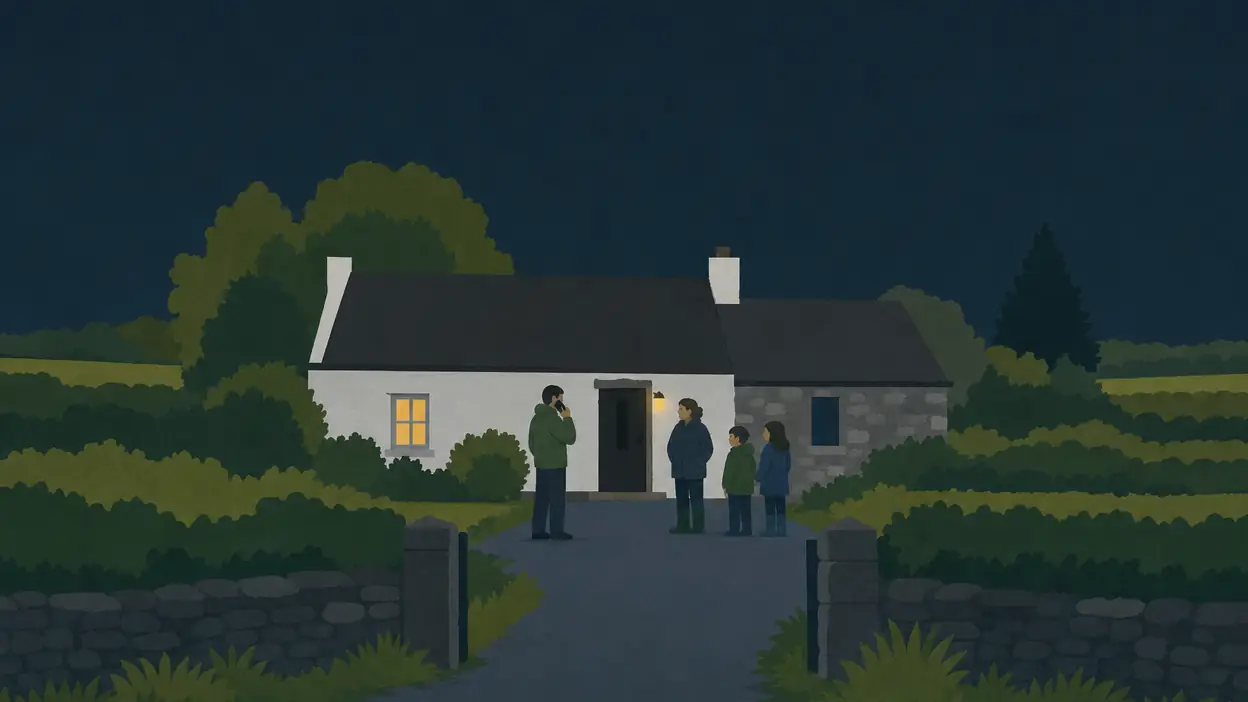
Where carbon monoxide alarms belong
Gas Networks Ireland and the awareness campaign recommend an alarm in every room with a fuel-burning appliance, plus one within 5 metres of every bedroom.[2][5] A kitchen boiler, a sitting-room stove and an upstairs sleeping area can mean three alarms. Caravans, boats and mobile homes need one too.[5]
The Building Regulations guidance for heating appliances says an alarm in the appliance room should be on the ceiling away from the wall, or high on a wall above doors and windows, and one to three metres across the room from the appliance, or as its maker instructs.[8] In a bedroom it should sit near where people breathe while asleep.[8]
- Ask about hidden flues. Some gas flues run behind ceilings or wall panels. Irish standards now require access panels and alarms where they do; your Registered Gas Installer will advise.[5]
- Test monthly and replace at the end of its life, usually 5 to 10 years. Never rely on an alarm past its expiry date, even if it still beeps on test.[5]
- Keep sprays and air fresheners away from it.[5]
The law. Since 1 September 2014 the Building Regulations require carbon monoxide protection when a new or replacement heating appliance is fitted in a home, or when other relevant building work starts.[7][8] That does not cover every older house automatically, but the safety advice to fit alarms applies to all.[1][2] For rented homes, check current requirements with the RTB and Citizens Information.
Smoke alarms do a different job
A carbon monoxide alarm does not detect fire, and a smoke alarm does not detect carbon monoxide. You need both.[2][13]
The current national advice, from the 2024 Fire Safety at Home leaflets:[10][11]
- A smoke alarm in every room except the bathroom and garage, for full protection. The hall and landing are essential in every home. Add one in the utility room.
- A heat alarm in the kitchen, where toast and steam would set off a smoke alarm.
- Fit it on the ceiling, as near the centre as you can, and check you can hear it in bed with the door closed.[13]
- Never borrow its batteries for a torch during a power cut.[10]
If anyone is deaf or hard of hearing, there are units that link to the alarm and use a flashing light and a vibrating pad.[11] Your local fire authority runs a Community Smoke Alarm Scheme that gives free alarms, including these units, to people who cannot afford them.[11][13] Dublin Fire Brigade also recommends linking the alarms so all sound together.[19]
Outage lighting: remove the flame where you can
Keep a working torch on each bedside locker.[14] See Power cuts in Ireland: what to do for the wider outage checklist.
If you must use candles, the national fire booklet’s rules are:[18]
- A proper holder, away from curtains, clothes and bedding.
- Out of draughts, where it cannot be knocked over.
- Never leave it burning in an empty room, and never move it while lit.
- Put it out properly before leaving the room or going to bed.
Do not line a dark stairs with candles to mark the escape route. Use battery lights. If someone uses home oxygen, follow the supplier’s fire rules and Medically dependent at home in a power cut in Ireland.
Heating and cooking: the outage red lines
The HSE and the awareness campaign say:[1][4]
- Never use a barbecue or camping stove indoors, in a tent or under an awning. A barbecue can still give off carbon monoxide after it looks out.
- Never run a generator, car or lawnmower in a garage or any enclosed space. An open garage door does not make it outdoors.
- Never use a gas cooker or oven to heat a room.
- Never sleep in a room with a gas fire or paraffin heater that has no flue.
- Never burn rubbish in a stove or open fire. It can block the chimney.
For an open fire, use a spark guard, keep clothes and furniture back, and never dry clothes near it.[10][12] Have the chimney cleaned and the heating serviced at least once a year.[10][12] Never use petrol or paraffin to light a stove.[10] Put ashes in a metal bucket with a lid, outside and away from the house: they can stay hot for days.[12]
For stoves linked to radiators or hot water, ask the installer before an outage whether it can run safely with the pump off. Stoves must be installed by a competent installer under the Building Regulations guidance.[12] This is a question for your system, not a universal permission. Use Staying warm and cooking without power in Ireland to plan a safe alternative.
Practise getting out while the lights work
The fire directorate says to plan at least two ways out, keep them clear day and night, keep door and window keys nearby, and agree a meeting point outside.[10] Walk it with children and anyone who needs help.
- At an alarm, raise the warning and leave. Do not investigate or collect belongings.
- Check a closed door with the back of your hand. If it is warm, fire may be behind it: use the other way.[10]
- Meet outside and count everyone. Call 112 or 999, ask for the fire service, give your address and Eircode, and say if anyone is missing. Only hang up when the operator tells you to.[10]
- Never go back in, for any reason.[10]
If you are cut off: close the door, block the gaps with towels or sheets, go to the window, open it and attract attention, and call 112 or 999.[14][10] Stay by the window. Dublin Fire Brigade says that from a first-floor window, as a last resort only, you can hang from the sill and drop, lowering children first.[19]
The last check before bed
Fire Ireland’s nightly check takes a couple of minutes: unplug what you do not need, turn off gas appliances you do not need, put out candles, put the spark guard in front of the fire, empty ashtrays, clear the escape routes and close all doors to slow fire and smoke.[16][15] Keep the phone and torch to hand.
During an outage, do the same check. Darkness changes how you light and heat the home; it does not suspend the escape plan.
Sources (20), all checked 2026-10-29
All checked 2026-10-29. All Irish.
- HSE, carbon monoxide poisoning (reviewed 20 September 2024).
- Gas Networks Ireland, carbon monoxide alarms.
- Carbon Monoxide Awareness campaign, home page.
- Carbon Monoxide Awareness campaign, causes.
- Carbon Monoxide Awareness campaign, alarms.
- Carbon Monoxide Awareness campaign, signs and symptoms.
- Irish Statute Book, Building Regulations (Part J Amendment) 2014, S.I. 133/2014.
- Department of Housing, Technical Guidance Document J, Heat Producing Appliances (2014, current edition).
- RTB and Citizens Information, current rental requirements.
- National Directorate for Fire and Emergency Management, Fire Safety at Home leaflet (2024).
- NDFEM, Smoke and Heat Alarms leaflet (2024).
- NDFEM, Chimney and Stove Fire Safety leaflet (2024).
- Fire Ireland, detection.
- Fire Ireland, evacuation.
- Fire Ireland, prevention.
- Fire Ireland, routine fire safety check.
- Fire Ireland, fire statistics 2021 to 2025.
- NDFEM, Fire Safety in the Home full booklet (fourth edition, 2011), still the full booklet on the Fire Ireland leaflets page.
- Dublin Fire Brigade, essential fire safety for the home.
- Office of Emergency Planning, fire safety (updated 26 August 2026).
prepared.ie is independent public information, published by Gallan Software. It is not affiliated with the Government of Ireland or any agency. In an emergency call 112 or 999.