If fire threatens you, move to a safe place with nothing to burn, upwind if you can, and ring 112 or 999. Never try to fight it. If told to evacuate, leave promptly.[3][9] Staying indoors with windows closed is advice for smoke only while the home is safe.[9] Burning growing vegetation on uncultivated land is an offence from 1 March to 31 August.[6][1]
The scene this guide is for
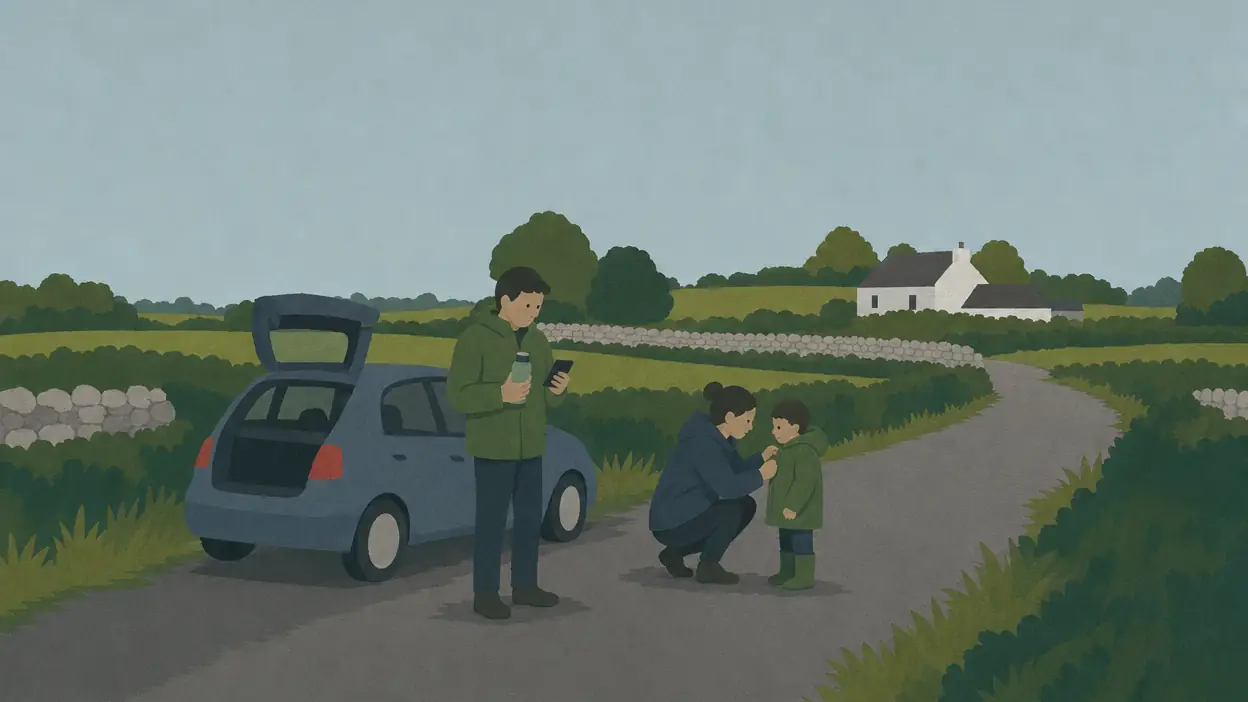
A dry April afternoon on the edge of a village. You smell smoke before you see it. Beyond the back field, gorse is burning on the hillside and the wind is pushing it your way. Your house is clear of smoke, the road passes the fire, and your neighbour has asthma.
The first question is whether the fire threatens your safety, or only the smoke reaches you. The official advice is different for each.[9]
How often this happens
Coillte and the National Parks and Wildlife Service (NPWS) say there have been over 300 fires on Coillte land since 2021, damaging over 2,500 hectares. In Ireland these fires almost never start naturally: they come from campfires, disposable barbecues and burning that gets out of control.[12] In 2026 alone the Department of Agriculture issued nine Orange notices by the end of July.[1] Recent large fires include the Dublin Mountains in May 2026 and Slievenamon, County Tipperary, in July 2026.[14][13]
Read the fire danger notice, not just the weather app
The Department of Agriculture, Food and the Marine issues Forest Fire Danger Notices from March to September. They are built from Met Éireann’s fire weather data and use four colours. Each step up asks for more preparation and vigilance.[2]
| Condition | What the Department says it means | What you do |
|---|---|---|
| Green, low risk | Fires that do start spread slowly. | Make or update your plan now. |
| Yellow, moderate | The default from March to June. Upland vegetation burns steadily. Rural residents should clear dangerous vegetation near homes and fuel stores.[2] | Be aware. No fires or barbecues near gorse, heather or forest. |
| Orange, high | Prepare for fire breaking out. Access routes should be clear.[2] | Check your plan, park clear of gates, avoid open land with any flame. |
| Red, extreme | Rare. Any spark in dry vegetation can cause rapid, unpredictable fire over large areas. Take immediate action.[2][4] | No outdoor fires at all. Check on older or vulnerable neighbours.[4] |
The Department says the Yellow notice it issues each spring stays the minimum level until September, unless it upgrades it.[2] So there is no “safe” colour during the closed season.
Decision rule the colour tells you how fast a fire would spread. It never gives permission to burn, and if you can see a fire, act on the fire, not the colour.
- Read the dates on it. Each notice has an expiry time; a screenshot may be out of date.[3]
- Do not confuse it with Met Éireann’s weather warnings. An Orange fire notice is a different system from an Orange rain warning.[2]
When the risk is highest
The Department says gorse burns readily in every season, but the risk is greatest in dry spells from March to June, when ground vegetation is dead and dry. Low humidity and wind make it worse.[1] Teagasc warns that one or two dry days after rain are enough to dry dead moorland vegetation in a wind, and that fires are most often started in the evenings and at weekends.[11] Bank holidays bring the busiest days.[3] The Office of Emergency Planning says fire risk is typically greater in spring than summer, and the land most at risk is peatland, bogs, uplands and young forest next to them.[17]
The closed burning season: what the law says
Section 40 of the Wildlife Act 1976, as amended, makes it an offence to cut, grub, burn or otherwise destroy vegetation growing on uncultivated land, or in a hedge or ditch, from 1 March to 31 August.[6]
- The dates are fixed. The Heritage Act 2018 let the Minister allow burning in parts of March by regulation. No regulations were made, and that power expired on 17 July 2020. Changing the dates now needs a new Act.[7][8]
- The exemptions do not cover burning. Some cutting in ordinary farming, roadworks and public safety work is exempt, but the Act says those exemptions never apply to anything done by burning.[6]
- The emergency defence is narrow: acts needed to stop a fire spreading or to save life.[6]
- Penalties can include fines of up to €50,000, up to two years in prison, and loss of farm payments.[1] Councils can also charge for the fire brigade.[16]
Outside the closed season, burning is still not a free choice. The Department’s own advice is: if you have the slightest doubt, do not burn.[1] A planned burn needs a written fire plan, at least three experienced adults, notice to neighbours, Gardaí, the council and the fire service control centre, and, within a mile of a forest you do not own, written notice to the Gardaí and the owner at least 7 days ahead.[1][15][16]
If you discover a fire
- Never walk uphill above a fire. The Department warns it can travel uphill faster than you can run. Avoid passing through smoke.[1]
- Say what you see: the size of the fire, the wind direction, and whether homes or forest are near.[1]
- Stay on the line until the operator tells you to hang up. If it gets worse, ring again.[1]
Then stay away, keep local roads clear, and do not fly drones: they endanger the firefighting helicopters.[13][14] Report suspicious burning to the Gardaí.[3]
If fire threatens your home
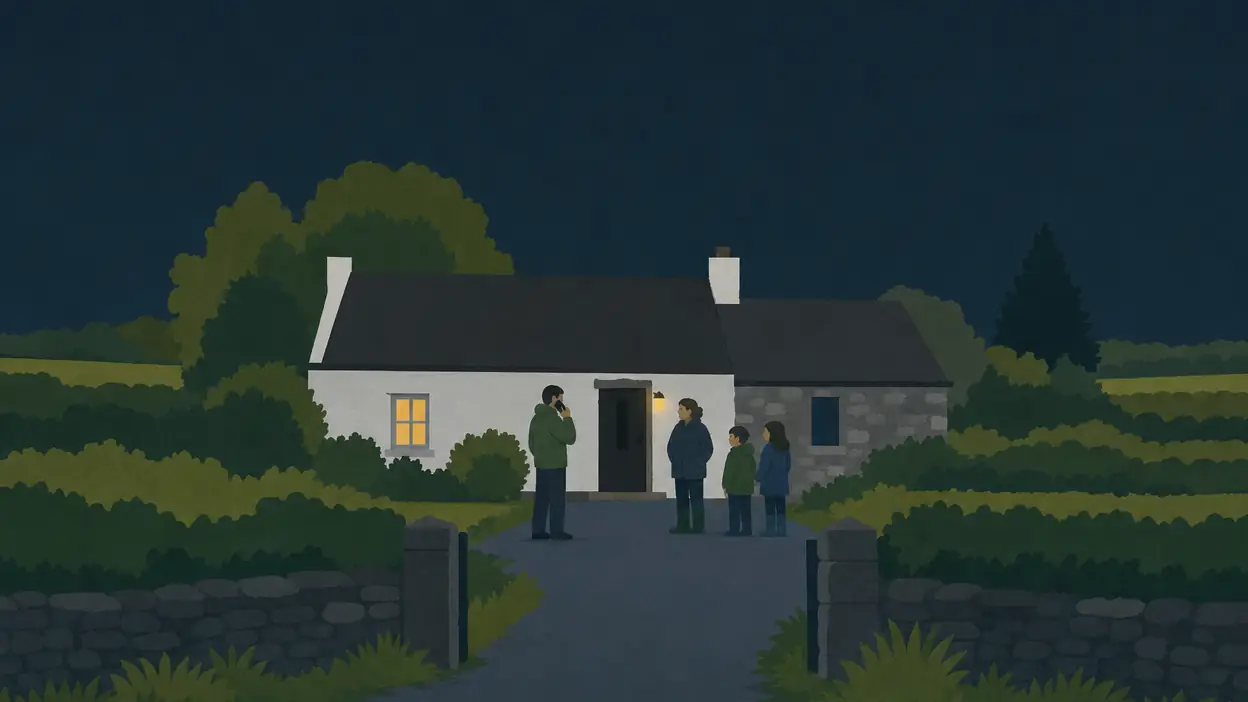
Follow the instructions of the fire service and the council. If you are in immediate danger, move to safety and ring 112 or 999. If told to evacuate, leave promptly and go where you are told.[9][3]
If you can take them without delay, the HSE lists:[9]
- Essential medicines and inhalers.
- Medical equipment.
- Important documents.
- Supplies for children, older people, pets and anyone who depends on you.
Check on neighbours only if it is safe.[9] If someone needs help to move or uses powered equipment, tell the responders early. If you cannot leave safely, ring 112 or 999 and say where you are and what stops you leaving. Use Pets and animals in an emergency in Ireland for animals and Medically dependent at home in a power cut in Ireland for powered equipment.
Smoke: stay inside only if the building is safe
Wildfire smoke can travel many kilometres. The HSE says smoke is the main health risk for most people in Ireland. It can irritate the eyes, nose and throat and cause coughing, wheezing and breathlessness.[9]
When the fire itself is no danger to you:[9][14]
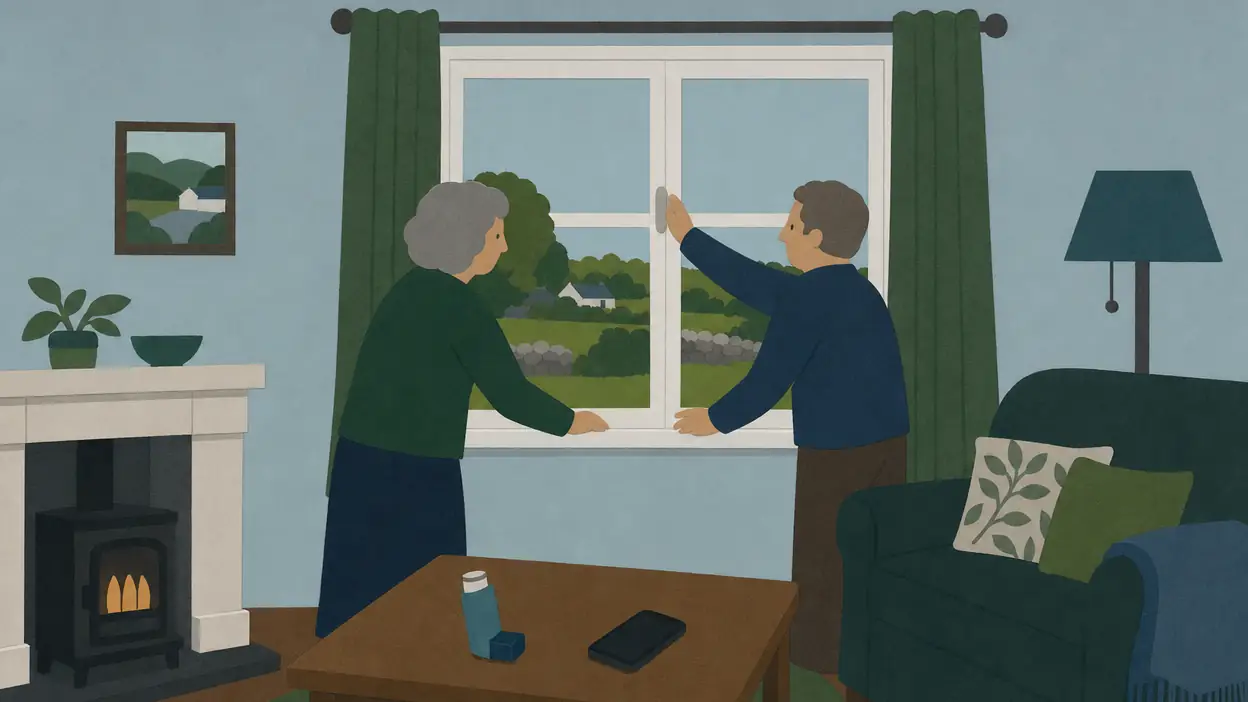
- Stay indoors with doors and windows closed.
- Close vents and switch off any system that draws in outside air.
- Avoid outdoor exercise. If you must go out, keep it short and gentle.
- Cut indoor smoke: no smoking, stoves, aerosols, frying or grilling.
- Keep regular medicines and inhalers with you, and use them as prescribed.
- In a car, keep the windows closed.
- Check air quality on the EPA’s air quality website.[10]
Masks: the HSE says staying indoors matters most. For a short time outside, a close-fitting mask sold as FFP2 or FFP3 helps; a cloth face covering gives little protection.[9]
If the closed house gets too warm, use the coolest room, close sun-facing curtains, drink water, use cool damp cloths and fans, and open windows once the air clears.[9] See Heatwave: keep cool and check on others.
Who needs extra care, and when to get medical help
The HSE lists babies and children, adults 65 or over, pregnant people, people with asthma, lung disease, heart disease or diabetes, and outdoor workers.[9]
Get urgent medical help for difficulty breathing, chest pain, severe wheeze or worsening asthma, a burn, or feeling unwell and not improving after leaving the smoke. In an emergency, ring 112 or 999.[9] If you have a heart or lung condition, the HSE says to plan with your doctor before the season how you would avoid smoke.[9]
Farms, forests and the rural fringe
The Department and Teagasc ask forest owners to keep a current fire plan: a map of access routes, assembly points and water sources, and contact numbers for the emergency services, neighbouring owners and foresters.[3][11]
- Keep firebreaks bare and at least 6 metres wide, cleared by machine.[3]
- Keep gates and forest roads clear, with a sign asking visitors not to block them.[3]
- Machinery in hay and cereals: keep it maintained, check bearings and belts, clear dust, and never leave it unattended in a high-risk field.[3]
- Livestock: Dublin Fire Brigade asked farmers near the Piperstown fire to check their animals. Do it without entering the danger area.[14]
- Insurance: Teagasc says to check cover for replanting, which is often about €3,000 a hectare, and for fire brigade call-out charges, which can be substantial.[11]
- After a fire, report forest losses to the Gardaí and the Department.[3]
For ordinary rural homes: the Office of Emergency Planning says to keep gorse, bracken and grass cut low and keep at least 30 metres of fuel-free space around buildings. Keep the lane clear, know where water and hydrants are, and help older neighbours do the same.[17][2] Add a known Eircode, an agreed neighbour contact and readiness to follow instructions. For broader planning, use Make getting ready a project.
Sources (17), all checked 2026-10-29
All checked 2026-10-29. All Irish.
- Department of Agriculture, Food and the Marine, fire management (updated 29 July 2026), including the list of 2026 Fire Danger Notices.
- DAFM, Fire Danger Notice 01 of 2026, Condition Yellow, with the Forest Fire Risk Warning System 2026.
- DAFM, Fire Danger Notice 10 of 2026, Condition Orange.
- DAFM, Fire Danger Notice 08 of 2025, Condition Red.
- Met Éireann, Fire Weather Index.
- Law Reform Commission, revised Wildlife Act 1976, section 40.
- Irish Statute Book, Heritage Act 2018, section 7.
- Oireachtas, written answer on section 7 of the Heritage Act 2018, 26 July 2022.
- HSE Health Protection Surveillance Centre, wildfires.
- EPA, air quality in Ireland.
- Teagasc, dealing with wildfires.
- Coillte and NPWS, forest fire season begins, 1 April 2026.
- Coillte, Slievenamon wildfire response, 23 July 2026.
- Dublin Fire Brigade, Piperstown Road gorse fire, 28 May 2026.
- DAFM, Fire Safety: Burning Questions for Farmers.
- DAFM, Prescribed Burning Code of Practice.
- Office of Emergency Planning, wildfires (updated 26 August 2026).
prepared.ie is independent public information, published by Gallan Software. It is not affiliated with the Department of Agriculture, Coillte, NPWS, Teagasc, the HSE or the fire service. In an emergency call 112 or 999.