The scene this guide is for
Halloween night, a Saturday, a housing estate outside Navan. The bangers started at teatime. Your terrier has squeezed under the side gate for the first time in six years, and the phone with his photo and chip number is at 12%. Or: January, a Red wind warning, the power gone, and a tropical tank cooling in the sitting room.
Both go better if a few things were done in daylight.
Keep pets indoors in storms and at Halloween, never leave a dog in a parked car, and keep dogs out of floodwater.[4][5][6] If a pet suddenly falls ill for no clear reason, check for carbon monoxide.[7] If your dog goes missing, tell its microchip database and your council dog warden the same day.[3][8]
How long to plan for
Storm Éowyn crossed Ireland on 24 January 2025 and cut power to 768,000 customers at its peak.[2]
| After | Customers back on |
|---|---|
| 3 days | almost 7 in 10 |
| 1 week | almost 9 in 10 |
| 18 days | everyone |
So more than 230,000 were still off after three days. The Government’s review recommends households plan for 72 hours without outside food, water and power, and the Office of Emergency Planning booklet asks you to “plan how you will keep animals safe”.[2][1]
Decision rule stock at least 3 days for every animal. The UK animal-welfare organisation PDSA suggests a week’s worth of sealed food for a flood kit; if you live where floods or long power cuts come round, go to a week.[9]
How we worked this out
The review says almost 70% were restored within 72 hours, so just over 30% were still off: 30% of 768,000 is about 230,000. All were restored on 11 February 2025, 18 days after the storm.[2]
The pet emergency kit
Keep it in one bag or box near the door, with the documents in a sealed waterproof bag.[9][10]
| Item | Why | Source |
|---|---|---|
| Food for 3 days at least, a week in flood areas | Shops and deliveries may stop | [2][9] |
| Fresh water, and collapsible bowls kit options | For drinking away from home | [9] |
| Medicines | Ask your vet how much spare to keep | [9] |
| Lead and collar with your name and address on the tag; add a phone number too kit options | The owner’s name and address are required; a phone number is an extra practical contact | [28] |
| Carrier for cats, rabbits and small pets kit options | Get them used to it now, not on the night | [9][10] |
| Pet first aid kit kit options | Our suggestion: for cuts and paws while the vet is hard to reach | none |
| Microchip number, certificate of registration, vaccination record, vet’s number, a recent photo | For reclaiming a lost pet, or boarding at short notice | [3][10] |
| Poo bags, litter and a tray | A cat kept in during a flood still needs one | [9] |
The two legal documents for a dog
- Microchip and registration. Have your puppy microchipped and registered on a database approved by the Department of Agriculture by 12 weeks, or earlier before it leaves its birth premises or is sold or supplied; the transport exception is a booked veterinary visit for microchipping and registration.[3] There are four approved databases: Animark, Fido, the Irish Kennel Club and Microdog ID.[12] You must also hold a current certificate of registration and show it to an authorised officer on request.[3] Ask your vet about microchipping.[12]
- Dog licence. The puppy exemption applies only while the dog is under 4 months and kept with its mother or foster-mother; otherwise a licence is needed unless another legal exemption applies.[29] An individual licence costs €20 a year or €140 for the dog’s lifetime, from licences.ie or a post office.[8] A pound may ask to see it before you take your dog home.[8]
The microchip law covers dogs only.[3] The NSPCA advises chipping cats too.[13]
Do this today: ring your vet, ask them to scan the chip and tell you which database holds it, then check your phone number and address with that database.[12][4]
Halloween, fireworks and storms
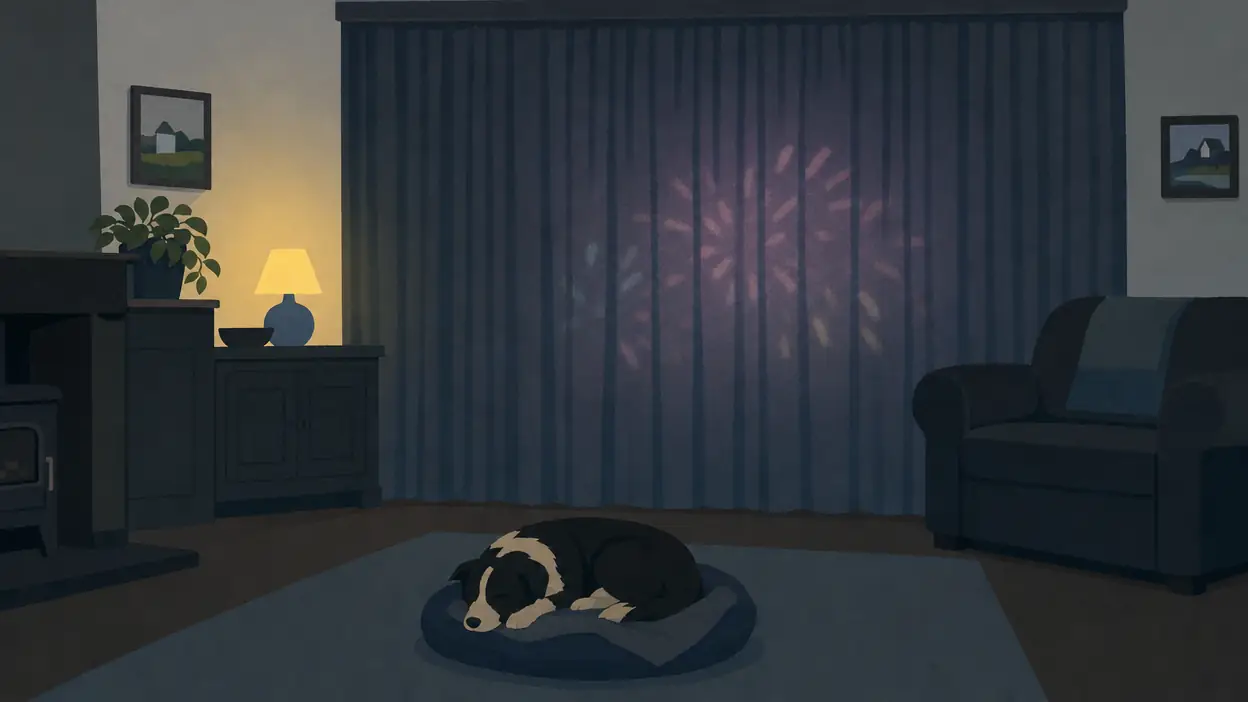
The NSPCA warns that fireworks can start days or weeks before 31 October.[13] Storms frighten many dogs the same way.[5]
- Walk them earlier in the day, on the lead, and have them settled indoors before dark.
- Feed them before the bangs start; frightened dogs often will not eat.
- Take them out to the toilet on a lead, even in a garden they have never escaped from.
- Close windows, curtains and blinds, turn the lights on and the television or radio up.
- Give them a safe spot away from the front door. Halloween is not the night to introduce a crate.
- Stay with them. Comforting a frightened dog does not make the fear worse.
- Keep chocolate, sugar-free sweets, grapes and raisins out of reach. If they eat any, ring the vet at once; do not wait for symptoms.
Cats: keep them in from early on 31 October until the next day, with a quiet hiding place they can leave freely.[13]
Rabbits (UK advice): bring the hutch into a quiet room, garage or shed if you can; otherwise give extra hay and bedding, a box to hide in, and keep companions together.[15]
Decision rule if your dog shakes, hides, paces or tries to escape at fireworks, see your vet as soon as possible, not on the night. Medicine from a vet can stop the fear growing each time.[14]
For storms, keep animals in, check the garden is secure, and skip walks when extreme weather is forecast.[5] At Orange, Met Éireann asks you to delay or cancel activity; at Red, to follow the authorities’ instructions.[16] Animals kept outside need shelter, feed and water in place before the storm, so nobody has to go out in it.[17]
If a pet goes missing
In the 2024 council-pound statistics, 19% of dogs leaving pounds were reclaimed. That includes surrendered and seized dogs as well as strays, so it is not the chance that a missing pet will return home.[18] For a stray seized by a dog warden or Garda, the law allows rehoming or humane destruction five days after the register entry or the notice to the owner, whichever is later, if the dog has not been reclaimed and the costs paid.[30] Contact the pound immediately.
- Search home, nearby gardens and your usual walks. Ask neighbours.
- Ring your council dog warden and ask whether your dog is in the pound. Some pounds see visitors by appointment only.[19]
- Report the dog missing to its microchip database. The law requires this immediately after a loss.[3]
- Ring nearby vets and rescues, and post a recent photo in local lost-pet groups.
- If you think the dog was stolen, tell the Gardaí and give them the chip number and photos.
Bring your dog licence and expect a reclaim fee.[8][19] If you find a stray, it is unlawful to hand it to anyone except the owner, the dog warden or the Gardaí.[19]
Heat
Met Éireann’s lowest heat warning starts at over 27°C.[16] Dogs can get heatstroke well below that: a study cited by Dogs Trust found cases at 16.9°C.[6] Flat-faced breeds, puppies, old, overweight and large dogs are most at risk; UK research found Bulldogs 14 times more likely to suffer than Labradors.[6]
- Never leave a dog in a parked car, even for a few minutes. Shade and open windows do not keep it safe.[6][20]
- Walk early morning or late evening. Press the back of your hand on the tarmac for five seconds: too hot for you, too hot for paws.[6]
- Check sheds and greenhouses before you shut them: a trapped cat can get heatstroke quickly.[21]
Signs of heatstroke: heavy panting that does not stop, drooling, red gums, wobbliness, vomiting, collapse.[6] Call the nearest vet immediately if your dog has collapsed or is struggling to breathe. For other signs, seek veterinary advice urgently. Follow the vet’s advice on cooling and transport; Dogs Trust says cooling should begin before transport, while help is arranged.[6]
Dog alone in a hot car: look for the owner, then ring the local Garda station and stay with the dog. Breaking in may count as criminal damage.[6]
Cold and snow
- Keep dogs on a lead in snow: it hides holes and unsafe ground.[22]
- Keep dogs off frozen ponds. If one falls through, do not go in after it; call it towards you and ring 112 or 999.[22]
- Wipe legs, feet and belly after walks; road grit irritates skin.[22]
- Antifreeze is poisonous and tastes sweet to dogs. Store it high and mop up spills.[22]
- Horses: break ice on troughs daily, add hay or haylage as grass slows, and feel for ribs, because a winter coat hides weight loss.[23] For a welfare problem in severe weather, the Department of Agriculture’s Animal Welfare Helpline is 01 607 2379.[17]
Floods
Never let a dog into floodwater, and never go in after one. Floodwater can carry sewage and chemicals, and lifted manhole covers and other hazards hide under it.[5][24][25] Never put a human life at risk to save an animal.[10] Even shallow water moving fast can knock over children and many adults.[25]
- Bring outdoor pets inside and take everyone upstairs with food and water.
- Keep cats in and species apart.
- If you are told to leave, take your animals with you: dogs on a sturdy lead, cats and small pets in carriers. It may be days before you can get back.
If you have to leave home
The sources reviewed did not establish whether your emergency rest centre or community hub accepts pets. Check the local arrangements before relying on them. In Storm Éowyn, more than 380 hubs offered water, hot food, phone charging and showers; the Government review does not mention pets.[2]
Decision rule arrange now, with family or friends outside your flood or storm area, to take your animals at short notice, and name a boarding kennel or cattery as a back-up.[9][10] If your insurer moves you into temporary accommodation, your pets may not be allowed to come (UK advice).[9]
Power cuts: fish, reptiles and other heated pets
Most pets will not be affected by a power cut. The ones at risk depend on a heater, filter or pump.[26]
Tropical fish (UK network operators’ advice):[26][27]
- Wrap the tank in blankets, cover the top, and stand hot water bottles of warm water against the outside.
- Without a battery air pump, scoop tank water with a jug and pour it back for 5 minutes every hour.
- Feed little or nothing until the power returns.
- The cheap backup is a battery air pump and battery heater from a pet shop.
Reptiles, amphibians and other heated pets: we found no official advice for these, Irish or UK. The UK operator’s advice is to ask your pet shop or supplier.[26] Ask them, or your vet, now, and write the answer for your species on a card in the kit. See Staying warm and cooking without power in Ireland for safe ways to keep a room warm.
Generators: never run one in a house, garage, stable or other enclosed space.[7]
Carbon monoxide: watch the animals
The smaller the animal, the faster carbon monoxide affects it, so pets are often the first to show symptoms.[7]
If your pet suddenly falls ill or dies with no known cause, or your pets and people feel ill together:[7]
- Switch off all appliances.
- Open doors and windows and go outside, taking the animals.
- Ring Gas Networks Ireland on 1800 20 50 50.
- Ring 112 or 999 if anyone is unconscious, struggling to breathe, or you think it is carbon monoxide poisoning.
- Do not go back in until the emergency services say so.
Fit an alarm in every room with an appliance that burns gas, oil, coal or wood.[7]
Farms, smallholdings and livestock
Before a storm, check that backup generators for feeders and ventilation work.[17] The farm and livestock guide covers the wider plan: Farms and livestock in storms and power cuts in Ireland
Sources (29), all checked 2026-10-29
All checked 2026-10-29. Irish sources unless marked (UK).
- Office of Emergency Planning, Be Emergency Ready booklet (from gov.ie/BeEmergencyReady).
- Government of Ireland, Review of Storm Éowyn (October 2025).
- Microchipping of Dogs Regulations 2015, S.I. No. 63 of 2015, regulations 3, 4, 6 and 9.
- NSPCA, keeping dogs safe at Halloween.
- Dogs Trust Ireland, stormy weather.
- Dogs Trust Ireland, hot weather.
- HSE, carbon monoxide poisoning.
- Citizens Information, dog licences and ownership.
- (UK) PDSA, flood safety for pets.
- (UK) Blue Cross, preparing for a flood with your pet.
- Department of Agriculture, Food and the Marine, how to be a responsible dog owner.
- Dogs Trust Ireland, microchipping FAQ.
- NSPCA, keeping cats safe at Halloween.
- Dogs Trust Ireland, fireworks.
- (UK) Blue Cross, rabbits and fireworks.
- Met Éireann, warning system explained.
- Department of Agriculture, Food and the Marine, Storm Éowyn advice (23 January 2025).
- Department of Agriculture, Local Authority Control of Dogs Statistics Report 2024.
- Mayo County Council, missing and stray dogs (an example; check your own council).
- Dogs Trust Ireland, hot cars warning (2026).
- NSPCA, keeping your cat safe in hot weather.
- Dogs Trust Ireland, cold weather advice.
- NSPCA, winter horse care.
- Department of Defence, flooding advice.
- OPW, impacts of flooding.
- (UK) SP Energy Networks, looking after your pets and livestock during a power cut.
- (UK) NIE Networks, what about my tropical fish?
- Control of Dogs Regulations 1998, S.I. No. 442 of 1998, article 6.
- Control of Dogs Act 1986, revised, section 5(e).
prepared.ie is independent public information, published by Gallan Software. It is not affiliated with the Government of Ireland, the Department of Agriculture, Food and the Marine, the NSPCA, Dogs Trust or any agency. In an emergency call 112 or 999. 30. Control of Dogs Act 1986, revised, section 11(7).