In a Red warning area, the Road Safety Authority (RSA) advises road users to avoid any travel during the storm window.[1] At Orange, check local traffic and weather before you set out, and delay or cancel if you can.[2][3] If you must drive, slow down, expect fallen trees and branches, take exposed stretches slowly and give cyclists, motorcyclists and high-sided vehicles extra room.[3] Never drive over or near a fallen electricity line: assume it is live and report it to ESB Networks on 1800 372 999.[4]
What each warning means for a journey
Met Éireann’s three levels, with its own advice for each:[2]
| Warning | Met Éireann says | For a driver |
|---|---|---|
| Yellow | “Be aware” and “Do not take any avoidable risks” | Check the warning and your route. Expect debris and fallen branches.[1] |
| Orange | “Check your activity/event and delay or cancel as appropriate” | Delay or cancel if the journey can wait. If not, check local traffic and weather first.[3] |
| Red | “Take action to protect yourself” and “Follow instructions and advice given by the authorities” | The RSA advises avoiding “any travel during the storm window”.[1] |
Read the warning, not just the colour. It gives the counties and the start and end times, and they change as the storm gets closer.[2] A storm can bring Orange or Red gusts to exposed places “without the event being named”.[2]
The window matters both ways. The RSA warns that roads stay dangerous after the wind drops, with “downed pylons, lines, trees, branches, and other debris which could block roads”.[1] Check your route again before setting out once a Red warning ends.[1]
Before you set out
Ask whether the journey is necessary. The RSA says: “If it is not, you might consider delaying your trip until the weather and road conditions improve.”[5] That costs nothing and is the best protection there is.
If you have to go:
- Check Met Éireann’s warnings for every county on your route.[2]
- Check road closures on TII Traffic for motorways and national roads, and listen to local radio for local roads.[6][7]
- Charge your phone. Tell someone your route and when you expect to arrive.[7]
- Make sure you have enough fuel.[7]
- Keep a hi-vis jacket and a torch in the car.[7] See Stranded in a car for a full car kit.
Driving in strong wind
These points are from the RSA’s storm advice:[3][7]
- “Control of a vehicle may be affected by strong cross winds. High-sided vehicles and motorcyclists are particularly vulnerable to strong winds.”
- “Drivers should allow extra space between themselves and vulnerable road users such as cyclists and motorcyclists as they may be blown off course by strong winds.”
- “Expect gusts at open areas, where gaps in high buildings and hedgerows create a wind channel.”
- “Beware of objects being blown out onto the road. Expect the unexpected.”
- “Watch out for falling / fallen debris on the road and vehicles veering across the road.”
- Drive with dipped headlights at all times.
Met Éireann adds that wind is often stronger than the warning suggests on coasts, high ground and in some low-lying places where it funnels. It warns about high-sided vehicles “particularly when overtaking”.[2]
In practice: slow down before bridges, gaps in hedges and open bends. Hold back from lorries, vans and anything towing. Leave a gap when you pass a cyclist, so a gust cannot push them into you.
Storms usually bring rain too. Slow down and leave more distance, because you need longer to stop. If a road is flooded, “choose another route”, the RSA says: it could be deeper than it looks.[3] See Flooding.
A tree or branch across the road
Stop well back and put your hazard lights on.
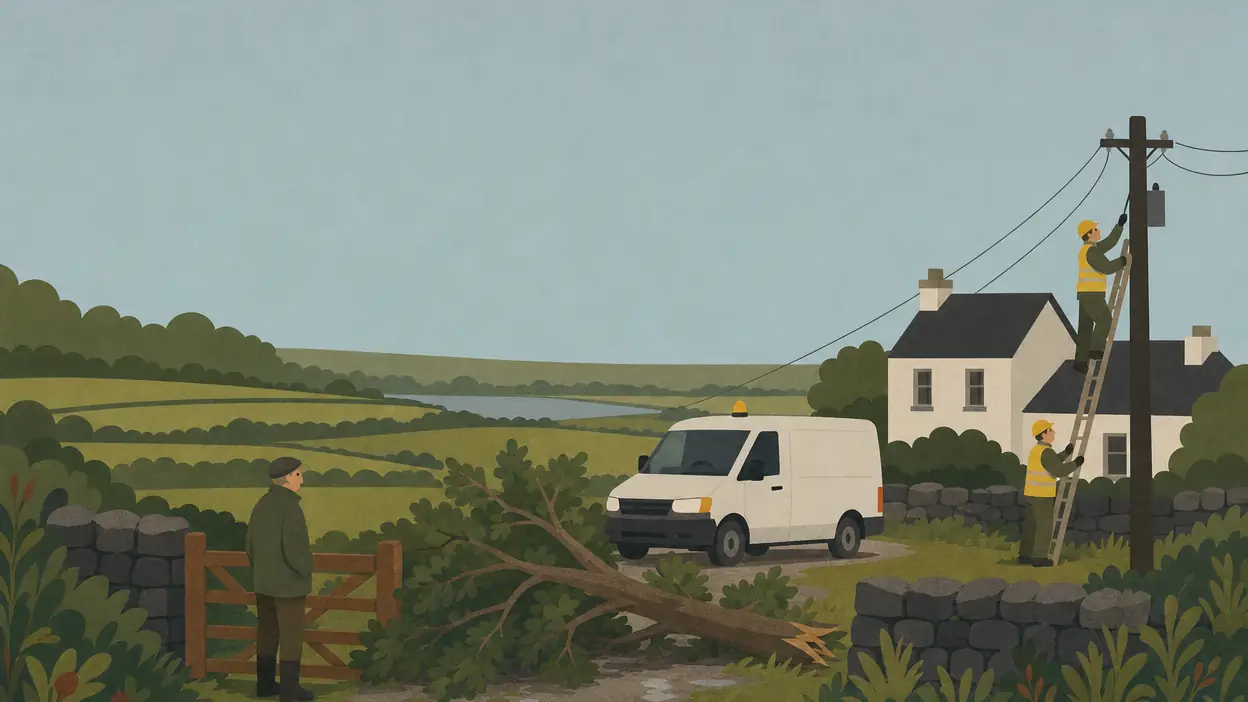
- If there are wires in it or near it, do not go near it and do not try to move it. Assume the wires are live and ring ESB Networks on 1800 372 999.[4]
- If there are no wires, do not try to drag a large tree yourself in the wind: more branches can come down. Turn round if you can do it safely. After the storm, our storm clean-up guide covers fallen trees and lines.
- Tell the Gardaí about debris on the road. On a motorway, the RSA says: “NEVER stop on a motorway to remove debris.”[7]
Obey every road closure and diversion that the council or An Garda Síochána puts in place.[3]
If a line falls on or near your car
ESB Networks says “Fallen wires are never safe to touch or handle”.[8] Its three rules, word for word:[4]
- “Keep away and contact the ESB Networks immediately at 1800 372 999.”
- “Never approach or handle fallen electricity wires.”
- “Assume electricity wires are always live.”
There is no ESB advice for private cars on its public pages. The closest Irish guidance is the code of practice that the Health and Safety Authority and ESB wrote for machines that touch an overhead line. If the vehicle can still move, the code says to drive slowly well clear of the line, but only if that will not break the wire.[9] For a vehicle that cannot move away and is not on fire, it says:[9]
- “STOP WORK, remain calm and stay in the cab”
- “Instruct everyone outside the vehicle not to approach or make contact with it”
- “Do not exit the cab until ESB confirm that it is safe to do so”
Ring 112 or 999 as well as ESB Networks, and wave or shout to keep other people back. The code gives ESB’s number as 1850 372 999; the current number is 1800 372 999.[4][9]
Only if there is a fire or other immediate danger, the code says to “jump clear of the machine and avoid making contact with any part of the vehicle when on the ground”. Land “with the feet kept as close together as possible”, then “Shuffle away from the vehicle” by “taking half steps only or hop with both feet together”.[9]
If you see a line touching someone else’s car, keep back and ring for help. Do not go to the car.[4]
Cannot make a voice call? Text 112.
The emergency text service can be used by "anyone who is not able to make a voice call due to a speech or hearing impairment or other situations where a voice call might not be possible". It works "from any Irish registered mobile phone (either pre-pay or bill pay) on all the Irish Mobile networks". If you can talk, ring instead: a text is slower.
Your text needs four things:
- Which service: Ambulance, Coastguard, Fire or An Garda Síochána.
- What the problem is.
- County you are texting from.
- Where help is needed: town, road, Eircode or a landmark.
Wait for a reply: "an SMS/Text 'Delivery Report' does not mean your message has been received". If no reply comes within 3 minutes, send another message straight away. It does not work from a foreign phone, or from an Irish phone roaming abroad, including in Northern Ireland.
No registration is needed. 112.ie says: "There is no preparation or registration required to use either Emergency SMS, or RTT when contacting the ECAS." If you might need to text one day, you can choose to give the service your address, access details and a next of kin in advance at 112.ie/register. Most smartphones can also use Real-Time Text to type during a call to 112 or 999: turn on RTT in your phone’s accessibility settings.
Source: 112.ie, emergency text service, sending a text to 112, SMS questions and answers, emergency SMS terms and conditions and Real-Time Text pages, checked 1 November 2026.
Which situation are you in?
The school run as a storm arrives. If a Red warning covers your area, do not set out. In a Red warning, the National Emergency Coordination Group can tell schools in the area to close.[10] At Orange, check before you leave and allow far more time.[3]
A delivery or work journey with a deadline. A deadline is not a reason to drive into a Red warning. Talk to your employer early, before the window starts.[1]
A tree down with a line in it. Stay back, ring ESB Networks on 1800 372 999 and warn others.[4]
A fallen line touching your car. Stay inside unless there is a fire, ring for help and keep people away.[9]
On a motorway when the wind gets up. Slow down, expect cross winds and keep clear of high-sided vehicles. If you break down, see Stranded in a car.[3]
For preparing your home, see Storms. For power cuts, see Power cuts.
For the Government’s advice, see Road safety from Be Emergency Ready (gov.ie).
Common questions
Should I drive in a Red weather warning in Ireland?
No: the RSA advises road users in a Red warning area to avoid any travel during the storm window.[1]
Can I drive in an Orange wind warning?
Met Éireann’s advice at Orange is to delay or cancel as appropriate, and the RSA asks drivers to check local traffic and weather before setting out.[2][3]
What should I do if a power line falls on my car?
Stay inside unless there is a fire, keep everyone else away and ring ESB Networks on 1800 372 999, because fallen wires must always be treated as live.[4][9]
Which vehicles are most affected by strong wind?
The RSA says high-sided vehicles and motorcyclists are particularly vulnerable, and cyclists can be blown off course.[3]
Should I move a fallen tree off the road?
Never touch one with wires in or near it, and on a motorway the RSA says never to stop to remove debris.[7][4]
Data sources (11), all checked 2026-11-01
Footnotes
-
Road Safety Authority, Road safety alert: Red weather warning issued for Donegal, 3 October 2025. Red warning travel advice. Checked 2026-11-01. ↩ ↩2 ↩3 ↩4 ↩5 ↩6 ↩7
-
Met Éireann, Warning system explained. Warning levels quoted verbatim; wind impacts. Checked 2026-11-01. ↩ ↩2 ↩3 ↩4 ↩5 ↩6 ↩7
-
Road Safety Authority, Road safety weather alert: Orange and Yellow warnings issued for Storm Austen, 21 October 2026, updated 22 October 2026. Wind advice quoted verbatim. Checked 2026-11-01. ↩ ↩2 ↩3 ↩4 ↩5 ↩6 ↩7 ↩8 ↩9 ↩10
-
ESB Networks, Report a fallen wire. Quoted verbatim. Checked 2026-11-01. ↩ ↩2 ↩3 ↩4 ↩5 ↩6 ↩7 ↩8
-
Road Safety Authority, Severe weather campaign. Checked 2026-11-01. ↩
-
Transport Infrastructure Ireland, TII Traffic. Live traffic map for national roads. Checked 2026-11-01. ↩
-
Road Safety Authority, Severe weather advice for road users (PDF). Checked 2026-11-01. ↩ ↩2 ↩3 ↩4 ↩5 ↩6 ↩7
-
Health and Safety Authority and ESB, Code of practice for avoiding danger from overhead electricity lines, first edition, September 2008, appendix 5, scenario 3 (machine in contact with an overhead line). Written for workplaces; quoted verbatim. Checked 2026-11-01. ↩ ↩2 ↩3 ↩4 ↩5 ↩6
-
Citizens Information, Severe weather. Schools and Red warnings. Checked 2026-11-01. ↩
-
112.ie, SMS questions and answers. Checked 2026-11-01. ↩
prepared.ie is independent and is not affiliated with the Government of Ireland, Met Éireann, the RSA, ESB or any agency. In an emergency, call 112 or 999.[11]