The scene this guide is for
Imagine February, 7pm, on the R756 over the Wicklow Gap. Snow has been falling for an hour. The car ahead jack-knifed on the climb, yours will not grip, and the phone says 30%. Nobody is hurt. What you do in the next ten minutes decides whether this is a cold, boring night or a dangerous one.
Most of what follows is decided before you leave home.
Never drive into floodwater: water 300mm deep and flowing can move a car.[3] If you run the engine, keep the exhaust clear, run it about 10 minutes an hour with a window slightly open, and switch it off if snow drifts round the car.[4][5]
Before you set off: read the warning, then decide
Met Éireann issues warnings when the weather is expected within about 60 hours. Each level carries an instruction, not just a colour:[6]
| Level | Met Éireann’s instruction | Snow that triggers it |
|---|---|---|
| Yellow | Be aware. Do not take any avoidable risks. | 3cm or more in 24 hours |
| Orange | Prepare. Check your activity and delay or cancel as appropriate. | 3cm in 6 hours, 5cm in 12, or 10cm in 24 |
| Red | Take action. Follow instructions from the authorities under all circumstances. | 10cm in 6 hours, 15cm in 12, or 30cm in 24 |
Decision rule at Orange, the default is not to drive unless the journey cannot wait. The RSA asks you to delay any journey that is not necessary in extreme weather, and the Office of Emergency Planning (OEP) suggests public transport where it is running.[7][8] At Red, follow what the Gardaí and your council say.
If you must go:
- Fill the tank. The OEP advises keeping it as full as possible in winter.[8]
- Travel between 10am and 4pm if you can. The OEP says road conditions are likely to be best then.[8]
- Check the route, not just the forecast: TII traffic for national roads, Garda and council updates, local radio.[8]
- Do not let a sat-nav pick the route. It can send you over mountain passes or narrow back roads that hold snow and ice.[8]
- Tell someone your route and expected arrival time.[8]
- Check tyres, including the spare. The RSA says replace them below 3mm tread.[7][9] On snow or ice, stopping can take up to 10 times the normal distance.[2]
The car kit
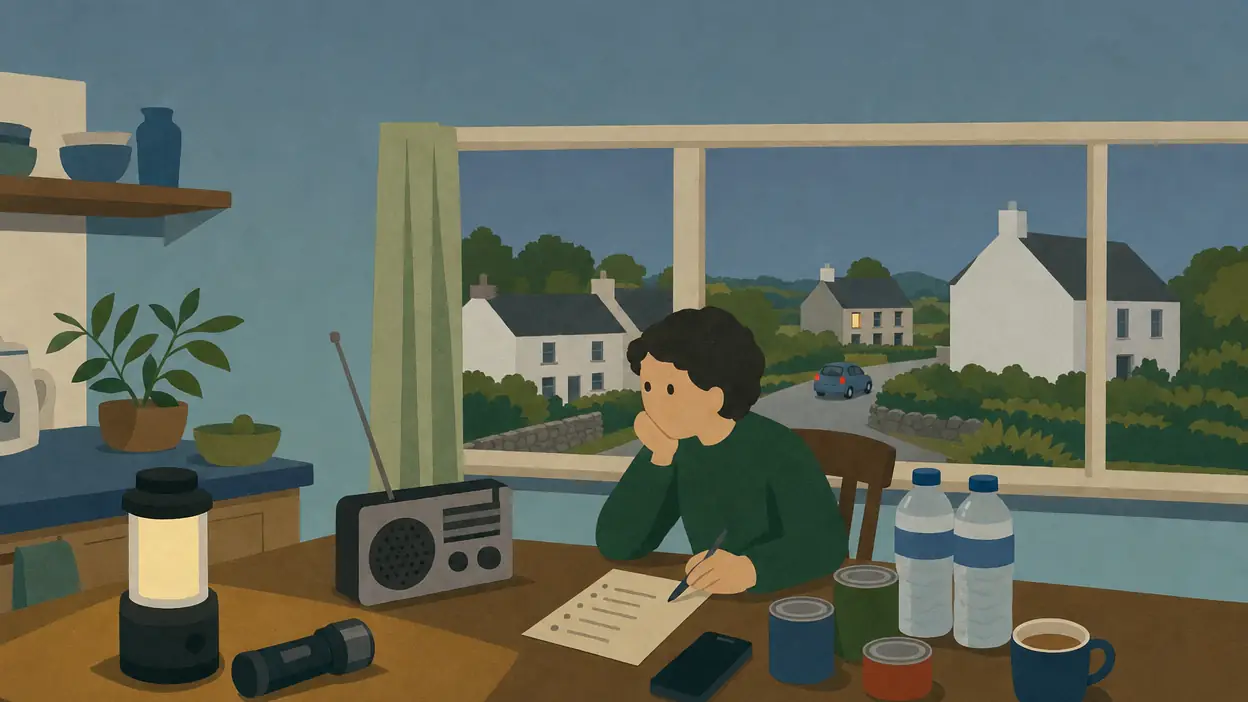
The essential items below are on the OEP’s current car emergency kit list.[8] The useful items come from RSA and Garda lists for prolonged snow and ice.[9][10] See the kit pages for equipment options.
| Item | Why it earns its space | Status |
|---|---|---|
| Hi-vis vest, one per person kit options | Helps traffic see you if you can leave safely; otherwise stay belted in with hazards on.[2] | Essential |
| Warning triangle kit options | Warns traffic on ordinary roads. Never place one on a motorway.[2] | Essential |
| Torch kit options | Checking the exhaust in the dark; being seen. Test it monthly.[8] | Essential |
| Spare fuses and bulbs | Keeps lights working, which is how you are seen.[8] | Essential |
| Ice scraper and de-icer kit options | Never use hot water: it can crack the windscreen.[9] | Essential |
| First aid kit First aid kits for home, car and outdoor trips in Ireland | Treating minor injuries while help is hours away.[8] | Essential |
| Warm clothing and boots | You may have to leave the car, or sit in it for hours.[8] | Essential |
| Charged phone, cable and power bank kit options | Calling for help and finding your Eircode.[8] | Essential |
| Food and drink for everyone | To sustain you and passengers.[8] | Essential |
| Map, or charged GPS | When mobile data fails.[8] | Essential |
| Shovel kit options | Clearing the exhaust and the wheels.[9][4] | Useful |
| Blanket | Warmth with the engine off.[9][10] | Useful |
| Salt or sand | Grip under driving wheels.[9][10] | Useful |
| Tow rope kit options | Lets a passing driver pull you out.[9] | Useful |
| Fire extinguisher kit options | Listed by the RSA and Gardaí; the Department of Transport recommends one.[9][10][12] | Useful |
A triangle is not on the Department of Transport’s list of required documents; it appears under recommended equipment.[12] Carry one anyway.
Stuck in snow: stay or go
Stay with the car. Leave only if:[4][1][2]
- water is rising around it (get out at once);
- you are stopped on a motorway and can leave safely (use the left-hand door and wait behind the barrier; if you cannot, including in a live lane, stay belted in with hazards on);
- the car is on fire; or
- there are buildings close by where you know you can shelter. Drifting snow makes distances look shorter than they are.
Otherwise call 112 or 999, give your Eircode or nearest road sign, and wait.[8]
Carbon monoxide: the engine rule
Carbon monoxide has no smell or taste. A very high level can kill within minutes. The HSE lists faulty or blocked car exhausts as a cause.[13] In a snowbound car, the blocked exhaust is the danger.
UK council guidance, in the absence of an Irish official figure, gives this routine:[4][5]
- Clear the exhaust pipe before starting the engine, and keep checking it.
- Run the engine and heater for about 10 minutes every hour.
- Open a window slightly whenever the engine runs.
- If snow has drifted round the car, switch the engine off: it can fill the car with exhaust fumes.
Decision rule the engine runs only if you can see the exhaust is clear and you can keep it clear. If you cannot get out to check, it stays off.
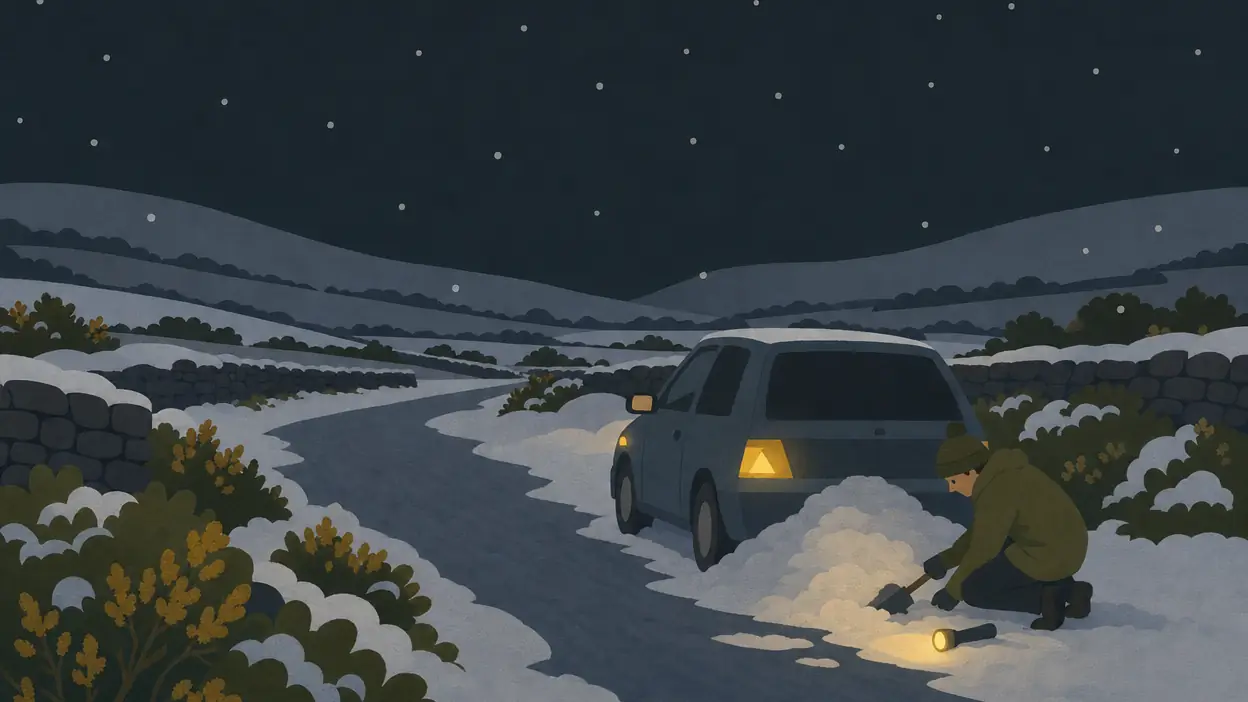
Headache, dizziness, nausea, tiredness, confusion or breathlessness inside a running car mean engine off, window open, and get medical help. Fresh air alone does not treat CO poisoning.[13]
How long the fuel lasts
An idling engine burns fuel fast, and the 10-minute routine is what makes a tank last.[14]
| What you do | 10 litres lasts about |
|---|---|
| Engine running all the time | 4 hours |
| Engine on 10 minutes in every hour | a full day |
These are examples based on the assumptions below, not a promise of how long your car will run. Fuel use and the amount in a quarter tank vary. Set off with the tank as full as possible.[8]
Lights and battery
With the engine off, lights run down the battery. Sidelights on a healthy battery can last a night, but the RAC says not to rely on it.[15] Use the hazard lights when traffic could reach you, and switch them off when nothing can.[10][4] Do not assume a short engine run will fully recharge the battery; the exhaust precautions still apply.
Phone power
A common power bank, the size of a phone and sold as “10,000”, charges a typical phone about twice from empty. This is an assumption-based example, not a tested result for your phone or power bank.
Make it last: lower the screen brightness, close apps, and switch on low-power mode. Save the battery for calls, not scrolling.
How we worked this out
A “10,000mAh” bank at 3.7 volts holds about 37 watt-hours (the UK Civil Aviation Authority’s formula: volts × mAh ÷ 1,000).[16] Assuming about 80% reaches the phone, that is about 30 watt-hours. A typical phone battery holds about 15 watt-hours, so about two full charges. Fuel: UK councils put idling at 0.6 to 2.3 litres an hour;[14] we used the higher figure, so 10 litres ÷ 2.3 = about 4 hours running, or about 26 hours at 10 minutes an hour.
Keeping warm
The HSE says hypothermia starts when body temperature falls below 35°C. Call 112 or 999 for any of: shivering; pale, cold, dry skin or blue lips; slurred speech; slow breathing; tiredness or confusion.[17]
- Move, but do not overexert. Huddle together. Drink fluids. Keep one person awake to watch for rescuers.[4]
- Warming someone: remove wet clothing, wrap them with the head covered, and give a warm non-alcoholic drink and something sugary if fully awake.[18]
- Do not rub their limbs, give alcohol, or use a hot water bottle.[18]
We could not find an Irish or UK official figure for how fast a body cools in a parked car, so this guide gives none.
Flooded road or car in water
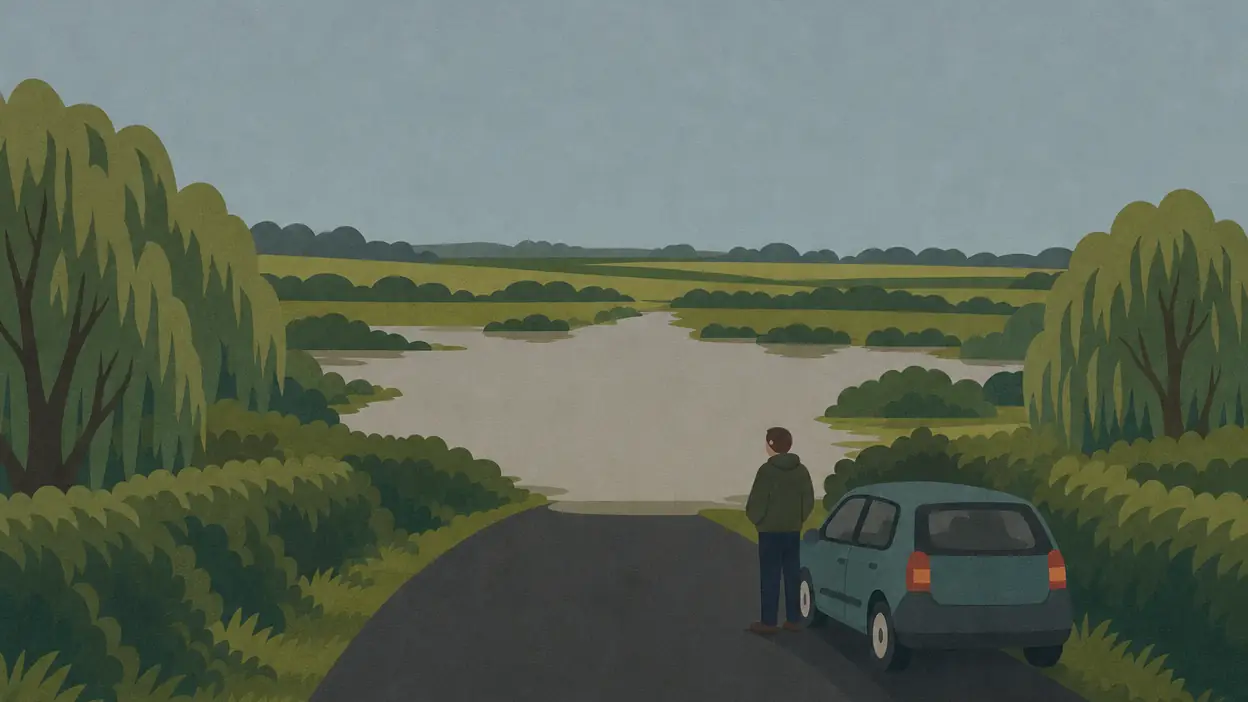
Never drive into floodwater. The water could be deeper than you think; turn round and find another route.[8][19]
The figures from official sources:
- 300mm (one foot) of flowing water can move a vehicle.[3]
- The RSA’s 2009 leaflet warns that six inches (about 150mm) of water can be enough to lose control of a small vehicle.[1]
- Even shallow water flowing at 2 metres a second can knock children and many adults off their feet.[3]
Wading out is not the safe alternative: do not walk through floodwater either.[19]
If water is rising rapidly around the car, abandon it immediately, and watch for strong currents and debris.[1] Call 112 or 999.
If you got through water, drive slowly with your foot lightly on the brake for a short distance to dry the brakes.[20]
Breaking down: motorway or rural road
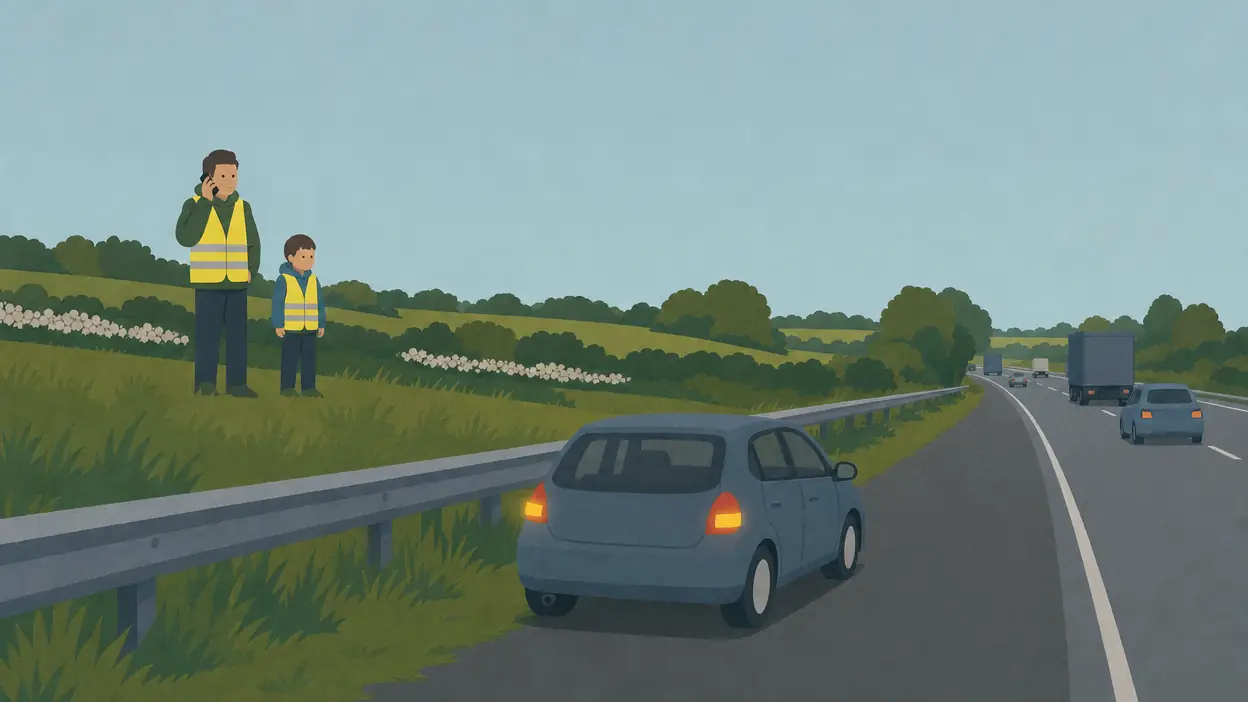
On a motorway it is an offence to stop on the hard shoulder except in an emergency such as a breakdown.[21] If you must stop there:[2]
- Pull as far left as you can and switch on hazard lights.
- No warning triangle. Placing one on a motorway may be too dangerous.
- Put on hi-vis. Leave by the left-hand door only if you can reach safety; otherwise stay belted in with hazards on.
- If you can leave safely, wait well behind the crash barrier on the embankment side, children kept close.
- Do not attempt repairs.
- Call TII’s Motorway Traffic Control Centre on 0818 715 100, or 112 or 999 in an emergency.[21][22] Read out the nearest location sign (spaced about every 500m) or the marker painted on the hard shoulder (every 100m), which also points to the nearest emergency phone.[2]
If you cannot leave safely, stay in the car with your seatbelt on and hazards flashing.[2]
TII still runs emergency roadside telephones that connect to the emergency services, often in high-risk areas.[22] Never step onto the carriageway to reach one: do not walk on the motorway.[2]
On a rural road there is often no hard shoulder.[12] Pull off the road if you can.[4] Switch on hazards and wear hi-vis: leaving the vehicle is dangerous.[8] An RSA leaflet from June 2009 gives a distance of 45 metres behind the car.[24] Place one only where you can do it without walking in the traffic lane, and never on a motorway. If nobody is hurt or at risk, call your breakdown provider.
Children, older passengers and pets
- Carbon monoxide hits the smallest first. Pets often show symptoms first; a drowsy child or dog is your early warning.[13]
- Older people are at higher risk of hypothermia.[17] Give them the blanket and the warmest seat.
- Children with hypothermia: older children get a warm drink and sugary food; babies a breastfeed or warm formula.[17] Frostbite can happen at any temperature below −0.5°C: check hands, feet, ears, nose and lips.[17]
- On a motorway, if you can leave safely, keep children under control away from the lanes; otherwise stay belted in with hazards on. Leave animals in the car unless it is an emergency, then keep them under control on the verge.[2]
After
- Get checked if you suspect CO exposure, even if you feel better.[13]
- Collision: if no Garda attended, you must report it to a Garda or station as soon as possible. Write down what happened, sign and date it.[23]
- Insurance: note the Garda’s name or number; a Garda report may be needed for the claim.[23]
- Hazards: tell the Gardaí about debris on the road. Never stop on a motorway to move it.[1]
Sources (23), all checked 2026-10-29
All checked 2026-10-28; source 2 rechecked 2026-10-29. Irish sources unless marked (UK).
- RSA, severe weather advice for road users (2009).
- RSA, motorway driving booklet (2018).
- OPW, impacts of flooding.
- (UK) Ceredigion County Council, snow and ice.
- (UK) Staffordshire County Council, winter driving.
- Met Éireann, warning system explained.
- RSA, severe weather campaign.
- Office of Emergency Planning, road safety guide.
- RSA, top 10 tips for driving in snow and ice.
- An Garda Síochána, adverse weather conditions.
- Retail price provenance is held in the internal source record; equipment options are on the kit pages.
- Department of Transport, driving in Ireland.
- HSE, carbon monoxide poisoning.
- (UK) Renfrewshire Council, idling; Cornwall Council, vehicle idling.
- (UK) RAC, parking lights.
- (UK) Civil Aviation Authority, battery watt-hours. Calculations use stated assumptions.
- HSE, keeping warm in winter, winter and older people and looking after children in winter.
- (UK) NHS, hypothermia.
- Department of Defence, flooding advice.
- RSA, top tips for wet, flooded and windy conditions.
- RSA, TII and An Garda Síochána, motorway safety campaign.
- TII, motorway emergency service 0818 715 100 and network management, emergency roadside telephones.
- Citizens Information, motor vehicle collisions.
prepared.ie is independent public information, published by Gallan Software. It is not affiliated with the Government of Ireland, Met Éireann, the RSA or any agency. In an emergency call 112 or 999. 24. RSA, towing a trailer or caravan leaflet (June 2009).