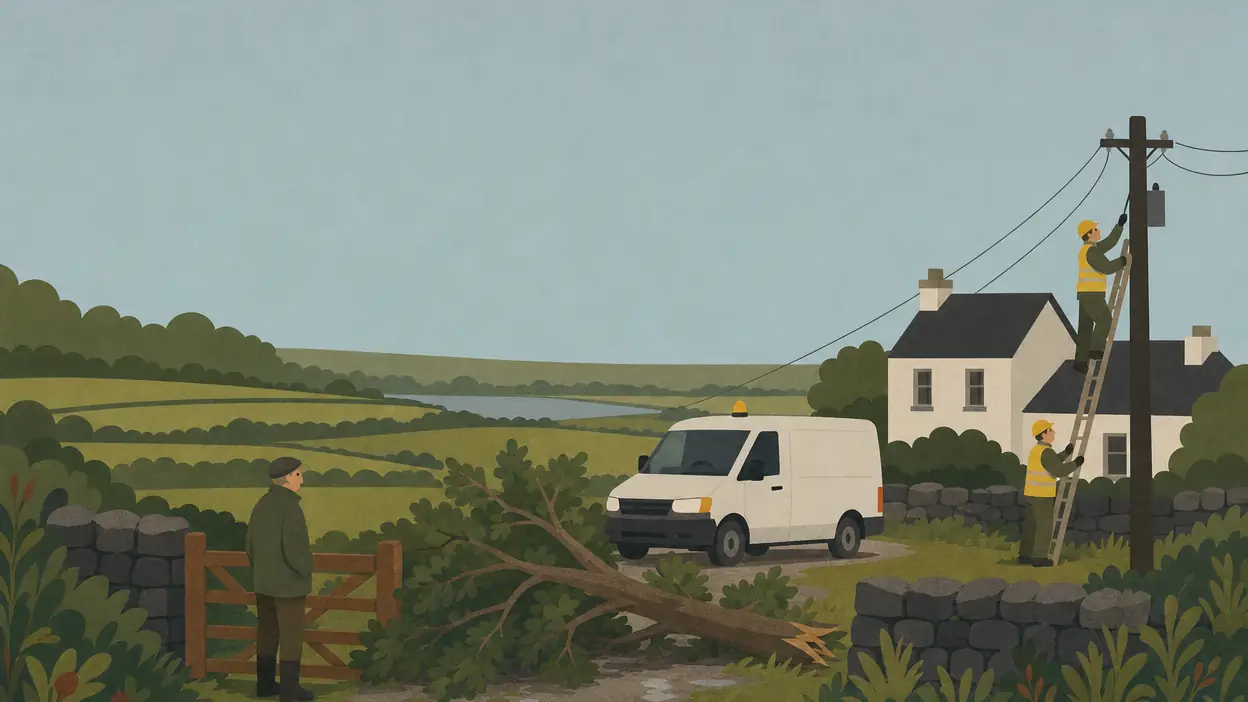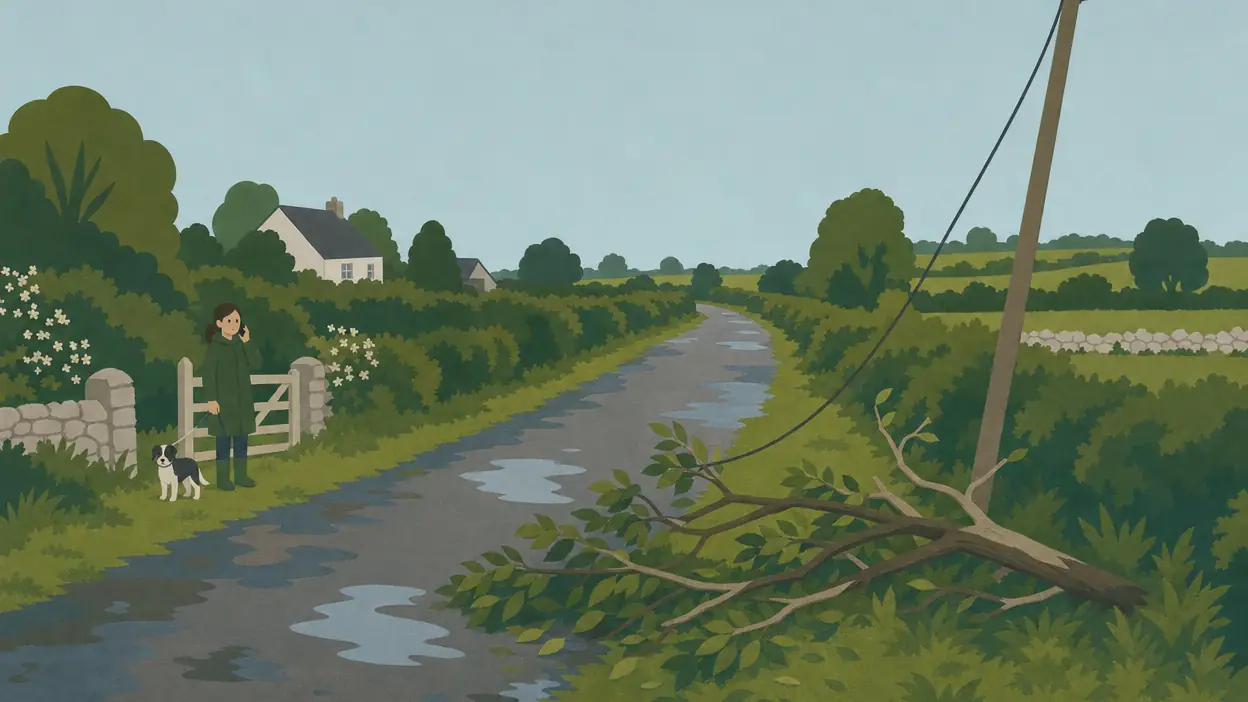
First: is a wire involved?
Look before you go near anything. A wire can be hidden under branches, and a tree lying on a line can hold it under tension.[3] ESB Networks’ instructions are short:[1]
- “Keep away and contact the ESB Networks immediately at 1800 372 999.”
- “Never approach or handle fallen electricity wires.”
- “Assume electricity wires are always live.”
ESB Networks also warns that “electricity can jump gaps”, so you do not have to touch a wire to be “seriously injured or killed”.[5] Its tree leaflet says that if a tree has brought a wire down, or is leaning across one, “do not approach”.[6]
ESB Networks also lists 021 238 2410 for trees on or over its lines.[5] If someone has been hurt or is in danger, call 112 or 999.
Cannot make a voice call? Text 112.
The emergency text service can be used by "anyone who is not able to make a voice call due to a speech or hearing impairment or other situations where a voice call might not be possible". It works "from any Irish registered mobile phone (either pre-pay or bill pay) on all the Irish Mobile networks". If you can talk, ring instead: a text is slower.
Your text needs four things:
- Which service: Ambulance, Coastguard, Fire or An Garda Síochána.
- What the problem is.
- County you are texting from.
- Where help is needed: town, road, Eircode or a landmark.
Wait for a reply: "an SMS/Text 'Delivery Report' does not mean your message has been received". If no reply comes within 3 minutes, send another message straight away. It does not work from a foreign phone, or from an Irish phone roaming abroad, including in Northern Ireland.
No registration is needed. 112.ie says: "There is no preparation or registration required to use either Emergency SMS, or RTT when contacting the ECAS." If you might need to text one day, you can choose to give the service your address, access details and a next of kin in advance at 112.ie/register. Most smartphones can also use Real-Time Text to type during a call to 112 or 999: turn on RTT in your phone’s accessibility settings.
Source: 112.ie, emergency text service, sending a text to 112, SMS questions and answers, emergency SMS terms and conditions and Real-Time Text pages, checked 1 November 2026.
Is it an electricity line or a phone line?
People often mix them up. ESB Networks says you can recognise its electricity lines by a “yellow danger plate attached to side of the pole” and “no footholds at the top of the pole”.[5] If you are not sure, treat it as an electricity line and ring ESB Networks. The HSA says to assume any cable brought down by a tree is live.[3]
ESB Networks says fallen wires are never safe to touch or handle.[2] For any storm-damaged tree, the Health and Safety Authority (HSA) advises you not to clear or fell it unless you are fully competent and experienced, and to contact your local authority instead.[3] If you have no chainsaw training and protective gear, hire someone who has.[3][4]
Leave it to the people with training
A storm-damaged tree is not the same job as cutting logs. The HSA says the most common cause of chainsaw deaths “arises from felling storm damaged trees and clearing branches during clean-up operations”.[3]
Its advice to anyone who comes across fallen or storm-damaged trees, quoted in full:[3]
“The HSA advises anyone encountering fallen or storm damaged trees not to try to clear or fell such trees unless they are fully competent and experienced in that type of work activity. Instead, they should contact their local authority who have trained crews with specialist equipment to deal with storm damaged and windblown trees.”
The HSA also says: “Do not walk or work under unstable windblown trees.”[3] We do not describe how to cut a windblown tree. The HSA’s felling advice is written for trained operators, and reading it is not the same as being trained.
Chainsaws: training first, then the gear
The HSA is plain about who should pick up a chainsaw:[3]
“If you do not have the competency and training required and do not have the correct personal protective equipment (PPE) for chainsaw work activities, then you should not be operating a chainsaw. You should engage the services of a competent chainsaw operator.”
What the HSA says about training:
- To fell a tree, you “must have successfully completed an accredited chainsaw training course suitable for the chainsaw work to be done”.[3]
- A basic course covering the felling of small trees is about 5 days. Shorter 2-day courses cover maintenance and cross cutting only, and “do not demonstrate the techniques required for felling trees safely”.[3]
- Courses should meet the standards laid down by QQI (Quality and Qualifications Ireland).[3]
What the HSA lists as protective equipment, “no matter how small the job”:[4]
- A safety helmet (EN 397), a visor (EN 1731) or safety glasses (EN 166), and ear defenders (EN 352).
- Chainsaw gloves with a protective pad on the back of the left hand (EN 381-7).
- Chainsaw trousers with clogging material (EN 381-5).
- Safety boots with steel toecaps and a good grip (EN 381/345).
- Non-snag, close-fitting outer clothing.
Buying the gear does not make an untrained person safe. The HSA says “PPE doesn’t protect you against falling trees”.[4] It also says never work on your own, keep bystanders at a safe distance and tell someone when you expect to be back.[3]
Who clears what
| Where the tree is | Who to contact |
|---|---|
| Touching, leaning on or near an electricity wire | ESB Networks, 1800 372 999. ESB Networks says that “under no circumstances” should you or anyone on your behalf try to remove the hazard yourself.[5] |
| Blocking a public road | Your county or city council’s roads section. The owner or occupier of the land the tree grew on has a legal duty to keep roadside trees from being a hazard to road users.[7] Longford County Council, for example, says landowners pay for removing fallen trees from public roads.[8] |
| In your own garden, clear of any wire | You, or a tree surgeon you hire. If it is storm-damaged and you are not trained, the HSA says to get someone who is.[3] |
| A neighbour’s tree on your side | Talk to your neighbour and both insurers before anyone cuts. Photograph it first (see After the storm). |
If you have to drive while trees and lines are down, see Driving in a storm.
Trees near lines before the next storm
Do not cut or trim near a line yourself, even in calm weather. ESB Networks says: “Under no circumstances should you or your tree surgeon attempt to cut the trees or branches within 6 meters of the electricity network yourself.”[5]
Instead:[5]
- Apply for a free tree cutting assessment through your ESB Networks online account if trees are within 6 metres of wires or equipment.
- A crew assesses the site within 4 to 6 weeks, and decides whether you or ESB Networks must cut. There is no charge to you for essential tree cutting.
- If you use your own tree surgeon, you still contact ESB Networks first, as the supply may need to be switched off.
ESB Networks also advises keeping a clear falling distance of twice the tree’s height from any electricity poles or overhead wires when felling, and doing all tree work in daylight.[5]
Which situation are you in?
A branch across the drive the morning after. Look for wires first, including along the hedge and at the pole. If there are none and it is small enough to move by hand, wear gloves and lift it clear. If it needs a saw and is under tension, leave it for someone trained.[3]
A tree on the garden fence, with a line sagging over it. Do not go near it. Keep children and pets indoors and ring 1800 372 999.[1][5]
A neighbour with a new chainsaw. Ask whether they have done a course. The HSA says that without training and the right gear, “you should not be operating a chainsaw”.[3] A first aid kit with large wound dressings should be close by for any chainsaw work.[3]
A leaning conifer over the shed roof. A leaning, storm-damaged tree is exactly what the HSA tells untrained people to leave alone.[3] Do not stand under it or climb onto the shed. If a line runs anywhere near it, ESB Networks must be told first.[5] See Ladders, roofs and gutters before anyone goes up to look at roof damage.
The storm is still blowing. Wait. The official Be Winter Ready booklet’s storm advice for farms says not to attempt repairs until the storm has fully passed, because “undertaking repairs during a storm will highly likely lead to a serious incident”.[9]
Hiring someone
Ask to see the person’s chainsaw training certificate: the HSA’s standard is an accredited course with an assessment suitable for the work.[4] If the job is within 6 metres of a line, ESB Networks must be contacted first.[5] Keep the receipt for your insurer (see After the storm).
Kit
| What | Why |
|---|---|
| Free or already in the house: ESB Networks’ number saved in your phone, and gloves you already own | So you can report a fallen wire at once and move small branches by hand.[1] |
| Torch kit options: Head torch | Storms bring down trees after dark. ESB Networks says to do tree work in daylight, so use the torch to look, not to cut.[5] |
| First aid kit kit options: Household first aid | The HSA says a first aid kit with large wound dressings should be readily available for chainsaw work.[3] |
We do not recommend chainsaw trousers, boots or helmets as a purchase on their own. The HSA’s position is training first, then the full set of protective equipment.[3][4]
Common questions
What should I do if a tree has fallen on an electricity line?
Keep away, keep others away and ring ESB Networks on 1800 372 999, and assume the wires are always live.[1] ESB Networks says you should never attempt to remove the tree hazard yourself.[5]
Can I cut branches growing near ESB wires?
No: ESB Networks says not to cut trees or branches within 6 metres of the electricity network yourself, and offers a free tree cutting assessment instead.[5]
Who removes a fallen tree from a public road?
Report it to your council’s roads section, because the owner or occupier of the land the tree grew on has a legal duty to keep roadside trees from being a hazard to road users.[7]
Do I need training to use a chainsaw after a storm?
The HSA advises anyone who is not fully competent and experienced not to clear or fell storm-damaged trees, and to contact their local authority instead.[3] To fell a tree, the HSA says you must have completed an accredited chainsaw course suitable for the work.[3]
Data sources (10), all checked 2026-11-01
Footnotes
-
ESB Networks, Report a fallen wire. Instructions quoted verbatim. Checked 2026-11-01. ↩2 ↩3 ↩4 ↩5
-
ESB Networks, Stay safe. “Fallen wires are never safe to touch or handle.” Checked 2026-11-01. ↩
-
Health and Safety Authority, Guidance on Safe Use of Chainsaws. Sections “Adverse Weather and Fallen Trees”, “Training in the Safe use of the Chainsaw”, “Fitness to operate a Chainsaw” and “Summary” quoted verbatim. Read with pdftotext; checked 2026-11-01. ↩ ↩2 ↩3 ↩4 ↩5 ↩6 ↩7 ↩8 ↩9 ↩10 ↩11 ↩12 ↩13 ↩14 ↩15 ↩16 ↩17 ↩18 ↩19 ↩20 ↩21
-
Health and Safety Authority, Chainsaw Safety Training Advice Information Sheet, September 2015. Protective equipment list and training standard. Checked 2026-11-01. ↩ ↩2 ↩3 ↩4 ↩5
-
ESB Networks, Tree cutting assessment. Safety guidelines, safety advice, the 6 metre rule and the frequently asked questions quoted verbatim. Checked 2026-11-01. ↩ ↩2 ↩3 ↩4 ↩5 ↩6 ↩7 ↩8 ↩9 ↩10 ↩11 ↩12 ↩13
-
ESB Networks, Tree and vegetation trimming leaflet. Read with pdftotext; checked 2026-11-01. ↩
-
Roads Act 1993, section 70, dangerous structures, trees, etc., subsection (2). Checked 2026-11-01. ↩ ↩2
-
Longford County Council, Roads Act 1993 (Section 70): dangerous structures, trees etc.. One council’s notice, given as an example; check your own council. Checked 2026-11-01. ↩
-
Government of Ireland, Be Winter Ready booklet, “Storm safety on the farm”. Checked 2026-11-01. ↩
-
112.ie, SMS questions and answers. Who can use the emergency text service. Checked 2026-11-01. ↩
prepared.ie is independent and is not affiliated with the Government of Ireland, ESB, the HSA or any agency. In an emergency, call 112 or 999.[10]