The checks you can do from the ground
November is the time to look, before the winter storms. Pick a dry, calm day and walk round the house.
- Slates and tiles. Look for any that have slipped, cracked or gone missing. A pair of binoculars helps if you have them.
- Gutters and downpipes. Watch them in heavy rain. Water spilling over the edge, or a downpipe that stays dry, usually means a blockage.
- Flashing and ridge. Look along the ridge, and where the roof meets the chimney or a wall, for anything lifted or loose.
- The attic. On a dry day, look up at the underside of the roof with a torch for daylight, damp patches or water marks.
- The chimney. If you use an open fire or stove, have the chimney swept before the first fire. Gas Networks Ireland says to make sure “all chimneys and flues are regularly swept and kept clear”.[2] See Carbon monoxide and fire at home.
The official Be Winter Ready booklet’s storm advice for farm buildings is a fair checklist for any house: make sure gutters are secure, drains are free of debris and the outfall is clear, and roof sheets are secure.[3]
Anything you find on the roof itself is a job for a roofer.
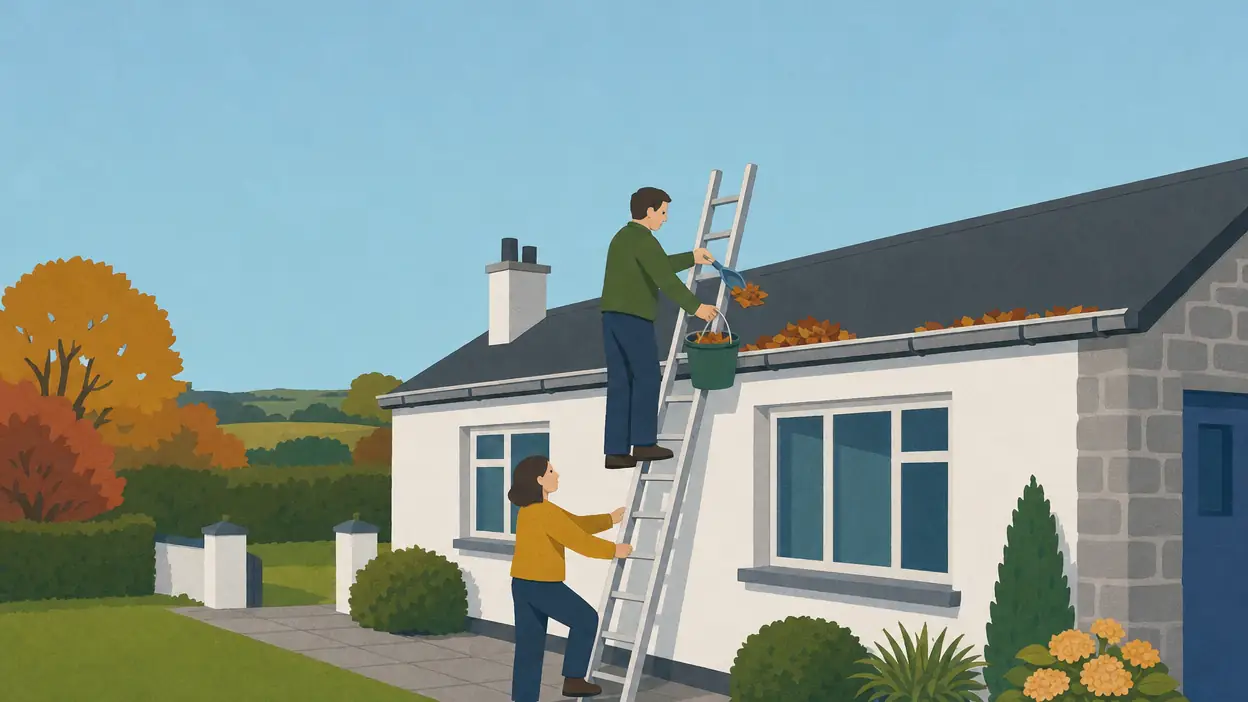
The Health and Safety Authority (HSA) says falls from ladders account for “numerous serious and fatal injuries each year”.[1] If you do use a ladder, its rules include firm level ground, an angle of 75 degrees (1 out for every 4 up), securing the ladder, keeping three points of contact, not overreaching and not working on the top three rungs.[1]
When a ladder is the wrong tool
The HSA’s first message on work at height is “Avoid work at height wherever possible”.[4] Its ladder sheet says to use a ladder only:[1]
- for work of short duration: “ladders are not suitable where they are in one position for 30 minutes or more”;
- for “light work”, and not for work that involves carrying heavy or awkward tools;
- where a handhold is available and you can keep three points of contact.
So a ladder may suit a quick look at a gutter on a bungalow. It does not suit a day of clearing gutters on a two-storey house, or any work on the roof. For that, a roofer will use a tower, a scaffold or a lift.
The Be Winter Ready booklet’s advice for farm roofs goes further. It says: “When working at heights always hire in suitable lifting equipment”, and to “never work off a ladder”.[3]
If you do use a ladder: the HSA’s rules
The HSA’s Work at Height Regulations do not cover private individuals working on their own homes.[5] Its ladder sheet, though, is written for “anyone who uses a ladder”.[1] These are its rules, in its own words where it matters.
Before you climb
- Check for “cracked or bent stiles or rungs”, corrosion, and “defective or missing fittings or ties”.[1]
- “Ensure ladders are of sufficient strength/class for the job.” If you are not sure, ask the supplier or maker.[1]
Setting it up
- “Set up the ladder on firm level ground.” Never on a movable surface such as pallets or blocks.[1]
- “Do not lean the ladder against a surface that may be slippy or not robust enough (gutter or glass).” The HSA names stand-offs or spreader bars as an alternative.[1]
- “The correct angle for a ladder is 75 degrees or the 1 in 4 rule”: 1 unit out from the wall for every 4 units up.[1]
- Secure it. The HSA says tying both stiles at the top is best, or use a ladder stabilising device as the maker instructs.[1]
- If you step off at the top, the ladder should extend about 1 metre past the landing point.[1]
- Think about the weather and about overhead lines before you set up.[1] ESB Networks warns that electricity can jump gaps, so you do not need to touch a wire to be hurt.[6]
On the ladder
- Keep “three points of contact (hands and feet)”.[1]
- “Do not overreach, keep your belt buckle between the stiles, both feet on same rung.”[1]
- “Do not work on top three rungs, or top two steps for stepladders.”[1]
- “Do not move a ladder while standing on the rungs”, and do not extend it while standing on it.[1]
- Grip the stiles while climbing. Do not carry heavy or awkward loads.[1]
The HSA adds a step most people skip: plan how someone would be rescued if you fell.[1] At the very least, do not work alone: have someone stay within call. Someone holding the foot of the ladder is not a substitute for tying it; the HSA says securing at the top is best.[1]
Roofs you should never stand on
The HSA counts working on a flat roof, or near fragile materials, as work at height.[5] Its ladder sheet warns against leaning a ladder on glass.[1]
Do not stand or kneel on:
- a conservatory roof, whether glass or plastic;
- a roof light or skylight;
- old corrugated or cement sheet roofs on sheds and garages.
If leaves are lying on a conservatory roof, clear them from the side with a long-handled brush, or leave it to someone with the right access.
After a storm
Wait until the storm has fully passed. The Be Winter Ready booklet says: “Undertaking repairs during a storm will highly likely lead to a serious incident.”[3]
If a slate or tile has come down, keep people away from that side of the house until a roofer has looked. Photograph the damage from the ground for your insurer before anything is repaired (see After the storm).
If a tree or branch has come down near a line, do not set a ladder anywhere near it. See clearing fallen trees and power lines after a storm.
Which situation are you in?
A dry October weekend, and the gutter overflowed in the last storm. On a single-storey house, a short job from a secured ladder at the right angle may be reasonable. On anything higher, or if it will take more than half an hour, the HSA’s sheet points to other equipment, so get a quote.[1]
A slate in the garden. Keep clear of that side of the house, photograph it, and call a roofer. Do not go up to look.
A neighbour offers you their long ladder. Check it first for cracked or bent stiles or rungs and missing fittings, and check it is strong enough for you and the job.[1] On a long ladder against a high wall, three points of contact and securing the top matter most.
Leaves lying on the conservatory roof. Never climb onto it. Clear from the side, or leave it.
Hiring a roofer
If you pay someone to work on your roof, the Work at Height Regulations apply to them. The HSA says that work must be properly planned, use the right equipment and be done by competent people, with risks from fragile surfaces controlled.[5] Ask how they will get up there. “A ladder” is the wrong answer for most roof work.
Kit
| What | Why |
|---|---|
| Free or already in the house: binoculars if you have them, a friend to stay within call, and a phone to take photos | Most pre-winter checks can be done from the ground, and the HSA’s rules assume you are not working alone.[1] |
| Torch kit options: Head torch | To check the underside of the roof in the attic for damp and daylight. |
A ladder stand-off or stabiliser keeps the ladder off the gutter and widens its base, and the HSA names stand-offs as an option.[1] It does not stop a fall, and it must suit your ladder. We have not picked one yet. We do not recommend a particular ladder, because the right one depends on the house and the job.
Cannot make a voice call? Text 112.
The emergency text service can be used by "anyone who is not able to make a voice call due to a speech or hearing impairment or other situations where a voice call might not be possible". It works "from any Irish registered mobile phone (either pre-pay or bill pay) on all the Irish Mobile networks". If you can talk, ring instead: a text is slower.
Your text needs four things:
- Which service: Ambulance, Coastguard, Fire or An Garda Síochána.
- What the problem is.
- County you are texting from.
- Where help is needed: town, road, Eircode or a landmark.
Wait for a reply: "an SMS/Text 'Delivery Report' does not mean your message has been received". If no reply comes within 3 minutes, send another message straight away. It does not work from a foreign phone, or from an Irish phone roaming abroad, including in Northern Ireland.
No registration is needed. 112.ie says: "There is no preparation or registration required to use either Emergency SMS, or RTT when contacting the ECAS." If you might need to text one day, you can choose to give the service your address, access details and a next of kin in advance at 112.ie/register. Most smartphones can also use Real-Time Text to type during a call to 112 or 999: turn on RTT in your phone’s accessibility settings.
Source: 112.ie, emergency text service, sending a text to 112, SMS questions and answers, emergency SMS terms and conditions and Real-Time Text pages, checked 1 November 2026.
Common questions
What is the correct angle for a ladder?
The HSA says the correct angle is 75 degrees, or the 1 in 4 rule: 1 unit out from the wall for every 4 units up.[1]
Which rungs should I not stand on?
The HSA says not to work on the top three rungs of a ladder, or the top two steps of a stepladder unless it has a proper handrail.[1]
Can I lean a ladder against the gutter?
No: the HSA says not to lean a ladder against a surface that may not be strong enough, such as a gutter or glass, and names stand-offs or spreader bars as an alternative.[1]
Should I fix my roof during a storm?
No: the Be Winter Ready booklet says repairs during a storm will highly likely lead to a serious incident, so wait until it has fully passed.[3]
Data sources (6), all checked 2026-11-01
Footnotes
-
Health and Safety Authority, Using Ladders Safely information sheet (publication page), updated November 2014. Rules quoted verbatim. Read with pdftotext; checked 2026-11-01. ↩ ↩2 ↩3 ↩4 ↩5 ↩6 ↩7 ↩8 ↩9 ↩10 ↩11 ↩12 ↩13 ↩14 ↩15 ↩16 ↩17 ↩18 ↩19 ↩20 ↩21 ↩22 ↩23 ↩24 ↩25 ↩26 ↩27
-
Gas Networks Ireland, Carbon monoxide. Checked 2026-11-01. ↩
-
Government of Ireland, Be Winter Ready booklet, “Storm safety on the farm”. Checked 2026-11-01. ↩ ↩2 ↩3 ↩4
-
Health and Safety Authority, Work at height top tips. Checked 2026-11-01. ↩
-
Health and Safety Authority, Working at height. Examples of work at height, requirements for employers, and the exception for private individuals working on their own homes. Checked 2026-11-01. ↩ ↩2 ↩3
-
ESB Networks, Tree cutting assessment. “Electricity can jump gaps.” Checked 2026-11-01. ↩
prepared.ie is independent and is not affiliated with the Government of Ireland, the HSA or any agency. In an emergency, call 112 or 999.