Read the warning for your area
Open Met Éireann’s warnings and read the affected area, weather type and start and end times. Check again before travelling: warnings can change as the forecast develops. A storm name alone does not tell you the conditions at your home.[2]
| Warning | What it means for your plans |
|---|---|
| Yellow | Local conditions or your activity may put you at risk. Check your exposure and avoid unnecessary risks. |
| Orange | Dangerous weather may seriously disrupt people and property. Prepare now and reconsider journeys and events. |
| Red | Exceptionally dangerous conditions. Take protective action and follow the authorities’ instructions. |
These are Met Éireann’s warning categories, summarised in plain language. Read the individual warning as well as the colour.[2]
During a red warning, shelter indoors and follow official instructions. Stay away from fallen wires, flooded roads and exposed coasts.[1]
Get your kit together before storm day
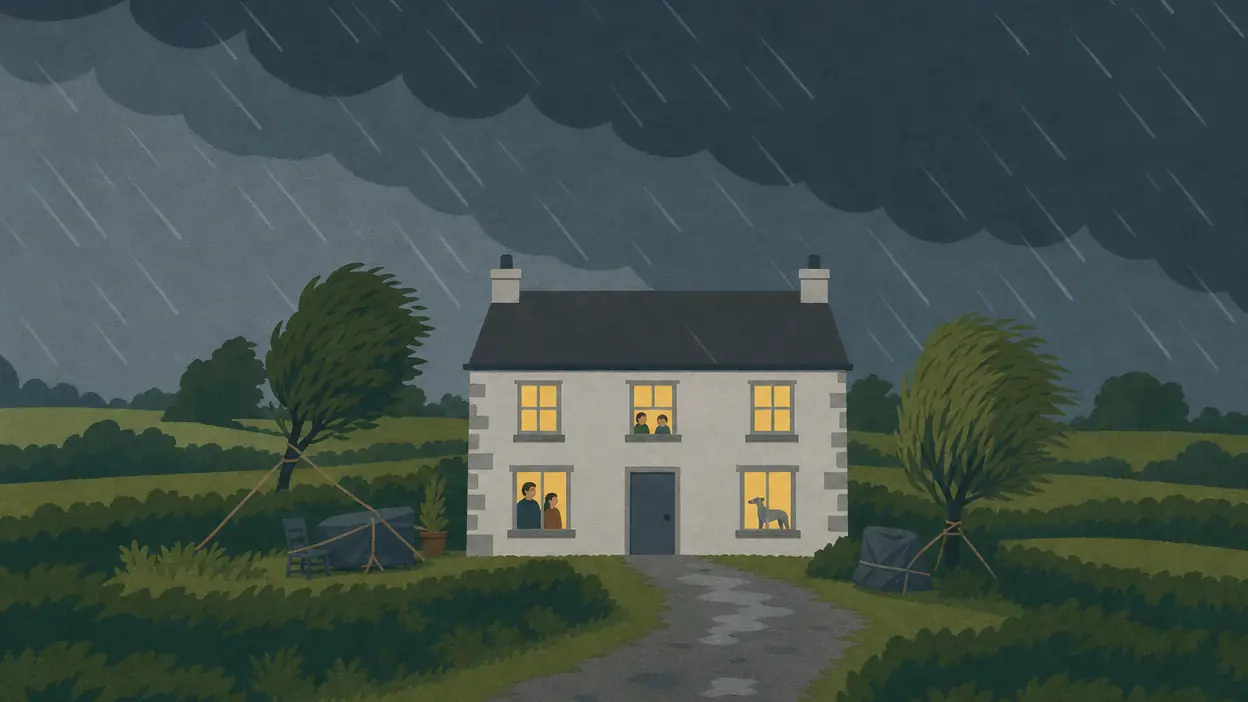
Do outdoor preparation while conditions are safe. Bring in or secure bins, plant pots and garden furniture. Secure shed doors and close windows and external doors. Leave roof work and other jobs at height to an appropriate professional; the Met Office advises against attempting storm repairs during the storm.[3][4]
Make gathering your essentials a family kit project on a quiet weekend. Start with what you already have. Try finding each item as you work through the list, then put everything where you can find it in the dark:[5]
- Charge your phone and power bank. Put the right charging lead beside them.
- Check your torch and spare batteries. See the equipment categories linked at the end of this guide.
- Set out a battery or wind-up radio. See the equipment categories linked at the end of this guide.
- Check drinking water and food that does not depend on refrigeration.
- Keep regular medicines, prescription details and important numbers together.
- Put identification and insurance details in a waterproof pouch.
- Include food and other essentials for babies and animals.
The official checklist gives 2 to 3 litres of drinking water per person per day. Cooking and washing need additional water. See Water outages and boil water notices for quantities and safe use.[5]
Talk the plan through together
Have a chat before bad weather about checking in with someone who lives alone or needs help. Agree the arrangements and write down the contact details, rather than leaving the only copy online. Talk through who could help if you had to leave and what you would take. Include medication, a phone and charger, warm clothing and essential documents in your plan.[5]
If anyone relies on electrical medical equipment, agree an outage plan with their healthcare team before bad weather. Register through your electricity supplier and keep the contact details current. ESB Networks offers additional communications and support, but faults can still occur.[6]
If you live in supported accommodation or temporary housing, speak to the service provider about the emergency arrangements.[5]
While the storm is passing
Stay indoors where advised and keep away from windows. Do not go out to watch waves, check a fallen tree or retrieve something that has blown away. Trees, walls and electricity lines can fall. Keep away from piers, cliffs and exposed coastal areas.[1]
For information, use the official warning and your local radio. Share the original source when passing on an update. The emergency booklet recommends keeping a radio available and staying connected with neighbours.[5]
If the lights go out
Use PowerCheck for outage information and estimated restoration times. Report a fault that is not listed, or a dangerous electricity situation, to ESB Networks on 1800 372 999. Never approach or touch a fallen wire; assume it is live.[7]
Read Power cuts in Ireland: what to do for switching off appliances, food safety and heating. Do not bring a generator, barbecue or outdoor heater indoors. They can produce poisonous carbon monoxide.[8]
When the wind eases
If your home is damaged, see After the storm: damage, claims and financial help before starting a claim or arranging major repairs. If flooding is the problem, use the separate flooding guide.
Booklet material used: household supplies, written contacts, neighbour planning and evacuation essentials are adapted from the Office of Emergency Planning’s Be Emergency Ready booklet and checklist.[5]
prepared.ie is independent and is not affiliated with the Government of Ireland, Met Éireann, ESB or any agency. In an emergency, call 112 or 999.[5]
Sources (8), all checked 2026-10-28
Footnotes
-
Office of Emergency Planning, Storms. Checked 2026-10-28. ↩2 ↩3 ↩4 ↩5
-
Met Éireann, Warning system explained. Checked 2026-10-28. ↩2 ↩3 ↩4
-
UK Met Office, Five tips for staying safe in strong wind. Checked 2026-10-28. ↩2
-
UK Met Office, Stay safe in a storm. Checked 2026-10-28. ↩ ↩2
-
Office of Emergency Planning, Be Emergency Ready booklet and resources and household checklist. Supplied PDFs read with pdftotext; checked 2026-10-28. ↩ ↩2 ↩3 ↩4 ↩5 ↩6 ↩7 ↩8
-
ESB Networks, Vulnerable customers. Checked 2026-10-28. ↩
-
ESB Networks, Storm Austen preparedness advice and PowerCheck. Safety and reporting guidance checked 2026-10-28; no live outage status reproduced. ↩ ↩2
-
Gas Networks Ireland, Severe weather advice. Checked 2026-10-28. ↩