First, check your supply and the exact notice
Use Uisce Éireann’s water-quality checker to check your address. For a public-supply outage or query, call 1800 278 278. Keep the relevant notice available for everyone in the household.[3][4][5]
If you use a private well or group water scheme, identify the operator rather than assuming a public-supply notice covers you. Householders manage individual wells; local authorities regulate group schemes and other regulated private supplies.[6]
Read the notice’s wording carefully. Water being available at the tap does not override a restriction issued for the supply.[2][3]
| Notice | What it means |
|---|---|
| Boil Water Notice | Follow the boiling instructions before consuming the water.[2] |
| Do Not Consume Notice | Use another safe source for consumption. Boiling is not a remedy.[3] |
| Do not use for any purpose | Do not use the tap water, including for bathing or flushing toilets.[3] |
During a boil water notice, use properly boiled water for drinking, brushing teeth, ice and uncooked food.[2] A Do Not Consume notice is different: boiling will not make that water safe to drink.[3]
Build your water supply a little at a time
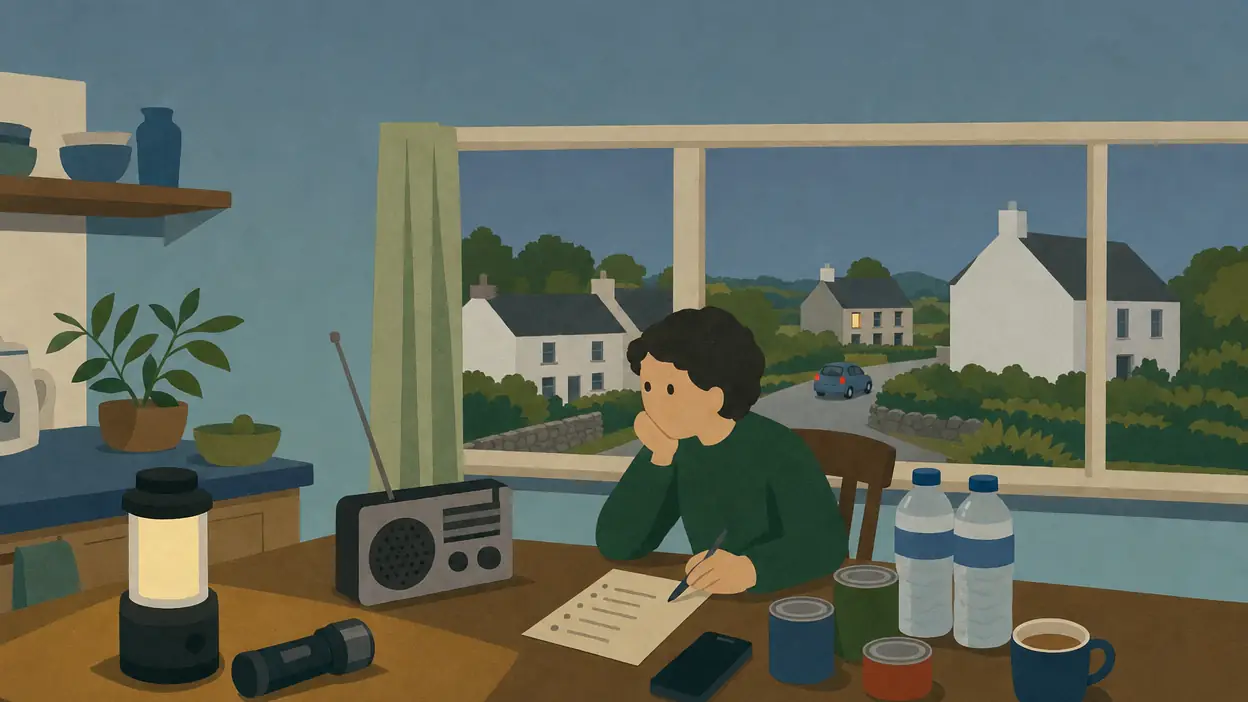
The Irish emergency checklist’s 2 to 3 litres per person each day is drinking water, not the whole household’s daily water requirement. Start by choosing a storage period that fits your circumstances. Use the table to plan your own small water-storage project. The three-day example is a planning choice, not an Irish government duration requirement.[1]
| People | Drinking water for one day at 3 litres each | Drinking water for three days |
|---|---|---|
| 1 | 3 litres | 9 litres |
| 2 | 6 litres | 18 litres |
| 4 | 12 litres | 36 litres |
These totals are simple calculations using the upper end of the official drinking-water figure. Allow separately for food preparation, washing, medical needs and animals. The table is a storage calculation, not feeding advice for babies or a replacement for an individual medical fluid plan.[1][5][7]
Give your bottled water a cool, dark home and follow the expiry date. Make checking it part of your normal shopping routine. Replace the bottles you use and enjoy having that job ticked off.[1]
See the equipment categories linked at the end of this guide.
What to do during a boil water notice
Uisce Éireann says to bring water to a vigorous boil for one minute, then cool it for ordinary drinking use. Store it in a clean container in a cool place. Keep boiling water out of children’s reach.[2]
Use boiled and cooled water for:[2]
- Drinking and mixing drinks.
- Brushing teeth and gargling.
- Washing fruit or salad that will be eaten uncooked.
- Making ice. Discard existing ice made from the affected supply.
- Pets’ drinking water.
Water from the hot tap is not a substitute. An ordinary home water filter does not guarantee safety.[2]
Baby formula needs a separate preparation step
Ready-to-feed formula needs no added water and is an option during a notice. Keep feeding equipment clean and sterilised. If you use powdered formula, follow the HSE preparation instructions: powder is not sterile.[2][7]
During a boil notice, properly boiled tap water or boiled bottled water can be used. Do not let water cool to room temperature before mixing powdered formula. HSE instructions say to boil one litre, leave it cooling for no more than 30 minutes, and use it while it is at least 70°C. Then cool the prepared feed to a safe feeding temperature.[2][7]
Use the exact water and powder amounts on the formula instructions. Bottled water also needs boiling for powdered formula; choose still water and avoid natural mineral water where another suitable water is available.[7]
Under a Do Not Consume notice, do not use tap water for formula, even after boiling. Use suitable boiled bottled water or ready-to-feed formula. If you have neither a safe way to prepare feeds nor suitable ready-to-feed formula, get prompt advice from your public health nurse or healthcare service.[3][7][8]
Washing, bathing and toilets
A standard boil water notice generally allows bathing, showering and toilet flushing. Do not swallow the water. Take extra care with babies and small children; a sponge bath can reduce the chance of swallowing bathwater. Follow any stricter instructions in your local notice.[2][3]
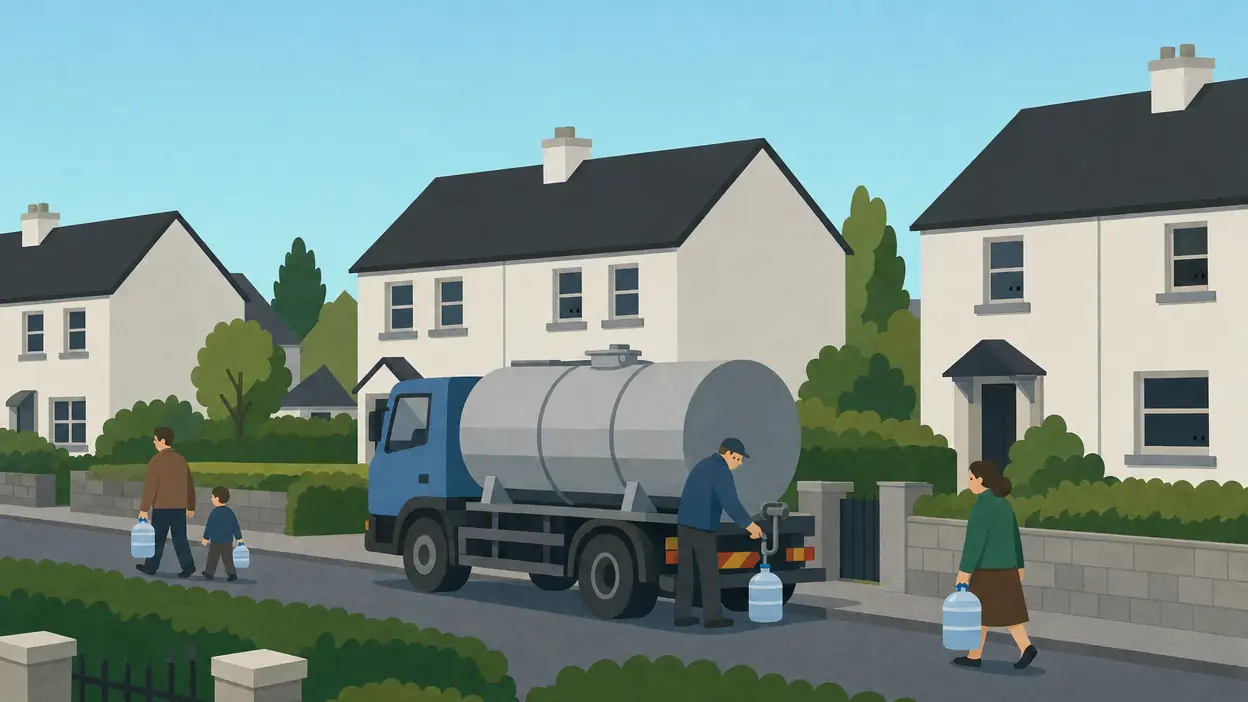
If an alternative public water tanker is provided, boil and cool its water before drinking or preparing food. The fact that it comes from a tanker does not remove that step.[3]
If power is also off
Plan how you will get safe drinking water without relying on an electric kettle. Stored bottled water and suitable ready-to-feed formula can reduce that dependency. Follow the power-cut guide, and do not bring outdoor cooking equipment inside to boil water.[1][8][9]
If a medical condition makes you critically dependent on water, ask Uisce Éireann about its Priority Services Register. It also has a Special Services Register for customers needing additional support. You can nominate another contact.[5]
Booklet material used: drinking-water quantities, bottled-water storage and ready-to-feed formula are adapted from Be Emergency Ready.[1]
prepared.ie is independent and is not affiliated with the Government of Ireland, Met Éireann, ESB or any agency. In an emergency, call 112 or 999.[1]
Sources (9), all checked 2026-10-28
Footnotes
-
Office of Emergency Planning, Be Emergency Ready booklet and resources and household checklist. Supplied PDFs read with pdftotext; checked 2026-10-28. ↩2 ↩3 ↩4 ↩5 ↩6 ↩7
-
Uisce Éireann, Boil Water Notice. Includes HSE advice; checked 2026-10-28. ↩ ↩2 ↩3 ↩4 ↩5 ↩6 ↩7 ↩8 ↩9
-
Uisce Éireann, Do Not Consume notices. Includes tanker and do-not-use guidance; checked 2026-10-28. ↩ ↩2 ↩3 ↩4 ↩5 ↩6 ↩7 ↩8
-
Uisce Éireann, Water quality checker. Checked 2026-10-28; no live notice status reproduced. ↩
-
Uisce Éireann, Vulnerable customer registers and contact details. Checked 2026-10-28. ↩ ↩2 ↩3
-
EPA, Drinking-water supply types and responsibilities. Checked 2026-10-28. ↩
-
HSE, Preparing baby formula. Checked 2026-10-28. ↩ ↩2 ↩3 ↩4 ↩5
-
HSE Health Protection Surveillance Centre, Flooding: drinking water and infant formula. Checked 2026-10-28. ↩ ↩2
-
Gas Networks Ireland, Severe weather advice. Checked 2026-10-28. ↩