A charged phone still needs a working network
Mobile and fixed networks can fail together when power supplies or infrastructure are damaged. A ComReg-commissioned study of network incidents found that power outages can outlast backup batteries. Some backup systems are intended to allow equipment to shut down safely, rather than keep running for a long period. [4]
There is no reliable nationwide countdown you can apply to your local mast from the sources checked here. Do not plan around a claim that every mast will last two, four or eight hours. Plan for the possibility of losing service during a prolonged outage, even while your phone still has charge. [4]
A power bank helps keep your handset running; it does not restore a failed mobile network. The Irish checklist recommends having power banks ready. Pair yours with the right cable now: a small job ticked off. See the equipment categories linked at the end of this guide. [2] [4]
Agree with your household and neighbours how to check in without an app. In an emergency, call 112 or 999 if you can; Ireland’s emergency SMS service is available when a voice call is not possible. [1] [2] [3]
Will your landline work without electricity?
ComReg says a phone service that depends on home broadband will stop when power loss stops that broadband connection. A backup battery for the modem may help, but only if the network beyond your home still has power. [5]
Ask your provider which equipment needs power for your particular service, including any cordless phone base. If you rely on a landline, agree a backup arrangement before you need it. Do not assume that the presence of a wall phone socket means the service works through a power cut. [5]
Listen on FM, not an internet-only radio
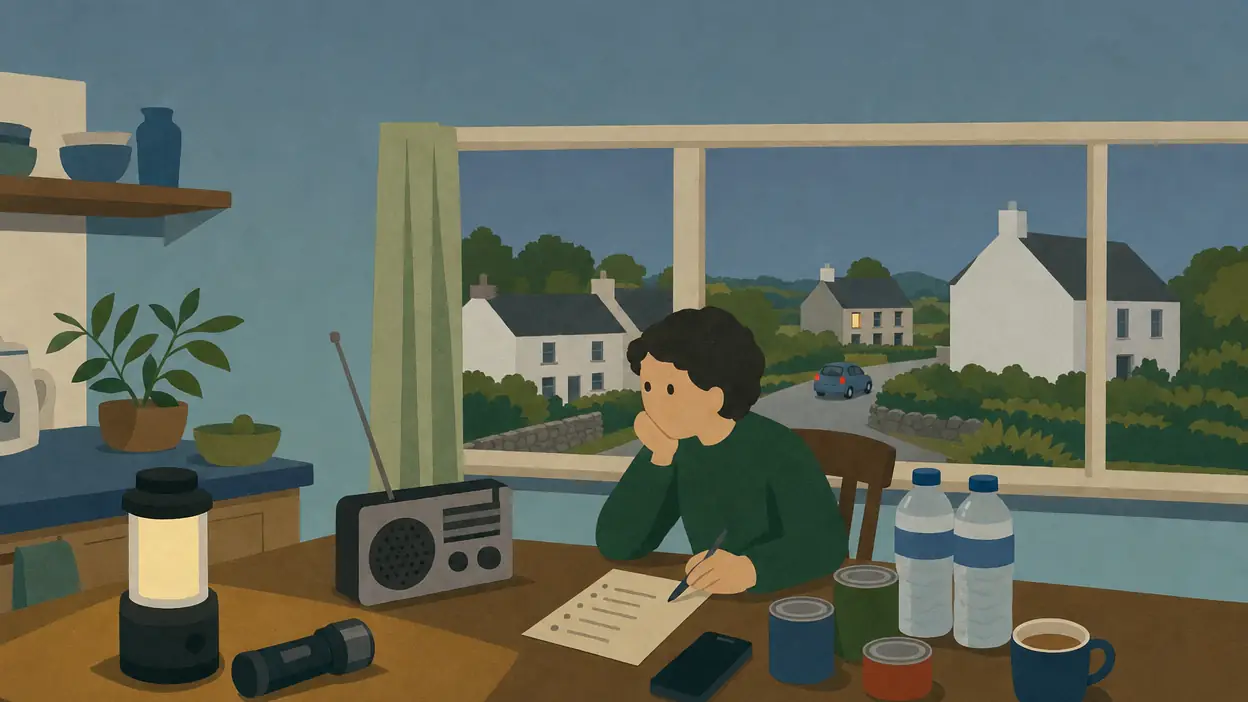
The Irish checklist recommends a battery, wind-up or solar radio, with spare batteries where needed. Choose a set with an FM tuner. Have a go with it before an outage. See the equipment categories linked at the end of this guide. [2] [6]
RTÉ lists Radio 1 in the 88 to 90 MHz FM range in its general tuning guide. Make tuning it a small weekend project: find the clearest setting at home and write it down. Also note a local station and its frequency from that broadcaster’s own information, because the Irish booklet recommends listening to local radio for updates. [6] [1]
RTÉ Radio 1 long wave on 252 kHz closed on 14 April 2023. Do not use an old checklist that tells you to rely on that service. FM remains available, while RTÉ’s online listening options require an internet connection. [7] [6]
Keep the radio and its power supply somewhere everyone can find them. For a deaf or hard-of-hearing neighbour, agree how someone will pass on official announcements in an accessible way. Radio should be part of a shared plan, rather than the only route to information for everyone. [1]
Make the plan together
The official booklet recommends written plans, accessible contacts and talking with neighbours about sharing information and resources. Put the kettle on and work through this worksheet together. These are household prompts, not fixed government rules. [1]
| Write down | Decide together |
|---|---|
| Essential contacts | Who needs to hear from you, and which nearby person can help? |
| Check-in arrangements | When will you try a call or text again? What happens if it fails? |
| Safe meeting point | Where could you meet if you must leave, subject to emergency instructions? |
| Neighbour support | Who has agreed to check on whom, when it is safe? |
| Equipment | Where are the radio, spare batteries, cables and power banks? |
| Accessible updates | How will you share an announcement with someone who cannot hear the radio? |
Keep a paper copy where it is easy to find and a photo on your phone. Talk through what a missed check-in means. Avoid building a plan that depends entirely on a group chat: the booklet specifically recommends written arrangements for when phones or internet are unavailable. [1]
Could PMR446 walkie-talkies help?
ComReg describes PMR446 as licence-exempt two-way radio for personal use in Ireland. Its guidance puts typical reach anywhere from a few hundred metres in a city to a few kilometres in open countryside. Treat that as variable, not a promised range between two homes. [8]
Use compliant PMR446 equipment. ComReg’s analogue equipment specification requires an integral antenna and limits effective radiated power to 500 mW. A programmable radio is not automatically licence-exempt simply because it can tune to a PMR frequency. [9]
Fancy trying a pair with a nearby neighbour? They may help with direct local voice contact. Agree a channel and listening time, then try your actual locations. Keep a paper or in-person fallback. This applies ComReg’s short-range guidance; it is not an emergency-service link. See the equipment categories linked at the end of this guide. [8] [1]
Emergency SMS 112 and registration
Current ECAS instructions do not require advance registration. The service operator says emergency texts can be sent from Irish registered mobile phones on Irish mobile networks. It provides an optional form for additional personal information, which may help responders. That is different from a compulsory registration step in older advice. [3] [10]
The service is particularly useful if you are deaf, hard of hearing or have a speech impairment. It is also available when another situation prevents a voice call. Use a voice call if possible, as text communication is slower. [3]
In a real emergency, text 112 with:
- The service needed: ambulance, Garda, fire or Coast Guard.
- What has happened.
- The county and exact location, including an Eircode, address or nearby landmark where available. [11]
Wait for an actual reply from the emergency service. A delivery report does not confirm that help has been arranged. ECAS says that if no reply arrives within three minutes, send another message straight away. Keep answering any questions. [11]
SMS delivery is not guaranteed, and texts can be delayed. If you have not received a reply, continue trying another way to get help, such as asking someone nearby to make a voice call. Emergency SMS still needs a functioning mobile service; it is not an off-network fallback. [12]
You can prepare a draft message with your usual location in advance and update it to match the real incident. ECAS recommends this approach. Keep it as a draft; do not send a practice emergency message. [13]
Booklet material used: written plans, contact lists, radio, power banks and neighbour support have been rewritten from Be Emergency Ready. Network, radio regulation and emergency SMS details come from the responsible organisations. [1] [2]
Sources (13), all checked 2026-10-28
- Office of Emergency Planning, Be Emergency Ready booklet. Checked 2026-10-28.
- Office of Emergency Planning, Your checklist. Checked 2026-10-28.
- Emergency Call Answering Service, Emergency Text Service. Checked 2026-10-28.
- ComReg, The Economic and Societal Impacts of Network Incidents, report 23/59a, Box 2. Checked 2026-10-28.
- ComReg, All about broadband, power-cut advice. Checked 2026-10-28.
- RTÉ, Keep Listening: How to Listen to RTÉ’s Radio Services. Checked 2026-10-28.
- ComReg, Broadcasting Services. Checked 2026-10-28.
- ComReg, Radio Licensing for Programme Making and Special Events, 08/08R7, section 6. Checked 2026-10-28.
- ComReg, Permitted Short Range Devices in Ireland, 02/71 R16, voice applications table. Checked 2026-10-28.
- Emergency Call Answering Service, Supplying Additional Information. Checked 2026-10-28.
- Emergency Call Answering Service, Sending a text to 112. Checked 2026-10-28.
- Emergency Call Answering Service, Emergency SMS Terms and Conditions. Checked 2026-10-28.
- Emergency Call Answering Service, SMS Questions and Answers. Checked 2026-10-28.