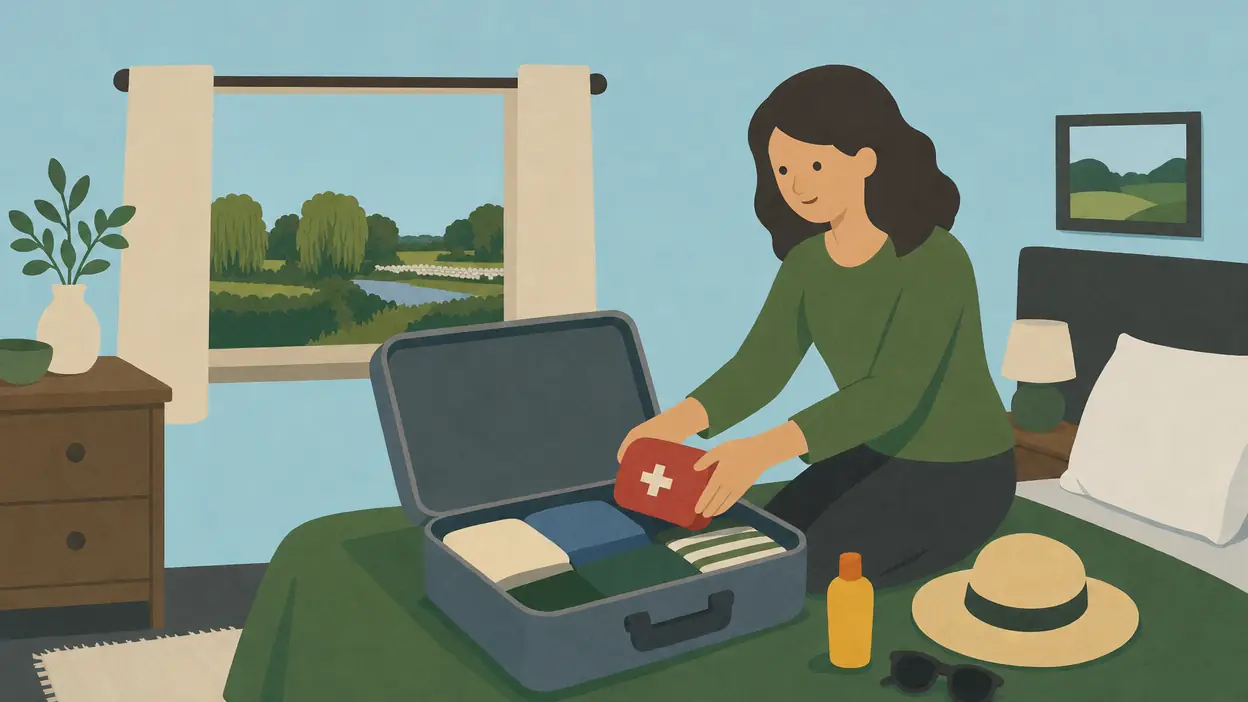
A travel kit is not a home kit in a smaller bag. It has to cope with heat, a different water supply, insects and a pharmacy whose labels you may not read. The parts that matter most cost little: your own medicines, a written list of them, and sunscreen.[1][2]
The scene this guide is for
Day three of a family holiday in Spain. A child has a grazed knee from the pool tiles, a parent has an upset stomach, and the inhaler is in the suitcase that went to Frankfurt. Two of those are small problems if the right things are in the day bag. The third is why medicines travel in your hand luggage.
Free, or already in the house
Before you buy anything:
- Write a medicines card for each person: each medicine, its dose, allergies, conditions and an emergency contact. The DFA says to carry full details of your regular medicines, medical history, allergies and drug sensitivities.[2]
- Ask for a paper copy of each prescription. An emailed Irish prescription will not work in a pharmacy abroad.[3]
- Get an EHIC for each person. For what it covers, see Emergencies abroad.
- Take what you already have: plasters, a crepe bandage and scissors from the home kit.
- Start any travel vaccines at least 8 weeks ahead. They are not free, even with a medical card, so ask your GP or a pharmacy about cost early.[4]
Start with a small core
The Health and Safety Authority’s travel kit list is an Irish starting point.[5] It is written for workplaces, so treat it as a guide for a family, not a rule:
| Item | HSA travel kit |
|---|---|
| Plasters | 20 |
| Sterile eye pads | 2 |
| Triangular bandages | 2 |
| Safety pins | 6 |
| Sterile dressings (medium, large, extra large) | 1 of each |
| Disinfectant wipes | 10 |
| Shears | 1 |
| Gloves | 3 pairs |
| Crepe bandage (7 cm) | 1 |
| Sterile water, where there is no clean running water | 2 × 20 ml |
| Water-based burns dressings, where there is no clean running water | 1 small, 1 large |
| Pocket face mask | 1 |
Our first aid kit guide explains each item. A ready-made household kit kit options: Household first aid covers most of it. The HSE adds tweezers for splinters and ticks, a digital thermometer, hand sanitiser for when there is no water, and burn gel for when you are not near cool running water. Cool running water for 20 minutes is still the first treatment for a burn.[6]
What changes by trip
| Trip | Add to the core |
|---|---|
| Sun holiday | Sunscreen, a hat, insect repellent, oral rehydration sachets, blister plasters. Keep a few plasters in the pool bag. |
| Long drive | Keep a kit to the HSA travel list in the car, where a passenger can reach it.[5] See Stranded in a car for the rest of the car kit. |
| Backpacking | Sterile water and burns dressings, because clean running water is not certain.[5] Split your medicines between two bags in case one is lost or stolen.[7] A head torch kit options: Head torch helps in a hostel or on a night bus. |
Your own medicines
- Bring enough for the whole trip, plus extra for delays, and copies of your prescriptions.[1]
- Carry vital medicines in your hand luggage. Checked bags can be delayed or lost.[8]
- Keep them in the original packs, with your name on the label. For controlled drugs, the Department of Health also advises a prescription copy or a doctor’s or pharmacist’s letter. The full wording is in Emergencies abroad.[9]
- Keep them out of the heat. The HPRA says to avoid exposing medicines or medical devices “to extreme temperatures for extended periods”. It also says to check the plug type so you can buy the right adaptor before you fly.[10]
- Allergies: if you have an adrenaline auto-injector, the HSE says to carry 2 with you at all times.[11]
- If you are unsure whether heat will affect a condition or medicine, ask your GP or pharmacist before you travel.[12]
Keep medicines in their own labelled bag, not loose in the first aid kit. With children around, the HSE says not to store medicine in the first aid kit at all.[6]
Sun and heat
The HSE’s SunSmart rules:[13]
- sunscreen with SPF 30 or higher for adults and 50 for children, and a UVA star rating of 4 or more or a UVA logo;
- put it on 20 minutes before going out, then every 2 hours, after swimming and after towel drying;
- a wide-brimmed hat, UV sunglasses and clothes that cover the skin;
- shade between 11am and 3pm.
Check the sunscreen’s expiry date before you pack it.[13] Abroad, the HSE also says to check local heat, wildfire and air quality warnings, carry water and drink regularly, and never leave children or pets in a parked car.[12] Heatstroke should be treated as an emergency.[12] Signs and first steps are in our heatwave guide.
Insects
The HSE says repellents containing 50% DEET work best. Cover up when insects are active and close windows or use netting.[14] Where mosquitoes carry malaria or dengue, see your GP before you go about vaccines and malaria tablets, and use bed nets where rooms are not screened.[14][1] Remove ticks as soon as you find them.[14]
Stomach upsets and water
Ireland’s Health Protection Surveillance Centre puts it simply: “boil it, cook it, peel it, or don’t eat it”. Only drink water from sources you trust: in some countries tap water and ice are not safe, and bottled or boiled water is better.[15]
For diarrhoea and vomiting, the most important thing is fluids. Oral rehydration sachets from a pharmacy help.[16] The HSE says:[16]
- do not give children under 12 medicine to stop diarrhoea;
- most people do not need antibiotics;
- get medical help if there is blood, if fluids will not stay down, or if diarrhoea lasts more than 7 days or vomiting more than 2 days;
- do not swim in a pool until at least 48 hours after symptoms stop.
Pools and the sea
Water Safety Ireland warns that pools in holiday centres “might only be partially lifeguarded or not guarded at all”. Its advice:[17]
- check the safety arrangements before children go near the pool;
- look for depth markings, which may be missing, and never dive into shallow water;
- watch for baby pools beside the main pool with no barrier;
- swim with others, never alone or after alcohol;
- in the sea, swim in lifeguarded areas and parallel to the shore.
Check your insurance covers jet skis and other water sports.[18] A waterproof phone pouch kit options: Waterproof phone pouch keeps a phone usable on the beach. At home, the same thinking is in the open-water swimming guide and the kayaking and sailing guide.
What you can buy there, and what you cannot
Usually easy to buy there: in most European holiday areas, pharmacies and supermarkets sell plasters, sunscreen, repellent and rehydration sachets. Check locally: this is general experience, not official advice. Buying them there saves luggage space, but pack enough for the first day.
Do not count on buying:
- Your prescription medicines. An Irish prescription is valid in the EU, EEA and UK if it carries the details the law needs, such as the medicine’s common name, strength and dose. Some medicines are not sold in other countries or go by other names.[3]
- The same over-the-counter medicine. Not everything sold over the counter in Ireland is legal elsewhere, so check before you pack it.[1]
- Anything, outside Europe, without checking first. The DFA travel advice for each country has a health section.[1]
Learn to use it
A kit only helps if someone knows what to do with it. The Irish Red Cross has a short video on what goes in a kit and how to treat a cut.[19] Travel health clinics give personal advice at an appointment, so ask yours about your destination.[4]
Common questions
What should be in a travel first aid kit?
The HSA travel kit lists 20 plasters, sterile dressings, triangular and crepe bandages, safety pins, wipes, shears, gloves and a pocket face mask, plus sterile water and burns dressings where there is no clean running water.[5]
Can I bring my prescription medicines on holiday?
Yes, in their original packs with a copy of the prescription, and enough for the trip plus delays. Check the rules of the country you are going to, especially for controlled drugs.[1][9]
What sunscreen does the HSE recommend?
SPF 30 or higher for adults and SPF 50 for children, with a UVA star rating of 4 or more or a UVA logo. Reapply every 2 hours and after swimming.[13]
What should I do about diarrhoea on holiday?
Drink plenty of fluids and use oral rehydration sachets from a pharmacy. Do not give children under 12 medicine to stop diarrhoea, and get medical help if there is blood or it lasts more than 7 days.[16]
Which insect repellent works best?
The HSE says repellents containing 50% DEET are most effective. Where mosquitoes carry malaria, see your GP before you travel.[14]
Data sources (19), all checked 2026-11-01
Footnotes
-
Department of Foreign Affairs, Travel insurance and health. Enough medication plus extra, prescription copies, over-the-counter medicines abroad. Checked 1 November 2026. ↩ ↩2 ↩3 ↩4 ↩5 ↩6
-
Department of Foreign Affairs, Sick or injured. Carry full details of your medicines, history, allergies and sensitivities. Checked 1 November 2026. ↩ ↩2
-
Citizens Information, Cross-border prescriptions. Page edited 5 January 2024. Paper copies, required details, medicines not available abroad. Checked 1 November 2026. ↩ ↩2
-
Citizens Information, Travelling abroad and vaccinations. Page edited 13 May 2025. At least 8 weeks ahead; not free with a medical card; GP, pharmacy or travel health clinic. Checked 1 November 2026. ↩ ↩2
-
Health and Safety Authority, First aid FAQ: what should be in a first aid box or travel kit. Travel kit contents. Checked 1 November 2026. ↩ ↩2 ↩3 ↩4
-
HSE, First aid kit for babies and children. Tweezers, thermometer, burn gel, sterile water and sanitiser when away from home; no medicine in the kit. Checked 1 November 2026. ↩ ↩2
-
Department of Foreign Affairs, Backpacking, volunteering and adventure tourism. Split medication between bags. Checked 1 November 2026. ↩
-
Department of Foreign Affairs, Mental health and travel. Vital medication in hand luggage. Checked 1 November 2026. ↩
-
Department of Health, Travelling into Ireland from Schengen countries with prescribed narcotics and/or psychotropic substances. Last updated 1 April 2023. Advice for Irish residents travelling out. Checked 1 November 2026. ↩ ↩2
-
Health Products Regulatory Authority, Top tips for using medicines and medical devices safely this festive season (18 December 2025). Travel, temperatures, plug adaptors (quoted). Checked 1 November 2026. ↩
-
HSE, Anaphylaxis. Carry 2 adrenaline auto-injectors. Checked 1 November 2026. ↩
-
HSE, HSE advises people to take care during upcoming spell of hot weather at home and abroad (10 July 2026). Travelling to hotter countries, heatstroke. Checked 1 November 2026. ↩ ↩2 ↩3
-
HSE, Protecting your skin from the sun and sunbeds. SunSmart 5S rule, SPF, UVA rating, expiry. Checked 1 November 2026. ↩ ↩2 ↩3
-
HSE, Insect bites and stings: prevention. 50% DEET, ticks, travelling abroad. Checked 1 November 2026. ↩ ↩2 ↩3 ↩4
-
Health Protection Surveillance Centre, Travel advice for international travellers. Food, water and ice (quoted). Checked 1 November 2026. ↩
-
HSE, Diarrhoea and vomiting. Fluids, oral rehydration, children, when to get help, swimming pools. Checked 1 November 2026. ↩ ↩2 ↩3
-
Water Safety Ireland, Stay safe on your holidays (leaflet). Pool and sea safety abroad (quoted). Checked 1 November 2026. ↩
-
Department of Foreign Affairs, Safety and security: water safety. Insurance for jet skis and water sports. Checked 1 November 2026. ↩
-
Irish Red Cross, What is in a home first aid kit. Checked 1 November 2026. ↩
prepared.ie is independent public information. It is not affiliated with the HSE, the HSA or any agency. In an emergency abroad, ring the local emergency number: 112 in the EU.