Choose a route within the whole group’s ability, check the mountain forecast and leave your route and return time with someone reliable.[1][2] Carry navigation, waterproofs, warm layers, light and emergency supplies.[3] If lost or injured and needing help, call 112 or 999, ask for Gardaí and say Mountain Rescue. For a coastal-cliff emergency, ask for the Coast Guard.[1][4]
The scene this guide is for
A November afternoon in Wicklow. The summit was clear when you left the car, but cloud has covered the ridge. The next path fork looks unfamiliar. One member of the group has stopped talking and is walking slowly. Stop to check location, time and that person’s condition before going further.
The summit can wait. Mountaineering Ireland says poor weather, running out of time or feeling out of your depth are reasons to turn around or take the easiest safe route off the hill.[1]
Pick the route for the group you have
A popular summit can still require navigation and serious walking. Mountaineering Ireland warns that much upland ground has no marked trails, and a line recorded by another walker in a phone app may pass through unsuitable terrain.[1]
Before leaving:
- Choose a route that suits the least experienced person, not just the strongest walker.[1][3]
- Identify the start, finish, main route and a way to shorten the day.[2]
- Check access and parking arrangements. Do not block gates or narrow roads needed by residents or rescuers.[1]
- Make sure someone can interpret the map and use a compass. If that skill is missing, use a suitable marked trail, a guide or a skills course.[1]
- Agree that anybody can raise a concern about the route or conditions. Discuss the shorter option while everyone is warm and rested.
The last point is our group-management recommendation. Make it explicit before a beginner feels obliged to keep following.
Read the mountain forecast, not just the town forecast
Met Éireann provides forecasts for named hills and mountains. Wind generally strengthens and temperature falls as you climb; use the forecast for the hill you intend to visit.[5]
Check the strongest gusts as well as the average wind, rain, visibility and whether snow or ice may affect the route. Met Éireann specifically recommends gusts for a more representative picture of peak winds.[5] Read the warnings alongside the forecast.[6]
Our conservative decision rules:
- If the expected weather exceeds the group’s skills or equipment, change the route or postpone.[1][5]
- If cloud would leave you unable to navigate the planned ground, choose a route you can manage before leaving the car.[1]
- If wind affects balance, leave exposed ground by a known safe route. Do not continue towards a narrow ridge because the forecast looked manageable.[5]
- If the forecast is for snow or ice and the party lacks winter skills, choose another day or lower route.[2]
How we worked this out
Met Éireann says its air-temperature forecasts are corrected for elevation for the first 48 hours only. Beyond that it advises a reduction of 2°C for each 304 metres gained.[5] We have not turned that into a homemade forecast or a safe-temperature threshold. Check close to departure and use the named mountain forecast.
Daylight is part of the route
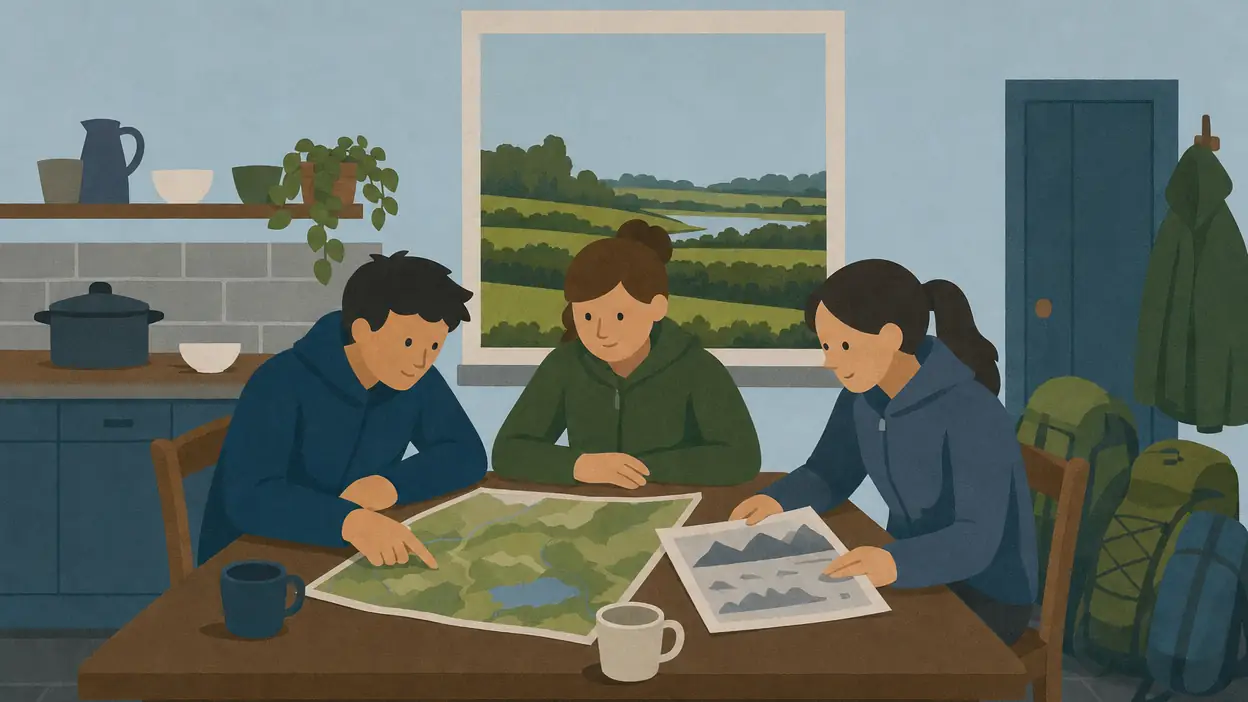
Check the day’s local sunrise and sunset. Mountaineering Ireland advises finishing with daylight to spare, starting early and having an escape route if progress is slower than planned.[2] Do not substitute a summer memory for a winter timetable.
Our planning suggestion is to write three times on the route card: departure, a decision time for turning back or shortening the walk, and expected return. Base them on your actual route and group’s pace; no single walking-speed formula covers bog, steep ground and tired people.
At the decision time, check where you really are and how everyone feels. Count the descent as walking still to do, with its own navigation and footing problems. A headtorch is emergency equipment even when you intend to finish in daylight.[1][3]
We give no fixed number of daylight hours for Ireland because the date and location change the answer. Check for the place and day you are walking.
Leave someone a useful route plan
Galway Mountain Rescue asks walkers to leave start and finish points, estimated return and contact details with an appropriate person.[3]
Our practical card adds enough detail to make that plan recognisable:
| Write down | Why it helps |
|---|---|
| Route and shorter alternative | Distinguishes the intended hill from a vague county name. |
| Start, finish and parking location | Identifies where the group entered the hills. |
| Group members and phone numbers | Gives a contact route and party description. |
| Return and agreed alarm time | Gives the home contact a clear action rather than indefinite waiting. |
| Emergency instruction | Call 112 or 999, Gardaí, Mountain Rescue, and explain that the group is overdue.[3][7] |
Agree the alarm time with the contact and make sure they understand the instruction. Tell them about changes when possible, then confirm everyone is back. Do not ask them to search unfamiliar mountain ground themselves.
Carry enough for an enforced stop
An ankle injury can turn a moving group into people waiting in wet clothing. Galway Mountain Rescue warns that help may take several hours to arrive.[7] That is why equipment for stopping belongs beside equipment for walking.
| Carry | Purpose |
|---|---|
| Waterproof jacket and trousers | Protection from rain and wind.[1] |
| Warm spare layer, hat and gloves | Warmth when stopped or exposed, including in summer.[3] |
| Map and compass | Navigation that does not depend on a charged phone; know how to use them.[3] |
| Headtorch kit options and spare power | Light if the day runs late.[1][3] |
| Food, water and a warm drink | Supplies for the group and delays.[3] |
| First aid supplies | Early care while help is arranged: First aid kits for home, car and outdoor trips in Ireland.[3] |
| Survival bag or group shelter kit options | Shelter and protection from the ground while waiting.[3][7] |
| Charged phone, protected from weather, and charging backup | Calling and being reachable; coverage is not assured.[1][3] |
| Whistle | Another way to signal an emergency.[3] |
Check that shared equipment is actually in somebody’s bag. If a group splits, one party can lose access to the only shelter or first aid kit. Plan to keep together and let the slowest person set the pace.[3]
Lost: stop making the search area bigger
Mountaineering Ireland advises staying calm, thinking back to the last definite feature and considering whether you can retrace your steps.[2]
- Stop on safe ground and put on a layer before getting cold.[2][3]
- Compare the map, known features and last confirmed position. A phone location helps only if you can interpret the terrain around it.[1]
- Retrace a route only if you can identify it and do so safely.[2]
- If you cannot establish a safe way out, call for help before fatigue, darkness or cold worsens the situation.[3]
Do not treat walking downhill as a universal escape rule. Unknown ground can include cliffs or steep gullies. Explain uncertainty to the rescue service instead of inventing a precise position.
Call early, then protect the group
Call 112 or 999, ask for Gardaí, and say Mountain Rescue.[7] The rescue team needs:
- Mountain or area, grid reference if known, and a description of the location.
- What happened, when, and the number of people involved.
- Injuries or illness, and the group’s condition.
- Phone numbers, weather at the scene and available shelter.[7]
Keep the calling phone available for contact. Update rescuers if the situation or location changes. Galway Mountain Rescue advises keeping injured or exhausted people warm and safe; insulate them from the ground and use shelter.[3][7]
On coastal cliffs, call 112 or 999 and ask for the Coast Guard. Stay on marked paths and away from unstable edges; do not climb down after a person or dog.[4] Describe the exact situation and let emergency services arrange the response.
Cold, heat and the person falling behind
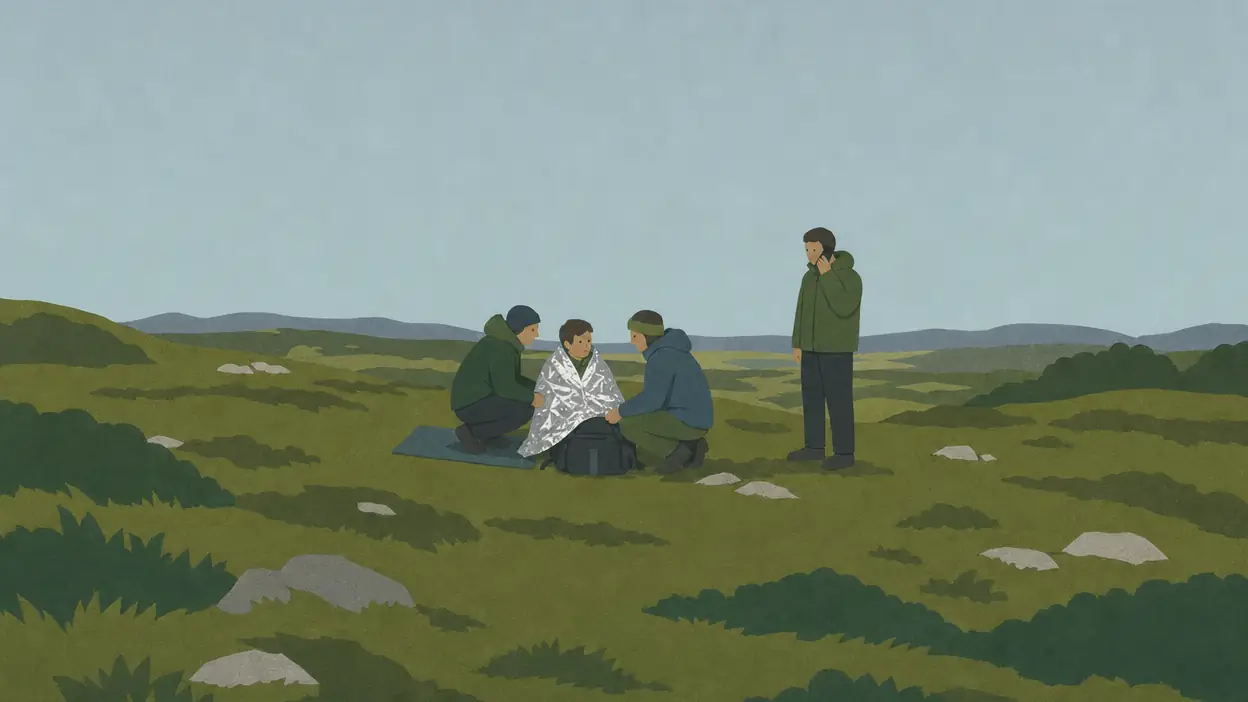
Shivering, confusion, slurred speech or slow breathing can mean hypothermia. HSE says to call 112 or 999 if you suspect it.[8] Protect the person from weather while help is arranged. Do not treat sudden poor judgement as stubbornness.
In hot weather, headache, dizziness, nausea, heavy sweating and thirst can indicate heat exhaustion. Stop, find a cooler place, remove unnecessary clothing and help an alert person drink. Cool the skin and stay with them.[9]
Call immediately for confusion, collapse, a seizure or unresponsiveness. If heat-exhaustion symptoms have not improved after 30 minutes of cooling and fluids, HSE also treats that as an emergency.[9] Do not wait for the half-hour if severe signs are already present.
Use Heatwave: keep cool and check on others and Snow and cold: keep warm and protect your water supply for wider preparation. After the walk, replenish food, check wet gear and tell the route contact everyone is safe.
Sources (9), all checked 2026-10-29
All checked 2026-10-29. Irish sources; Mountaineering Ireland covers the island.
- Mountaineering Ireland, Happy Hiking: how to start.
- Mountaineering Ireland, staying safe and winter walking.
- Galway Mountain Rescue Team, be prepared.
- Irish Coast Guard, coastal and cliff safety.
- Met Éireann, mountains forecast.
- Met Éireann, warnings and advisories.
- Galway Mountain Rescue Team, in an emergency.
- HSE, keeping warm in winter.
- HSE, heat exhaustion and heatstroke.