Start with an experienced caving club or qualified leader.[1] Check recent rain, the forecast and the cave’s flood behaviour; leave a written route and call-out time with someone on the surface.[2] In an emergency dial 112 or 999 and ask for Cave Rescue. The Irish Cave Rescue Organisation, ICRO, operates across the island with Gardaí and the Police Service of Northern Ireland.[3][4]
The scene this guide is for
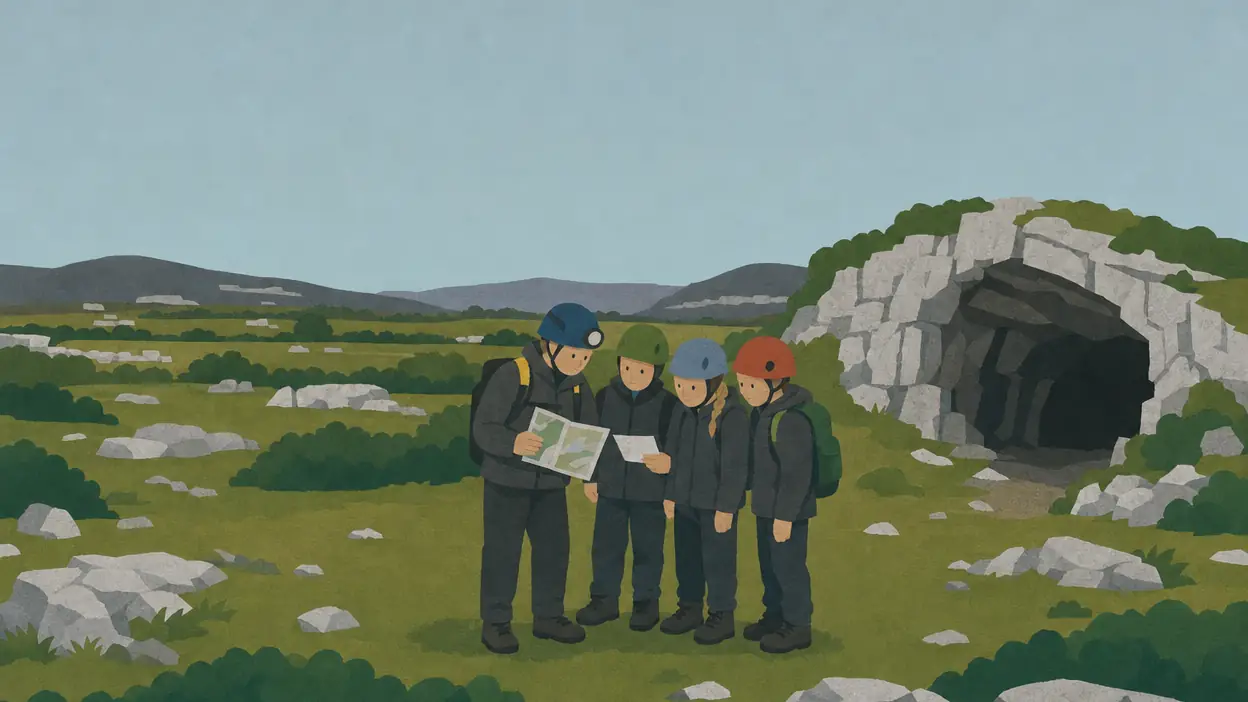
A Saturday morning in the Burren. The sky above the entrance is clear, but rain crossed the area overnight. Someone says the cave was straightforward last month. Before putting on a helmet, the leader needs to know how this cave responds to rain, what happened upstream and whether today’s access notice has changed.
A familiar entrance is not a water-level forecast. SUI says to obtain recent weather, stream levels and local advice before going underground.[2]
Go with people who know the cave and the group
The Speleological Union of Ireland, SUI, is the national caving body covering Ireland and Northern Ireland. Its beginner guidance recommends an experienced caver through a club or a qualified leader from an outdoor centre.[1]
For a first trip, ask what the route involves: crawling, deep water, climbing, vertical drops and the effort needed to get out. Tell the leader about medical needs or concerns before departure.[1] A show-cave tour and a sporting cave trip have different arrangements; book the experience you actually want.
Before agreeing to the trip:
- Confirm that the route suits the least experienced member.[2]
- Confirm who knows the cave and who is leading the group.[2]
- Ask how rainfall affects the route and what would cause cancellation.[2]
- Check that the group has first aid skills, emergency supplies and a surface contact.[2]
- Practise any necessary rope or ladder skills on the surface with competent instruction.[2]
A packing list cannot teach vertical caving. Leave technical rope choices and rescue practice to proper instruction, rather than trying an unfamiliar technique underground.
Rain can arrive underground faster than you expect
SUI describes the western Burren’s active caves as liable to sudden flooding. Its regional guide specifically flags severe flood risk in the Doolin and Coolagh river caves.[5] A route described as dry in an old trip account may still be affected during major floods.
This is a documented Irish hazard. On 20 July 2025, intense rain on the Marlbank catchments caused rapid runoff and significant flooding above and below ground in Fermanagh and Cavan. SUI reports moved sediment and boulders, and a landslide affecting the Cladagh Glen.[6]
Check Met Éireann’s rainfall warnings and forecast before travelling and again before entering.[7][8] For Fermanagh, also check the relevant UK Met Office warnings because the trip is in Northern Ireland.[9] Look beyond the exact entrance to the ground draining towards the cave.
Decision rules:
- If the leader cannot establish how recent or forecast rain affects this route, stay out.[2]
- If conditions appear dangerous, turn back. SUI explicitly advises doing so.[2]
- If the route is flood-prone and significant rain threatens it, choose a different activity after competent local assessment.[2][5]
- Never interpret the absence of a county warning as cave-specific clearance. Warnings cover areas; the cave needs its own assessment.[2][8]
We give no universal rainfall amount or waiting period. The official sources do not establish a safe rule that works for every cave.
Where you are matters, including across the border
| Area | What the regional guidance highlights | Emergency route |
|---|---|---|
| Clare and the Burren | Active river caves and sudden flooding; check current restrictions.[5][6] | 112 or 999, Cave Rescue. ICRO works with Gardaí.[3][4] |
| Fermanagh and Cavan | Cave country on both sides of the border, with cave-specific access arrangements.[6][10] | 112 or 999, Cave Rescue. ICRO works with PSNI in Northern Ireland and Gardaí in the Republic.[4] |
| Sligo-Leitrim | Limestone plateaux with numerous deep potholes; a short description does not imply an easy horizontal walk.[11] | 112 or 999, Cave Rescue, through the Republic’s emergency services.[3][4] |
Give the entrance location and county, not just a system name, particularly near the border. Let the emergency services arrange the appropriate response. You do not need to select a local rescue store or find an individual volunteer’s number.
ICRO lists main equipment stores at Doolin, County Clare, and Claddagh Glen, County Fermanagh.[3] Those locations demonstrate all-island provision; they do not provide an arrival-time estimate.
Check access every time
SUI maintains an access and restrictions page. It advises asking the landowner’s permission where possible, checking local information and reviewing current anchor notices before trips involving vertical sections.[6]
The page includes both older restrictions and newer updates. At this check it still carried warnings about instability in parts of Shannon Cave and closures affecting other caves.[6] Follow up with SUI or knowledgeable local cavers for the exact proposed route, rather than treating a general paragraph as permission.
Our planning rule is simple: record who confirmed access and when, alongside the route plan. Do not cross a closure or assume a gate is merely inconvenient. Changed access can also change your planned exit or the way rescuers reach the entrance.
The surface contact needs a call-out card
SUI says to leave the party, cave, proposed route and return time with a responsible person who knows how to summon cave rescue. Confirm when every member is out.[2]
Our suggested card makes the instructions explicit:
| Field | What to write |
|---|---|
| Trip | Cave name, entrance location, county and map reference or saved map pin. |
| People | Names, contact numbers and any agreed relevant medical information. |
| Route | Intended passages, entrance and exit, with a copy of the plan. |
| Timing | Start, expected return and an agreed alarm time. |
| Alarm instruction | If overdue with no confirmation, call 112 or 999, ask for Cave Rescue and explain the overdue party. |
| Surface arrangements | Vehicle location and who will meet emergency services. |
This is our expanded planning template, based on SUI’s destination note and ICRO’s required incident information.[2][12] The surface contact needs the card before the group disappears underground. Agree in advance what happens if a check-in fails; do not leave them guessing how much extra time is reasonable.
What goes underground
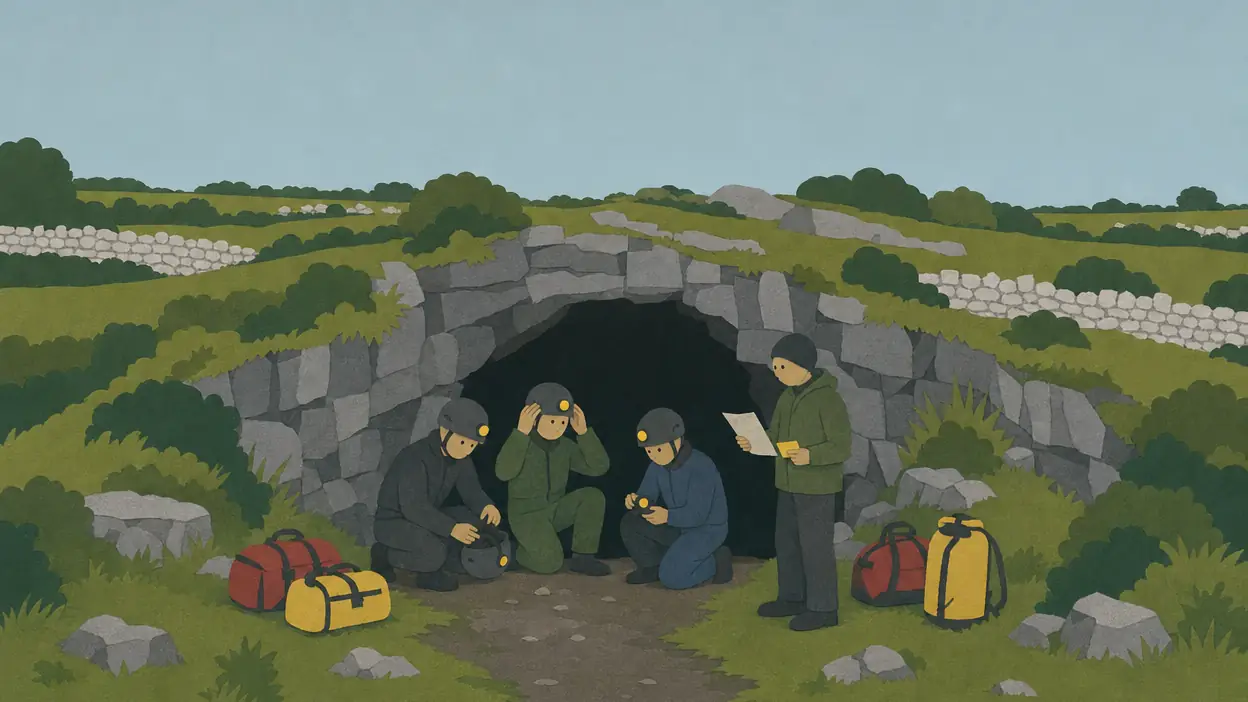
Each caver needs a suitable helmet and hands-free light. SUI lists spare lighting, food, a survival bag and a whistle among personal emergency supplies, with first aid, shelter and writing materials for the party.[2]
SUI’s clothing advice includes warm layers, gloves, suitable boots, and a complete change of clothes and towel for afterwards.[13] Select clothing for the actual wetness of the cave with the leader. Ordinary jeans and trainers are not a substitute for that assessment.[2]
| Group check | Practical action |
|---|---|
| Lighting | Check the main and spare arrangements before entering.[2] |
| Dry emergency supplies | Pack first aid, shelter and recording materials in suitable containers.[2] |
| Warmth | Confirm the leader’s plan for somebody who must stop moving.[2] |
| Comfort bag | Know where the more substantial emergency supplies are and how they can be retrieved.[2] |
| First aid | Know who has the training and where the kit is: First aid kits for home, car and outdoor trips in Ireland.[2] |
Our organisational suggestion is to show everyone the emergency bag before packing it. A bag known only to the leader is a poor plan if that person is injured.
If there is an injury or the group becomes overdue
Raise the alarm through 112 or 999, Cave Rescue.[3] ICRO’s call-out sheet asks for:[12]
- Cave name, location and entrance reference or map pin.
- What happened, injuries and how many people are involved.
- Where the incident is within the cave.
- Local weather during the last 24 hours.
- Available equipment and other parties in the area.
- Caller and callback number; remain reachable if possible.
Arrange the group’s immediate care within its training and the leader’s emergency plan. Do not assume a personal emergency beacon or ordinary phone will establish communication from inside the cave; the surface call-out arrangement must work independently of an underground check-in.
The 24-hour weather request helps explain the incident. It is not a claim that rain older than that can be ignored. For the walk to and from an entrance, especially in darkness, use Hill walking in Ireland: plan the return before the summit.
Afterwards, confirm the whole group is safe, close the call-out with the contact and report changed cave conditions to SUI.[6] Replace used supplies before the next trip.
Sources (13), all checked 2026-10-29
All checked 2026-10-29. All-island bodies unless otherwise marked.
- SUI, caving for beginners.
- SUI, guidelines for college and university clubs (2022).
- Irish Cave Rescue Organisation, emergency instruction and organisation.
- SUI and ICRO, organisation and rescue arrangements.
- SUI, Clare and Galway cave region.
- SUI, cave access and current restrictions.
- Met Éireann, warnings and advisories (Ireland).
- Met Éireann, warning system explained (Ireland).
- (UK) Met Office, Northern Ireland weather warnings.
- SUI, Fermanagh and Cavan cave region.
- SUI, Sligo and Leitrim cave region.
- ICRO, cave rescue call-out procedure (November 2024).
- SUI, caving equipment and clothes.