Wear a suitable lifejacket, fish with company and tell someone ashore your location and return time.[1] Check weather, tides and how you will get back. If someone is in trouble on the water or shoreline, call 112 or 999 and ask for the Coast Guard. From a boat, use marine radio channel 16.[4]
The scene this guide is for
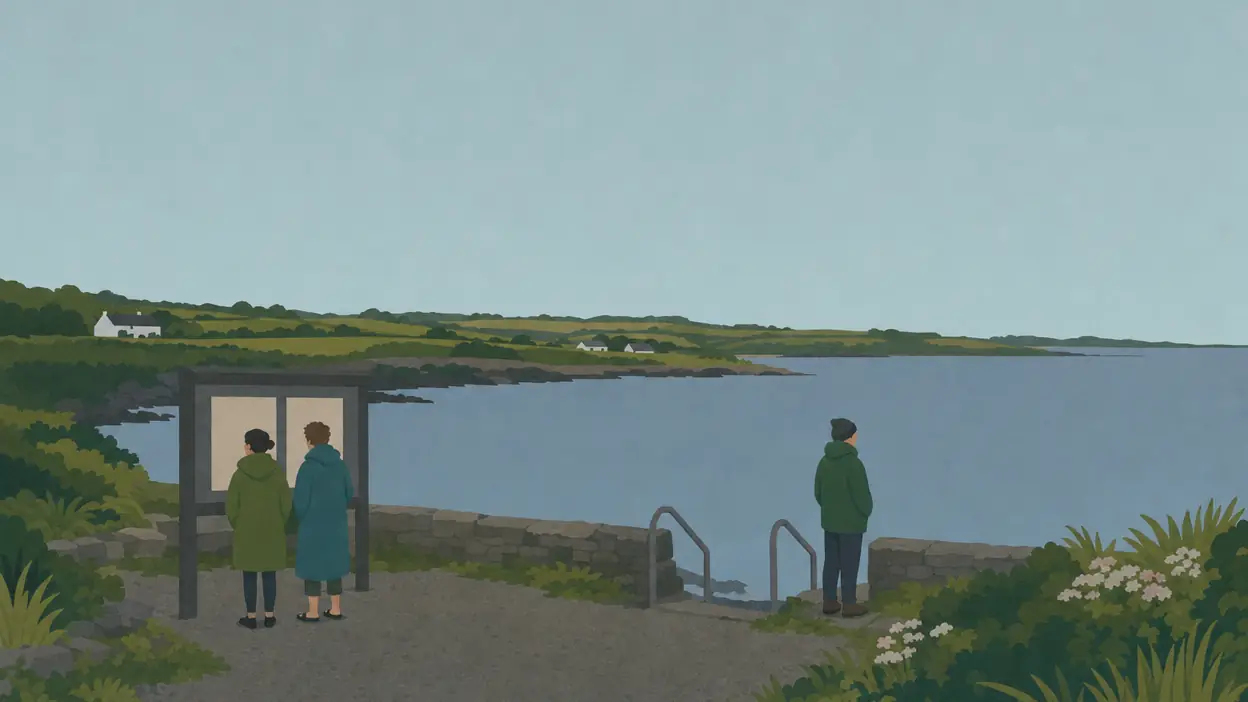
Early evening on a west-coast rock ledge. The fishing has improved, your tackle bag is behind you and the path back crosses a low gully. A wave reaches a patch of rock that was dry when you arrived. You still have a route out. Pack up while that is true.
Water Safety Ireland advises fishing in groups of three or more, within sight of each other: one can help from safety while another raises the alarm.[2] Company is part of the plan, not permission to choose a dangerous ledge.
Read the sea forecast before the fishing report
Met Éireann’s Sea Area Forecast gives the wind, visibility and weather for named coastal areas, with an outlook and separate warnings.[3] Find the section covering your fishing area, then check the conditions for the return journey as well as departure.
A Small Craft Warning means strong winds are forecast near the coast. Do not mistake the absence of a gale warning for a good day in a small angling boat.[5]
Our conservative decision rules for a leisure trip:
- If a Small Craft Warning covers your route and time, postpone a casual small-boat outing. This is our planning rule, not a universal official operating limit.[3][5]
- If waves are reaching the place you intended to stand, choose another location. Do not wait for a larger wave to prove the point.[1][2]
- If you cannot identify a safe return route as the tide rises, do not go onto the shore or rocks.[2]
- If conditions worsen, leave early. The forecast does not overrule what is happening in front of you.[1]
How we worked this out
Met Éireann issues Small Craft Warnings when winds of Beaufort force 6, at least 22 knots, are expected up to 10 nautical miles offshore.[5] That is the published warning threshold, not a safe operating threshold below which every boat can go. No conversion or estimated boat limit is used here.
A sunny weather symbol for the nearest town leaves out much of this information. Read the marine forecast itself, including the issue time. Use Storms: what to do before, during and after when travelling to and from the coast during severe weather.
Tides change the way home
Check high and low water times for the actual area. Water Safety Ireland warns that a rising tide can cut off beach anglers and bait diggers, while wind blowing against the tidal flow can make the sea much rougher.[2]
Before unpacking, identify the crossing, steps or slipway you need later. Ask experienced local anglers about the mark, currents and escape route. A tide time alone does not tell you whether a particular ledge will stay dry.
Our planning suggestion is to agree a leaving time before casting, then keep it visible on a watch or phone. If the return depends on crossing a low strip of beach, treat losing that route as a reason to leave while it remains safely usable. Do not plan a swim back.
Shore and rock fishing: the fall is only the start
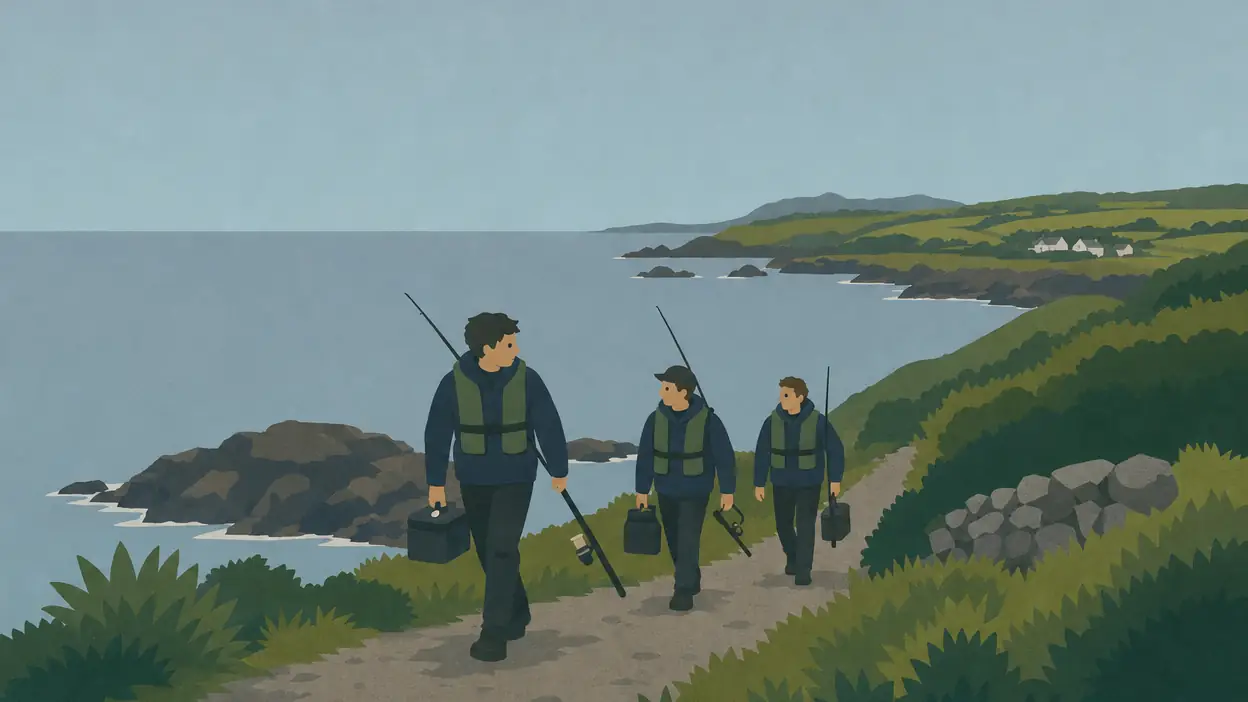
Wet, uneven ground, unstable edges and unexpected waves are hazards even without a boat.[1] Water Safety Ireland recommends grip underfoot, protective clothing and eye protection near casting lines.[2] Keep the tackle bag somewhere that does not block your retreat or force you towards the edge to retrieve it.
Deaths are a real part of this activity, but figures need labels. Inland Fisheries Ireland and Irish Water Safety reported 18 angling-related drownings from 2014 to 27 September 2016.[6] That includes different forms of angling; it is neither a current annual figure nor a rock-fishing total.
For a recent Irish example, Clare County Council’s April 2026 minutes record the loss of life at Blue Pool, Doonbeg, and a review request concerning promoted coastal fishing locations. The council recorded plans to review signage marking the area as unsuitable for fishing.[7] A published fishing mark is not a safety approval. We could not verify a current national rock-fishing-only death total.
Decision rules at the mark:
- Stay away from slippery or unstable edges and watch for waves.[1]
- Wear the lifejacket before approaching the exposed fishing position.[1]
- Keep companions in sight and tell the shore contact if you change location.[2]
- Do not enter the water to recover tackle. Water Safety Ireland’s advice is never to risk yourself for a fish.[1]
Boat angling needs a boat plan
The Department of Transport’s recreational-craft code includes sea angling, inland angling, passage planning and emergency procedures.[8] Check the boat, its load and the forecast with the skipper. Everyone should know where the emergency equipment is and how help will be called.
Ask before departure how someone overboard would be brought back aboard. Knowing where the lifejacket is stored does not answer that question. The Department’s Marine Notice 16 of 2025 advises wearing flotation equipment at all times, including in a tender going out to a larger boat.[9]
Take warm waterproof clothing even if the harbour feels sheltered. Keep hooks and cutting tools organised so movement around the boat does not create avoidable injuries.[2][8] The treatment supplies belong in a dry, accessible first aid kit: First aid kits for home, car and outdoor trips in Ireland.
For launching, returning under changing winds and the wider safety equipment plan, see Kayaking and sailing in Ireland: a safe plan before launch.
Lifejacket: fit and condition before price
The Department says the choice depends on your activity and boating conditions. Wear it correctly, with crotch or thigh straps where specified by its maker; a jacket that rides up cannot protect you as intended.[9]
A buoyancy aid and a lifejacket do different jobs. The Health and Safety Authority explains that a lifejacket is designed to turn an unconscious wearer face up; a buoyancy aid does not provide that turning function.[10] Get competent advice about your activity, clothing and body size rather than choosing by appearance.
Before each outing, follow the maker’s checks and servicing instructions. Show companions how yours works. Do not assume an inflatable jacket is ready because its cover looks tidy.
A beacon needs Irish registration
A personal locator beacon is a carried emergency transmitter that helps rescuers identify and locate a person in distress. ComReg registers personal beacons in Ireland and passes the information to the Irish Coast Guard. The device must be programmed for Ireland before registration.[11]
Before buying, especially second-hand or abroad:
- Ask the seller to confirm that it can be registered with ComReg for Irish use.[11]
- Complete registration and check the recorded owner and emergency-contact details.[11]
- Follow its instructions for testing, carrying, activation and battery replacement. Do not assume automatic activation.
- Keep it accessible on your person as part of the lifejacket and communication plan. The RNLI recommends more than one means of calling for help, kept within reach.[13]
BIM also stresses registering beacons: identifying the owner helps emergency services verify an alert.[12] Its fishing-industry advice supports registration, not an assumption that a leisure angler qualifies for a commercial-fishing grant.
How we worked this out
ComReg requires Irish country code 250 and provides a checking route using the beacon’s 15-character identity. Personal locator beacons (PLBs) are registered through ComReg; vessel emergency beacons (EPIRBs) use the Department of Transport route.[11] They are different registration processes. No radio-range or rescue-time estimate is made.
Carry what answers the actual hazards
| Item | Reason to carry it |
|---|---|
| Properly fitted lifejacket kit options | Keeps you supported after an unexpected fall; choose with competent advice.[9][10] |
| Waterproof phone pouch kit options | A backup call route which stays usable after spray or immersion.[4] |
| Registered emergency beacon kit options | Another way to raise a distress alert; registration is essential.[11][12] |
| Warm waterproof layers and sound footwear | Reduce exposure and slips.[2] |
| Dry first aid supplies | Deal with injuries while appropriate help is arranged.[8] |
The equipment options identify categories, not claims that any product will suit every angler. Choose fit, access and training before adding equipment.
If someone goes in
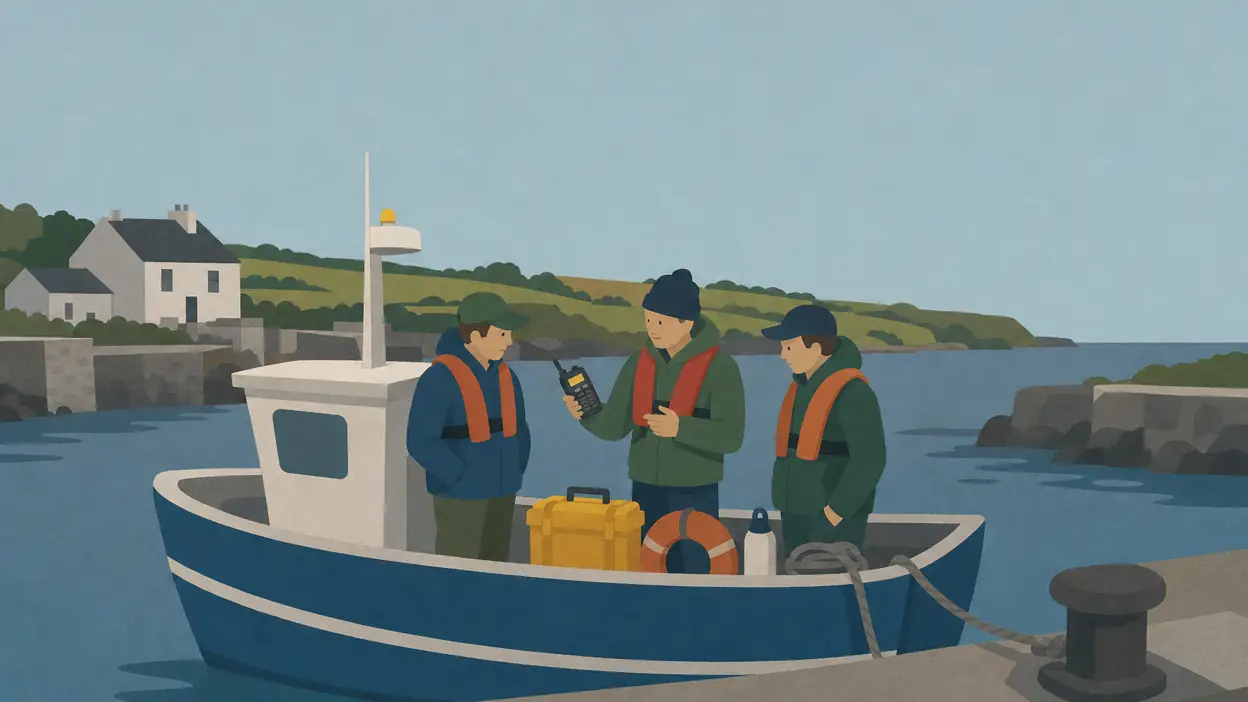
Call 112 or 999, Coast Guard, or use channel 16. Give the location, what happened, how many people are in the water and your callback number.[4][8] Keep them in sight from a safe position. Do not create another casualty by jumping in.
If you fall in unexpectedly, use the Department’s float advice: lean your head back, try to relax and get breathing under control. Let the worn lifejacket support you.[9] For the full floating sequence, read Open-water swimming in Ireland: decide before you get in.
After the trip, tell your shore contact that everyone is back. If you changed plans, explain what changed and update the next trip’s plan.[2]
Sources (13), all checked 2026-10-29
All checked 2026-10-29. Irish sources; RNLI is an Ireland and UK rescue service.
- Water Safety Ireland, angling.
- Water Safety Ireland, angling safety guidelines.
- Met Éireann, Sea Area Forecast.
- Irish Coast Guard, water safety.
- Met Éireann, warning system explained.
- Inland Fisheries Ireland, angler safety release (27 September 2016).
- Clare County Council, April 2026 meeting minutes, item 24.
- Department of Transport, safe operation of recreational craft (2024).
- Department of Transport, Marine Notice 16 of 2025.
- Health and Safety Authority, lifejackets and buoyancy aids.
- ComReg, personal locator beacons.
- BIM, register safety equipment with ComReg.
- RNLI, angling safety (Ireland and UK service).