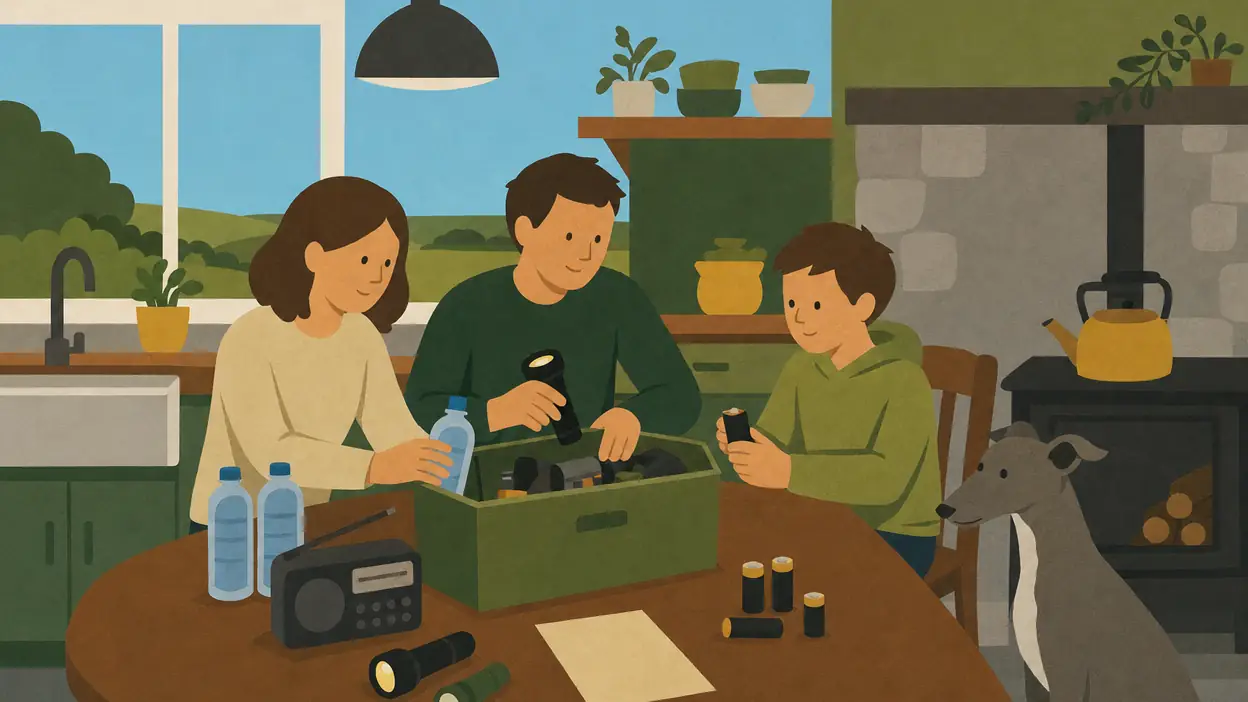
Start with at least three days of essential household supplies and a plan for longer disruption. The EU Preparedness Union Strategy sets an action to develop guidelines for at least 72 hours of population self-sufficiency. It is a preparation baseline, not a promise about restoration times.[1] Keep the plan usable without the internet, and follow Irish official updates.[5][8]
The scene this guide is for
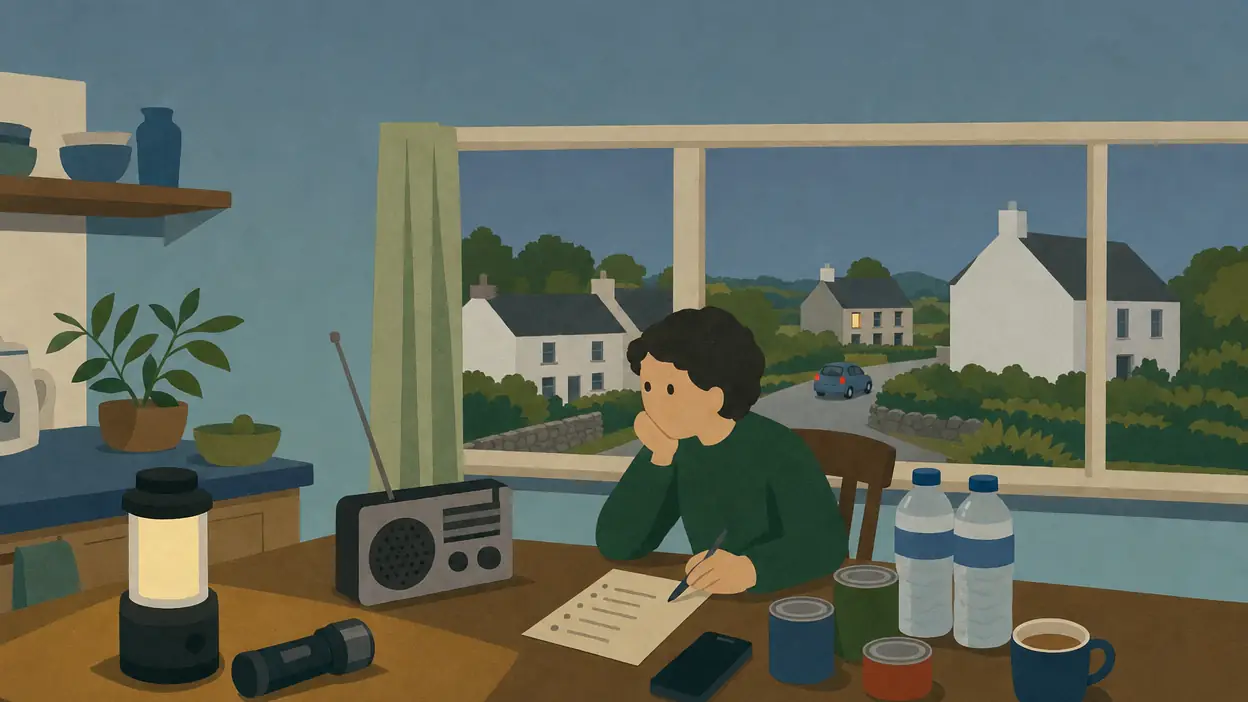
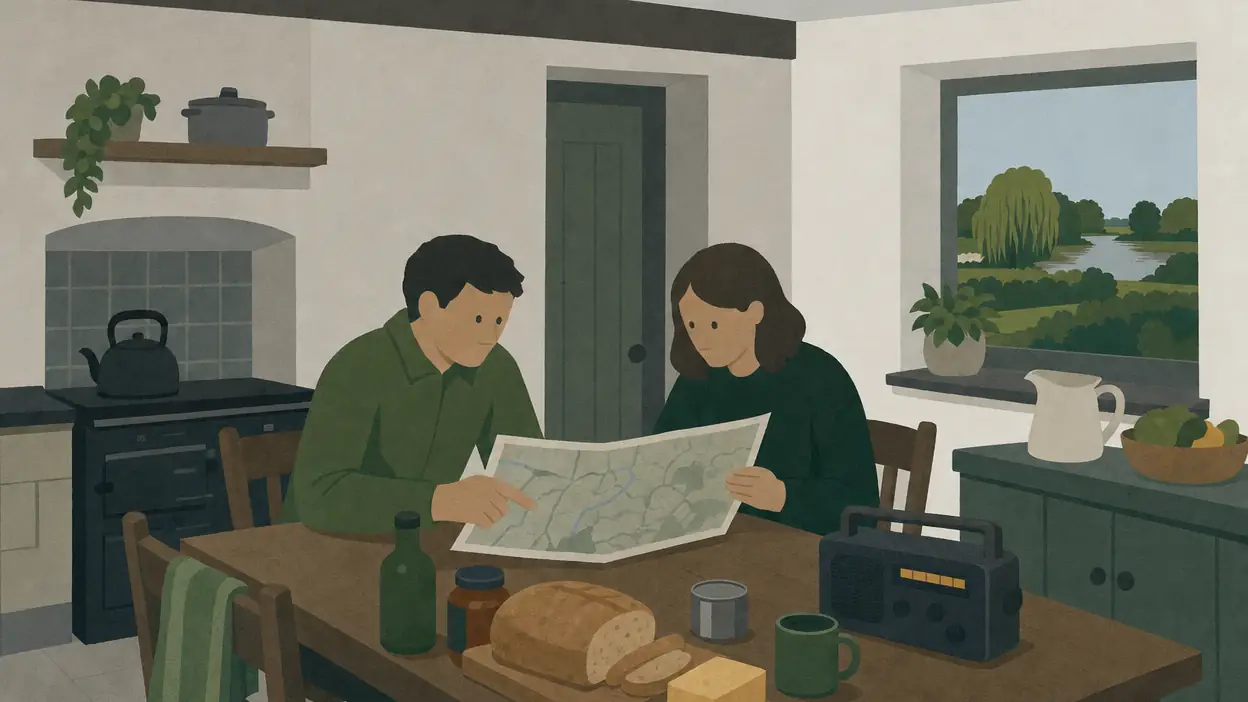
Breakfast time. The lights work, but a public-service website will not open. The radio reports disruption. Your appointment is tomorrow, the shop’s payment connection is unreliable, and messages in a group chat offer several explanations.
Start with what your household needs and what the responsible service has confirmed. A website failure, a payment problem and a cancelled appointment require different actions. None needs a guess about who caused it.
What the 72-hour baseline actually says
The strategy was published on 26 March 2025. Action 14 says the Commission will propose guidelines for member states to reach population self-sufficiency for at least 72 hours, covering essential supplies, crisis planning, shelter and protection of people, animals and property.[1]
That wording matters. It describes a programme to improve preparedness. It does not set a household legal obligation or say every service can be repaired within that time. Build the supplies around the people who live with you, then decide how you would obtain help if disruption continues.
How we worked this out
72 hours divided by 24 hours in a day equals three days. The number comes from action 14 of the strategy, not from an estimate of how long a particular Irish outage will last.[1]
Meath County Council’s household resilience leaflet independently recommends enough food, water and other essentials for at least three days, alongside a household plan.[8] Use Conflict and wider crises: practical preparation in Ireland for the wider preparedness context.
Prepare for the service you lose
Several kinds of disruption can produce the same household problem. A phone that cannot reach a server and a phone with no mobile signal both leave you needing another source of information. Plan for that practical result.
| Service affected | Household preparation |
|---|---|
| Electricity | Accessible torches, charged phones, your electricity-account reference and the outage number on paper.[5] |
| Food and drinking water | Enough ordinary essentials to cover the initial three days, including food suitable for your household.[8] |
| Healthcare access | Essential medicine supplies, the instructions on the packs and a way to contact your usual service.[9] |
| Communications | A radio you can use during a power cut, plus important contacts written down.[5][8] |
| Shopping and payments | A household emergency kit that includes cash, alongside your other arrangements.[8] |
Check Cash and payments during an outage in Ireland, When phones and internet are down in Ireland and Water outages and boil water notices for the individual problems. Buying unfamiliar equipment is less useful than knowing whether your existing arrangements will work without power or a connection.
Cyber-attack: the Irish example
On 14 May 2021, the HSE was affected by a ransomware attack. The National Cyber Security Centre’s contemporary alert says it severely disabled systems and led to the shutdown of most other HSE systems.[3]
In plain terms, the attackers locked computer files so staff could not use them normally. The HSE explains that the intrusion began with a deceptive email attachment opened earlier that year. Information was copied as well as systems disrupted, and the HSE says no ransom was paid.[2]
The household lesson is to keep essential information available when a service’s computers are unavailable. A printed appointment letter, medicine packaging and a written contact number give you something useful to work from.
- Check the provider’s current instructions about appointments, opening hours and alternative contact arrangements. For disruption affecting a planned hospital visit, contact the hospital or clinic rather than assuming it is cancelled.[9]
- Treat unexpected messages cautiously. During Storm Éowyn, Gardaí advised people to break contact with an unknown sender and reach the claimed service independently.[10]
- Use emergency care when it is needed. Ring 112 or 999 if someone is seriously ill or injured and their life is at risk.[11]
The 2021 attack is an example of service disruption, not a prediction of what another incident would affect or how long recovery would take.
Cables and the electricity network, without the jargon
Subsea cables carry communications or electricity between places. These are different functions: a data cable carries information, while a power cable carries electricity. The European Commission’s cable-security work addresses both kinds and sets out prevention, detection, response and recovery measures.[4]
A household cannot assess a cable fault from a slow connection. Use the service provider’s account of the problem, and carry out your communications or power-cut plan according to what is actually unavailable.
Decision rules:
- Power off: check ESB Networks’ outage information and report the fault through its official channels. Keep 1800 372 999 and your electricity-account reference available.[5]
- Power on, internet unavailable: use When phones and internet are down in Ireland and check your provider’s updates. Keep your radio option available for major outages.[5]
- Medical equipment affected: use the written plan agreed with your care team. See Medically dependent at home in a power cut in Ireland. Do not substitute a general three-day supplies target for a person’s treatment plan.[5]
- Fallen or low-hanging electricity wires: do not approach or touch them. Report them to ESB Networks.[10]
ESB Networks recommends deciding in advance what you and neighbours with medical needs would do during an extended power cut.[5] That decision is useful regardless of the original cause.
Fuel and supply shortages
Ireland has national emergency oil arrangements. NORA’s published stockholding page describes stocks held in Ireland and other EU member states, including purchase options under contracts. The page’s 2025 obligation is described as equivalent to 90 days of stocks.[6]
That is a dated national stockholding figure. It is not a guarantee that a particular filling station will have fuel or that a household will receive a personal allocation. This guide does not turn it into either claim.
Plan around the journeys and deliveries that matter. On your household sheet, identify medical travel, care visits, food access and anyone who depends on you. If those arrangements rely on one vehicle or one delivery, write down whom you would contact if it were unavailable. This is a planning exercise, not an instruction to accumulate fuel.
For food, use ordinary long-lasting items you already eat. The HSE recommends easy-to-prepare supplies, keeping essential medicines available, and following their storage instructions.[9] Include children’s needs and pet food in the household plan.[8]
Radiation: use the monitoring that already exists
The Environmental Protection Agency (EPA) continuously monitors radiation in Ireland and operates a round-the-clock Radiation Duty Officer service for emergency responders and Government. Ireland also receives international notifications.[7]
The EPA assesses the measurements and advises Government about protective measures. Official information would be provided through television, radio, government and agency websites and official social channels.[7]
- Use EPA and government advice to decide whether any household action is needed.
- Follow the specific instructions issued. Do not turn a report of an incident into an assumption that you must leave home or change food or water use.
- Read A nuclear incident abroad: what to do in Ireland for the separate subject. This page gives no tablet doses, sheltering times or invented radiation thresholds.[7]
A household plan you can use tonight
- Agree how to reconnect: where household members would meet and who can act as the family contact.[8]
Keep the plan where everyone can find it. In a prolonged disruption, ask the relevant service or local authority about the help currently available. Gardaí specifically ask people to make contact about isolated or vulnerable neighbours rather than assuming somebody else has done so.[10]
Sources (11), all checked 2026-10-29
All checked 2026-10-29. Irish official sources unless marked (EU).
- (EU) European Preparedness Union Strategy, action 14.
- HSE, cyber-attack and response.
- NCSC, health-sector ransomware alert, updated 16 May 2021.
- (EU) European Commission, submarine cable security toolbox.
- ESB Networks, outages safety advice.
- NORA, emergency oil stocks.
- EPA, nuclear and radiological emergencies.
- Meath County Council, Preparing for the Unexpected.
- HSE, preparing for severe weather.
- An Garda Síochána, supporting communities after Storm Éowyn, 29 January 2025.
- HSE, emergency care for adults.
prepared.ie is independent public information, published by Gallan Software. It is not affiliated with the Government of Ireland or any agency. In an emergency call 112 or 999.