Nothing here replaces 112 or 999. If you are in danger now, ring one of them.
This guide is about getting out and getting home: a night out, the walk from the bus, the taxi queue. It sets out what the Gardaí, the HSE and the support services say, and the choices that come with it. If someone hurts or threatens you, that is their doing, never yours. Nothing below is a rule you can fail.
There is more for particular readers in Safety for women and Safety for men.
Numbers to have
- Emergency: 112 or 999, any time.
- Crime Victims Helpline, free: 116 006.[8]
- Rape Crisis Helpline, free, 24 hours: 1800 77 8888.[10]
Cannot make a voice call? Text 112.
The emergency text service can be used by "anyone who is not able to make a voice call due to a speech or hearing impairment or other situations where a voice call might not be possible". It works "from any Irish registered mobile phone (either pre-pay or bill pay) on all the Irish Mobile networks". If you can talk, ring instead: a text is slower.
Your text needs four things:
- Which service: Ambulance, Coastguard, Fire or An Garda Síochána.
- What the problem is.
- County you are texting from.
- Where help is needed: town, road, Eircode or a landmark.
Wait for a reply: "an SMS/Text 'Delivery Report' does not mean your message has been received". If no reply comes within 3 minutes, send another message straight away. It does not work from a foreign phone, or from an Irish phone roaming abroad, including in Northern Ireland.
No registration is needed. 112.ie says: "There is no preparation or registration required to use either Emergency SMS, or RTT when contacting the ECAS." If you might need to text one day, you can choose to give the service your address, access details and a next of kin in advance at 112.ie/register. Most smartphones can also use Real-Time Text to type during a call to 112 or 999: turn on RTT in your phone’s accessibility settings.
Source: 112.ie, emergency text service, sending a text to 112, SMS questions and answers, emergency SMS terms and conditions and Real-Time Text pages, checked 1 November 2026.
The scene this guide is for
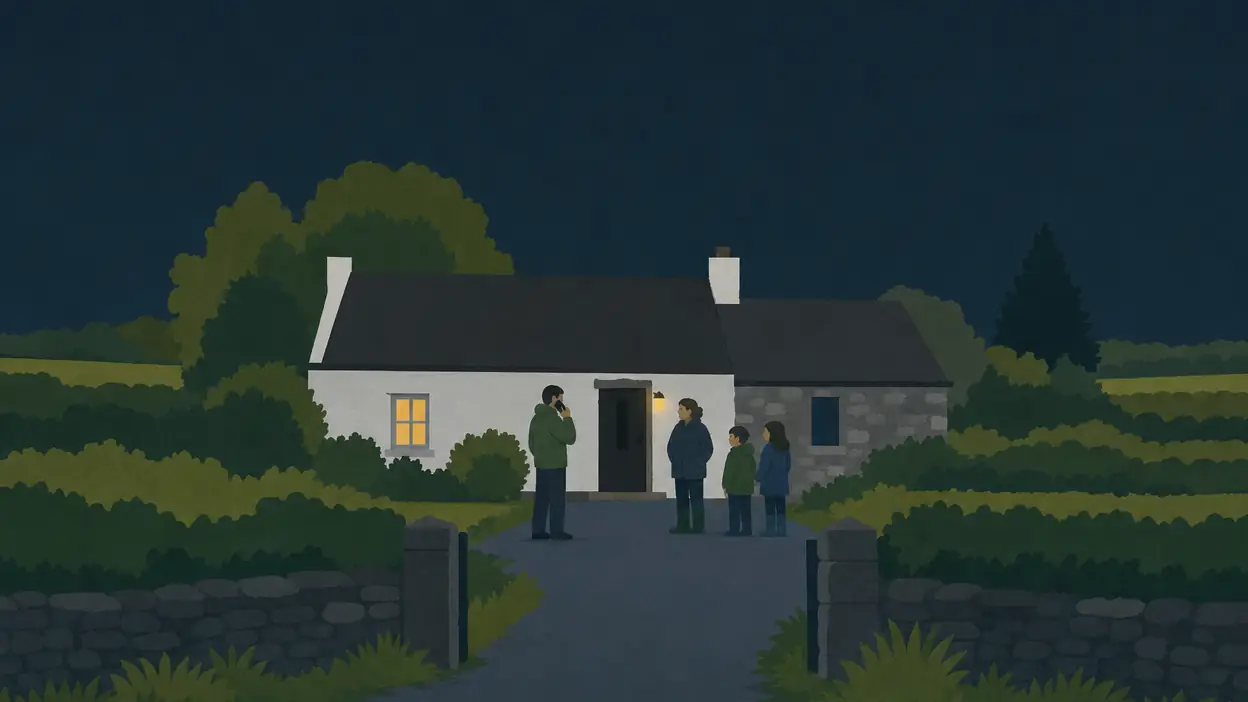
It is a Friday in December. You are leaving town after midnight. The last bus has gone, your phone is on 9% and the taxi rank has a long queue. The quickest way home on foot is down a lane with no lights.
Nothing has gone wrong. This guide sets out the options you have on a night like this, and a few small things that can widen them next time.
What the Garda advice says
In November 2025 the Gardaí set out their personal safety advice on Crimecall as PLANS, in their own words:[1]
- “Plan night out, how you are getting there and back?”
- “Let someone know where you are going and when you’ll be back.”
- “Avoid walking alone in dark areas. Where possible, try to walk in numbers and stick to busy streets with lots of lighting and traffic.”
- “Never attempt to reason with drunk or aggressive people”
- Streetwise, which they explain as getting “to know the locality and the surroundings, and mind your valuables.”
The same message adds: charge your phone before you go out, check public transport times, and have a designated driver or a “buddy” if you can.[1] It closes by asking everyone to “watch out for one another”, and to make sure a friend who has had too much gets home safely.[1]
The Garda Streetwise leaflet puts it as “Trust your instincts, avoid confrontation and if something is not quite right, go to a safe place straight away.”[2] It also says its advice “is not intended to be exhaustive or absolute.”[2] Treat these as options to pick from, not a checklist.
Before you go out: the phone
Your phone is your way to ring for help, pay, find the way and share where you are. The Gardaí suggest a few things that take five minutes at home:[1]
- Charge it before you leave. A power bank in a pocket gives you a second chance (kit options: Phone bank).
- Add emergency contacts to your phone.
- Turn on the phone’s “find my phone” feature, so it can be traced if it is lost or taken.
- Write down your IMEI number. Dial *#06# to show it, then take a screenshot and email it to yourself. It helps the Gardaí return the phone, and your network can block it if it is stolen.[1]
- Lock the phone with a PIN or your fingerprint or face.[1]
Many phones can also share your live location with someone you choose. If you use it, share it only with people you trust, and turn it off when you are home.
Getting home
Some choices people find useful, all from the Garda advice:[1][2]
- Agree the plan for home before you go: who is driving, which bus, or where you will meet for a taxi.
- Tell someone when you expect to be home, and tell your friends if you leave the group with someone else.[2]
- Keep a little cash separate from your wallet, in case the wallet or phone goes.[2]
- Walk with others or keep to busy, lit streets if that is possible on your route. If you have to go through a poorly lit area, the Garda leaflet suggests not doing so alone.[2]
- At a bus stop or on a train, the Gardaí suggest not waiting alone where you can avoid it, and sitting where the driver can see you.[2]
- Note the nearest public building or place of safety on your way: a shop, a hotel, a petrol station, a Garda station.[2]
None of this is a promise. People are hurt on bright streets in company, and plenty walk home alone safely. The point is to have choices.
If you walk on country roads after dark, being seen by drivers matters too. The RSA says: “We offer high-visibility materials to anyone who wants some.”[12] A head torch leaves your hands free (kit options: Head torch).
Taxis and lifts
Use a licensed taxi, as the Garda leaflet advises.[2] You can check one with the free TFI Driver Check App from the National Transport Authority. It lets you check the vehicle is correctly registered, see the driver’s photo, and share your journey details with a friend.[6] The NTA licenses the vehicles, and the Gardaí license the drivers.[6]
If the details in the app look wrong, you can report it through the app.[6] You do not have to get in.
If you think you are being followed
Trust the feeling. You do not need proof before you act.
- Go somewhere with people: a shop, a pub, a hotel lobby, a petrol station. The Garda leaflet says “go to a safe place straight away” if something is not right.[2]
- Ring a friend and stay on the line while you walk to a safe place.
- Do not confront the person. The Gardaí advise against trying to reason with drunk or aggressive people.[1]
If someone tries to take your bag or phone, the Garda leaflet says: “Do not struggle with the thief; you may injure yourself in the process.”[2] Things can be replaced.
Drink spiking
The HSE describes spiking as “when someone gives you drugs or alcohol without you knowing or agreeing to it.”[5] It can be a drug in a drink, more alcohol than you agreed to, or an injection. It can be done by a stranger or by someone you know.[5]
The drugs often have no taste, smell or colour.[5] The HSE says to trust your instincts: if you feel strange, or more drunk than you should, tell someone you trust straight away and ask them to stay with you.[5]
If you think you or a friend has been spiked:[5]
- Get to a safe place and tell a member of staff or security.
- If you are injured, have been spiked with a needle, or feel seriously unwell, ring 112 or 999 or go to an emergency department.
- If you feel well enough to go home, ask someone you trust to go with you.
Spiking is a crime, whoever does it and for whatever reason, and you can report it at your local Garda station.[5] If you think you may have been sexually assaulted, a Sexual Assault Treatment Unit can help, whether or not you report it.[5][9]
The Gardaí suggest never accepting a drink poured by someone you do not trust.[1] If it happens anyway, the fault lies with the person who spiked the drink.
A friend who has not come home
If a friend has gone missing on a night out, ring them, then the people they were with. If you think they are in danger, ring 112 or 999.
The Gardaí say to report a missing person in an emergency to any Garda station. Give as much as you can:[7]
- name, age, gender, height, build and hair colour
- when and where they were last seen, and what they were wearing
- anything else relevant, and a recent photo if you have one
If something already happened
You can report a crime to the Gardaí at any time, whether it happened tonight or weeks ago. The Garda leaflet says to “Try to recall as much information as possible about the incident” and to tell a friend or family member.[2]
When you report a crime, the Gardaí give you details of independent victim support services.[8] The Crime Victims Helpline is free and confidential on 116 006.[8]
After a sexual assault, you do not have to decide straight away about going to the Gardaí. Rape Crisis Ireland says: “You do not need to make any immediate decision about reporting what happened to the Gardaí.”[10]
- A Sexual Assault Treatment Unit (SATU) cares for people of all genders aged 14 and over, and all SATU care is free.[9]
- A SATU can take forensic samples up to 7 days after an assault and store them for up to a year while you decide. The Gardaí will not be there unless you want them.[9]
- After 7 days you can still go for care and to have injuries recorded.[9]
- The Rape Crisis Helpline is free, 24 hours, on 1800 77 8888, whether it happened today or years ago.[10]
Pepper spray and other “defence” items
Some websites sell sprays and stun guns for personal safety. In Ireland, the Department of Justice says CS gas spray, pepper spray and stun guns “are all totally prohibited in this country. Importation or possession of any of these items is illegal.”[11]
A personal alarm is legal. Nobody can promise it will stop an attack. It may help you be heard, and that is all it can claim.
Common questions
Do I need to register to text 112?
No. 112.ie says “There is no preparation or registration required to use either Emergency SMS, or RTT when contacting the ECAS.”[4]
How do I check a taxi is licensed?
Use the free TFI Driver Check App, which shows whether the vehicle is correctly registered and the driver’s photo, and lets you share the journey with a friend.[6]
What should I do if I think my drink was spiked?
Get to a safe place, tell staff or security and someone you trust, and ring 112 or 999 or go to an emergency department if you are injured or feel seriously unwell.[5] Spiking is a crime and you can report it at your local Garda station.[5]
Can I report an assault days or weeks later?
Yes, and the Gardaí will give you details of victim support services when you report it.[8] After a sexual assault, a SATU can take forensic samples up to 7 days later and can still care for you after that.[9]
Is pepper spray legal in Ireland?
No. The Department of Justice says CS gas spray, pepper spray and stun guns are totally prohibited, and importing or possessing them is illegal.[11]
Data sources (12), all checked 2026-11-01
All checked 2026-11-01. All Irish. Rape Crisis Ireland is not a public body. The safety advice comes from An Garda Síochána, the HSE, 112.ie (the State’s emergency call answering service), the National Transport Authority, the RSA and the Department of Justice.
- An Garda Síochána, Crimecall crime prevention message: personal safety, 17 November 2025.
- An Garda Síochána, Personal safety “Streetwise” (information sheet PS2).
- 112.ie, Emergency text service.
- 112.ie, Real-Time Text.
- HSE, Spiking.
- Transport for Ireland, TFI Driver Check App.
- An Garda Síochána, How do you report a missing person?.
- An Garda Síochána, Where else can I get support?.
- HSE, What happens at a Sexual Assault Treatment Unit.
- Rape Crisis Ireland, Advice if it has just happened.
- Department of Justice, Home Affairs and Migration, Firearms: your questions answered.
- Road Safety Authority, Pedestrians.
prepared.ie is independent public information, published by Gallan Software. It is not affiliated with An Garda Síochána, the HSE, the National Transport Authority or any support service named here. In an emergency call 112 or 999.