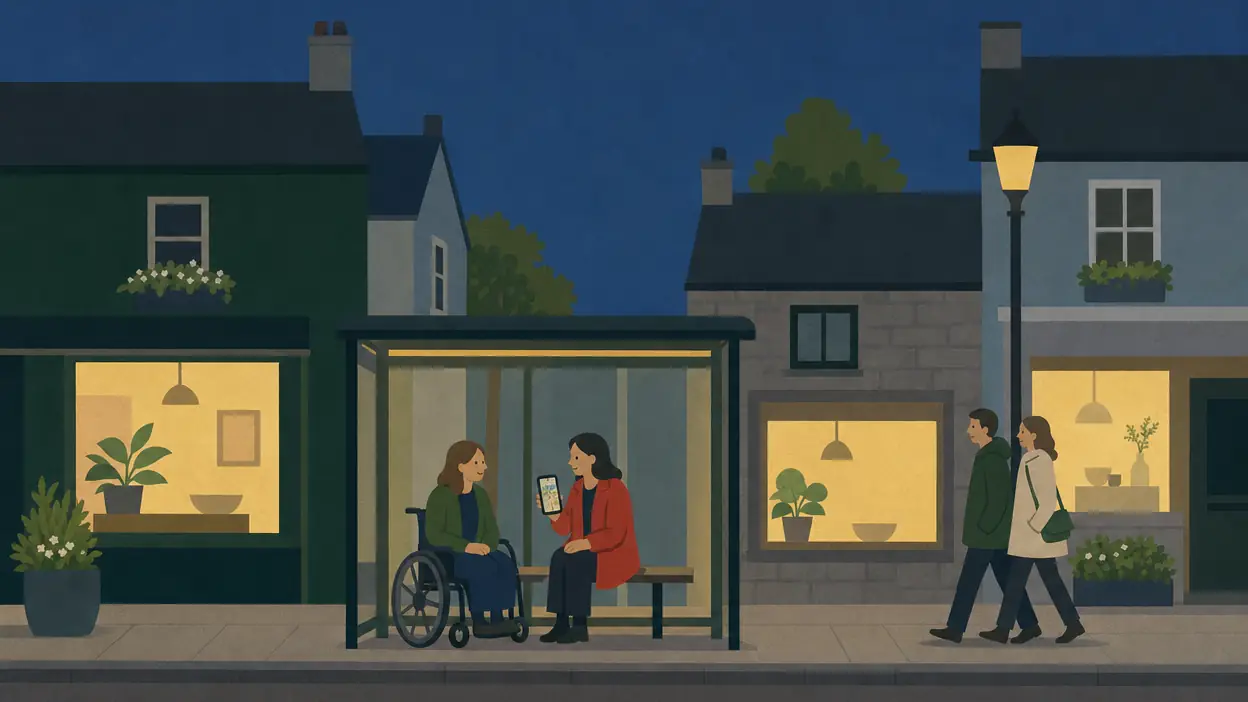
Nothing here replaces 112 or 999. If you are in danger now, ring one of them.
Cannot make a voice call? Text 112.
The emergency text service can be used by "anyone who is not able to make a voice call due to a speech or hearing impairment or other situations where a voice call might not be possible". It works "from any Irish registered mobile phone (either pre-pay or bill pay) on all the Irish Mobile networks". If you can talk, ring instead: a text is slower.
Your text needs four things:
- Which service: Ambulance, Coastguard, Fire or An Garda Síochána.
- What the problem is.
- County you are texting from.
- Where help is needed: town, road, Eircode or a landmark.
Wait for a reply: "an SMS/Text 'Delivery Report' does not mean your message has been received". If no reply comes within 3 minutes, send another message straight away. It does not work from a foreign phone, or from an Irish phone roaming abroad, including in Northern Ireland.
No registration is needed. 112.ie says: "There is no preparation or registration required to use either Emergency SMS, or RTT when contacting the ECAS." If you might need to text one day, you can choose to give the service your address, access details and a next of kin in advance at 112.ie/register. Most smartphones can also use Real-Time Text to type during a call to 112 or 999: turn on RTT in your phone’s accessibility settings.
Source: 112.ie, emergency text service, sending a text to 112, SMS questions and answers, emergency SMS terms and conditions and Real-Time Text pages, checked 1 November 2026.
This guide is for women and girls, and for anyone who wants to help one. It sets out what the support services, the Gardaí and the courts say, and the options that come with it. If someone abuses, follows, threatens or assaults you, the responsibility is theirs alone. Women’s Aid puts it plainly: “The abuser is solely responsible for their actions.”[20]
Keeping this visit private. If someone checks your phone or computer, Women’s Aid suggests browsing in Incognito mode, so the visit is not saved in your history. Women’s Aid suggests not saving the helpline number on your phone. If you need to save it, save it under a friend’s name.[4] To leave this page quickly, close the tab.
Who to ring
| Who | What for | Number |
|---|---|---|
| Gardaí | Danger now, or reporting a crime | 112 or 999, or text 112[7][22] |
| Women’s Aid | Domestic abuse, coercive control and stalking by a partner or ex. Free, confidential, 24 hours.[1] | 1800 341 900 |
| Rape Crisis Helpline | Rape, sexual assault, harassment or abuse, recent or years ago. Free, 24 hours.[13] | 1800 77 8888 |
| Your local domestic abuse service | Safe Ireland lists services in towns across Ireland, “free, confidential and available to all women”.[5] | Find a local service |
| Crime Victims Helpline | Support after any crime | 116 006[9] |
You do not have to speak when you first call. Women’s Aid says many women say nothing on their first call, and “we are still there to listen and provide support when you are ready.”[1]
Other ways in:
- Text and chat. Women’s Aid runs instant messaging on its website: Monday to Friday 10am to 10pm, Saturday 12pm to 3pm and 7pm to 10pm, Sunday 11am to 1pm and 7pm to 10pm.[2] The Dublin Rape Crisis Centre has a text service for Deaf or hard-of-hearing callers on 086 823 8443, Monday to Friday, 9am to 6pm.[13]
- Your own language. The Women’s Aid helpline offers free phone interpreting in 270 languages. Ring, say which language you speak and hold for a few minutes.[1] The Rape Crisis Helpline has interpreting in more than 240 languages at set hours.[13]
- At a Garda station. You can ask to speak to a Garda in private, and ask for a Garda of the same gender, which “if possible it will be facilitated”. The Gardaí will provide a translator or a sign language interpreter.[7]
- Under 18. The Women’s Aid helpline is for people over 18.[1] Childline is free on 1800 66 66 66.[16]
Women’s Aid services are “available to women, including transgender women, of any sexuality”.[6] It also points to LGBT Ireland, BeLonG To and TENI.[6] The National LGBT Helpline is on 1800 929 539.[17]
The scene this guide is for
You and a friend sit at her kitchen table. Her partner checks her phone, tracks where she goes and decides what she can spend. He has never hit her. She is not sure it “counts”, and she does not want to make a fuss.
It counts. Controlling someone like this can be a crime in Ireland, and the Women’s Aid helpline supports women going through exactly this.[7][1] She does not have to decide anything tonight. A call to a helpline is a conversation, not a commitment.
Going out and getting home
The Garda personal safety advice applies to everyone, and it is in Personal safety out and about: planning the way home, your phone, checking a taxi, and drink spiking. Treat it as a set of options. If something happens on a night out, it is not because you missed a step.
Coercive control
The Gardaí describe coercive control as “when a person knowingly and persistently engages in behaviour that is controlling and/or coercive and has a serious effect on you.”[7] It can mean fearing violence, or “alarm and/or distress” that affects your daily life.[7]
The Garda list of questions includes whether a current or previous partner:[7]
- calls you names, humiliates or degrades you
- controls your daily activities or makes you account for where you have been
- denies you money or controls what you spend
- has stalked or followed you, in person or by tracking your phone
- has made you feel you have no one to talk to
- has threatened you, your children, your pets or people you care about
- has “put their hands around your neck or applied pressure causing your breath to change”
If you report coercive control, the Gardaí will take a statement, investigate and send a file to the Director of Public Prosecutions. If the case goes to court, “You will not incur any legal fees as the case is managed by the State.”[7]
Stalking, harassment and image abuse: the law
From 1 November 2023, under the Criminal Justice (Miscellaneous Provisions) Act 2023, the Department of Justice announced:[8]
- “a new standalone offence of stalking, with a maximum sentence of up to ten years, is created and in effect”
- “the scope of the existing harassment offence is widened to include any conduct that seriously interferes with a person’s peace and privacy, or causes alarm, distress or harm”
- a standalone offence of non-fatal strangulation or suffocation, with up to ten years, and up to life imprisonment where it causes serious harm
Stalking does not need a partner or an ex. The Gardaí say it “does not have to involve an intimate partner.”[7] Signs on their list include being followed or tracked, someone impersonating you online, and someone loitering near your home or work.[7]
Intimate images shared without consent. Two offences cover sharing intimate images without consent, under the Harassment, Harmful Communications and Related Offences Act 2020, in force since February 2021.[10] That includes an image that has been digitally altered.[10] Hotline.ie can ask a website to take the image down and, in some cases, help you make a complaint to the Gardaí.[10] It says “it is not your fault and you are not alone.”[10]
Court orders
The courts can make domestic violence orders. In the words of the Courts Service:[14]
- A Safety Order “directs the respondent to stop committing further violence or threats of violence.” If they live with you, it does not order them to leave. One made by the District Court “can last up to 5 years.”
- A Barring Order directs the person to leave the home.
- A Protection Order is “a short-term order”, in place while the court hears your full application.
- An Interim Barring Order or Emergency Barring Order can order someone out of the home in the short term.
The orders are not only for married couples. You can apply for a Safety Order if you were “in an intimate relationship with the respondent”, for example, or are the other parent of their child.[14] Barring Orders have extra conditions, which the Courts Service sets out.[14]
How to apply. Most people apply at their local District Court office, on the court’s application form.[15] A temporary order can be heard the same day or within a day or two, in private, and usually without the other person being told in advance. You can ask a support worker to come with you.[15] “Breaching a domestic violence order is a criminal offence.”[15]
You do not need a solicitor for a domestic abuse order, though the Gardaí recommend one.[7] The Legal Aid Board is on 0818 615 200.[7] Women’s Aid can explain the orders on the phone.[1]
What happens when you ring the Gardaí
The Gardaí say that when you ring 999 or 112 about domestic abuse, uniformed Gardaí will come in a marked car and make sure you are not in immediate danger.[7] They will:[7]
- speak to the people involved separately
- arrest the abuser if a court order has been breached
- take a statement from you, then or later
- give you details of support services and how to apply for an order
- follow up with you after the call
They may ask whether the abuser has weapons, or access to children or pets. “There are no right or wrong answer to these questions.”[7]
A safety plan
A safety plan is a way of thinking ahead, at your own pace. Women’s Aid, the Gardaí or your local domestic violence service can help you make one.[3] Women’s Aid and Cuan, the State agency for domestic, sexual and gender-based violence, set out these ideas:[3][18][19]
While you are living with the person:
- Tell someone you trust, if it is safe to, so they can check on you.
- Agree a code word with a friend, a neighbour or your children that means “I need help”.
- Keep a phone with you, and write the numbers you need on paper too, in case you cannot use your phone.[19]
- Think about where you would go, even if you do not think you will need to.
If you are getting ready to leave, a bag hidden at home or kept with someone you trust can hold:[3][19]
- money, bank cards and spare keys
- passports, driving licence, birth certificates and PPS numbers
- medical cards and any medicine you or your children need
- court orders and any papers about the abuse
- clothes for a couple of days, and a favourite toy for each child
Women’s Aid says: “Do not worry if you cannot take anything with you, the most important thing is getting to safety.”[3] Papers can be got later.
Cuan’s Always Here campaign notes that leaving “can be the most dangerous time for the victim”, which is why a plan helps.[19] If pets are being used to control you, tell the Gardaí: their domestic abuse page covers it.[7]
After you leave, Women’s Aid suggests telling the Gardaí about any court orders, changing passwords and opening a bank account in your own name. Keep a record of every incident, with dates, and photos of any injuries or damage.[3]
Your phone and computer. If a partner always seems to know where you are, your phone may have tracking software on it. Women’s Aid advises not to try to remove it, because that may raise suspicion and it could be evidence.[4] Talk to a helpline from a safe phone instead.
After a sexual assault
The HSE says: “If you have been sexually assaulted, it was not your fault.”[11]
- You do not have to decide about the Gardaí now. You do not have to report an assault, and you can take time to think.[11]
- A Sexual Assault Treatment Unit (SATU) gives free care to people aged 14 and over. It can take forensic samples up to 7 days after an assault and keep them for up to a year while you decide.[12] The Gardaí are only there if you want them.[12]
- Emergency contraception works up to 5 days after, and HIV prevention medicine must be started within 72 hours, so go as soon as you can.[12]
- Bring someone with you, a friend or a volunteer from a rape crisis centre.[11][12]
- If it was more than 7 days ago, a SATU can still care for you and record injuries.[12]
The Rape Crisis Helpline is free and open 24 hours on 1800 77 8888, whether it happened today or many years ago.[13]
How a friend can help
The Gardaí sum it up in four words: listen, believe, reassure, support.[7] Women’s Aid adds:[20]
- Tell them abuse is never their fault, and that they are not alone.
- Do not tell them to leave if they are not ready. Let them make their own decisions.
- Offer to go with them to a GP, a hospital, the Gardaí or a solicitor.
- Offer to keep an emergency bag, or to take messages for them.
- Do not confront the abuser yourself. Women’s Aid says it is “not advisable” and may get your friend cut off from you.
If you think someone is at immediate risk of harm, ring 112 or 999.[7]
The numbers behind this
In 2024, women were three in every four (74%) recorded victims of sexual offences in Ireland, and 69% of recorded victims of harassment offences, according to the CSO.[21] In seven out of ten detected sexual offences from 2023, the suspected offender was known to the victim.[21] These are crimes reported to and recorded by the Gardaí, so they count only what was reported.
Common questions
Is the Women’s Aid helpline really open all night?
Yes. The Women’s Aid National Freephone Helpline, 1800 341 900, is open 24 hours a day, seven days a week, and it is free and confidential.[1]
Is coercive control a crime in Ireland?
Yes. The Gardaí investigate it and send a file to the Director of Public Prosecutions, and if it goes to court the State manages the case, so you pay no legal fees.[7]
How long does a Safety Order last?
A Safety Order made by the District Court can last up to 5 years, and you can apply to renew it on or before the date it expires.[14]
Do I have to go to the Gardaí after a sexual assault?
No. You do not have to report it, and a SATU can store forensic samples for up to a year while you decide.[11][12]
What can I do if someone shares an intimate image of me?
Sharing an intimate image without consent is an offence under the Harassment, Harmful Communications and Related Offences Act 2020.[10] Hotline.ie can help you report it and ask for it to be removed.[10]
Data sources (22), all checked 2026-11-01
All checked 2026-11-01. All Irish. Women’s Aid, Safe Ireland, Rape Crisis Ireland, the Dublin Rape Crisis Centre, LGBT Ireland and Hotline.ie are not public bodies. The legal statements come from the Courts Service, the Department of Justice and An Garda Síochána; the health advice from the HSE; the statistics from the CSO.
- Women’s Aid, Talk to us and Other languages.
- Women’s Aid, Instant message support service.
- Women’s Aid, Safety planning.
- Women’s Aid, Digital safety.
- Safe Ireland, Where to find help.
- Women’s Aid, LGBTI+ support.
- An Garda Síochána, Domestic abuse: how do I report domestic abuse?.
- Department of Justice, New criminal offences and tougher sentences take effect from 1 November 2023.
- An Garda Síochána, Where else can I get support?.
- Hotline.ie, Intimate image abuse.
- HSE, Help after rape and sexual assault.
- HSE, What happens at a Sexual Assault Treatment Unit.
- Dublin Rape Crisis Centre, National 24-Hour Helpline.
- Courts Service, Understanding court orders and eligibility.
- Courts Service, Apply for a domestic violence court order.
- HSE, Get urgent help for a mental health crisis.
- LGBT Ireland, National LGBT Helpline.
- Department of Justice, Cuan: about us.
- Always Here (Cuan), Making a safety plan.
- Women’s Aid, Helping someone else.
- CSO, Recorded Crime Victims 2024 and Suspected Offenders 2023: key findings.
- 112.ie, Real-Time Text and Emergency text service.
prepared.ie is independent public information, published by Gallan Software. It is not affiliated with An Garda Síochána, the Courts Service, Cuan, the HSE or any support service named here. In an emergency call 112 or 999.