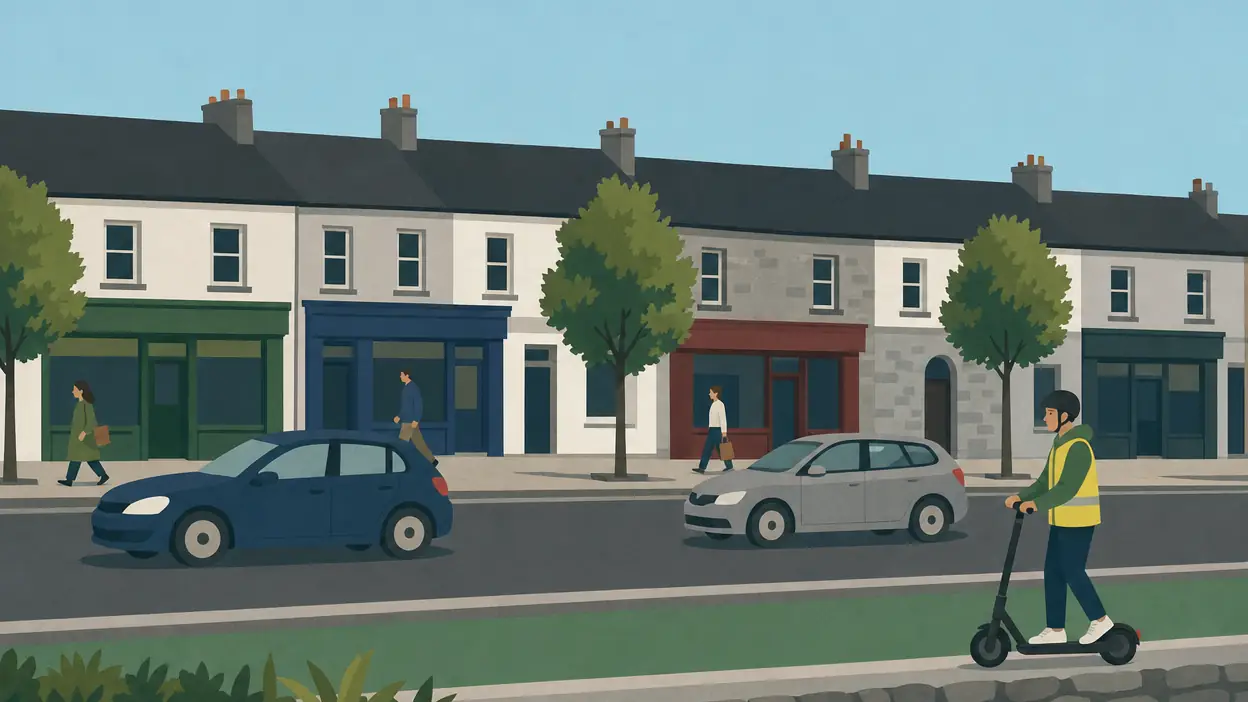
E-scooters and e-bikes have been legal on Irish roads since 20 May 2024, under the Road Traffic and Roads Act 2023.[1][2] The rules for e-scooters were tightened twice in autumn 2026. The other risk is at home: the lithium-ion battery, which fire services say can start a fast, toxic fire if it is charged or stored badly.[3][4]
The scene this guide is for
A teenager wants an e-scooter for the trip to college. A parent is choosing between an e-bike and a cheaper “e-bike” online that has a throttle. A commuter charges a scooter in the hall of an apartment block every night. Each of them is about to make a decision that the law, or the fire brigade, has already made for them.
E-scooters: who can ride, and where
The RSA and Citizens Information set out the rules.[1][2]
| Rule | What the law says |
|---|---|
| Age | 18 or over (since 2 October 2026). Gardaí can take an e-scooter from a rider under 18. |
| Helmet | Required (since 4 September 2026), securely fastened. |
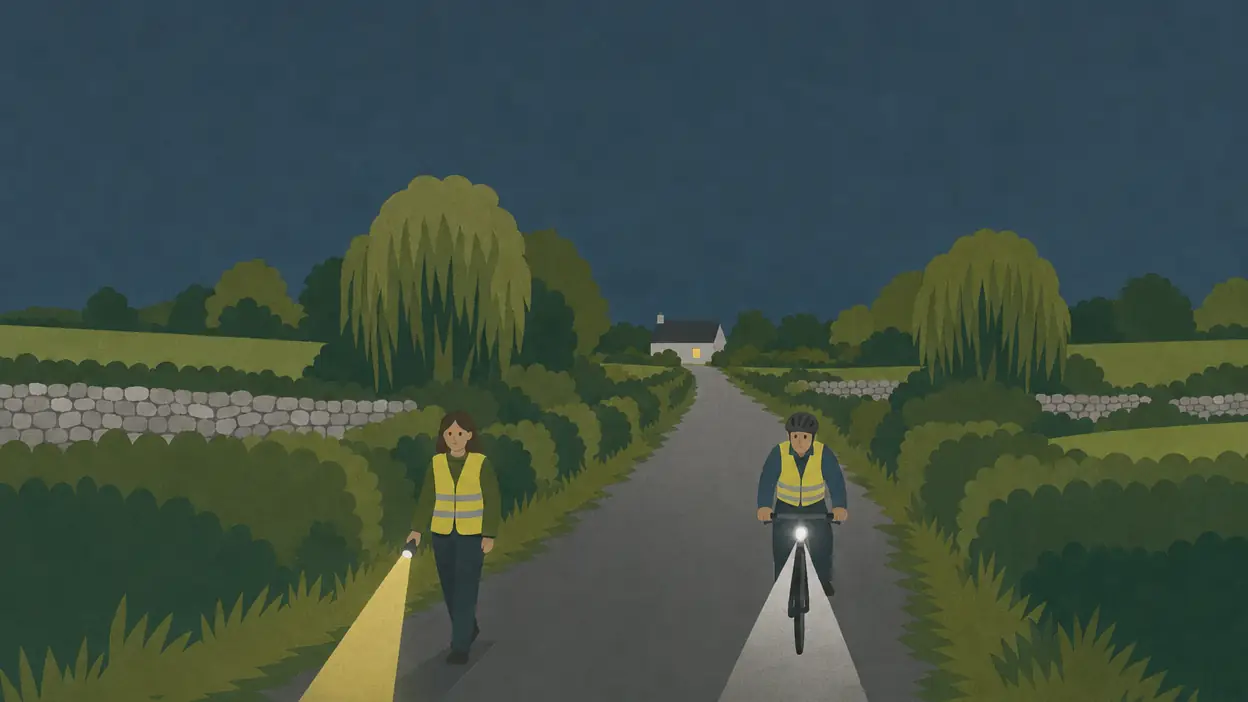
| Hi-vis | Required, covering at least the front and back of your body. |
| Speed | 20 km/h at most. |
| Where | Local, regional and national roads, cycle lanes and bus lanes. Keep to the left. |
| Not allowed | Footpaths, pedestrianised areas and motorways. |
| Passengers and loads | One person only. No passengers, goods or bulky items. |
| Phone and music | You must not use or hold a phone, or listen to music. |
| Alcohol and drugs | Not allowed. A court fine of up to €2,000. |
| Licence, tax, insurance | Not needed. |
E-scooters are also banned on all National Transport Authority services, including Dublin Bus, Bus Éireann, Iarnród Éireann and Luas. The ban does not cover e-bikes.[2]
Fines: most e-scooter offences carry a fixed charge of €50. From 18 November 2026 that rises to €100, and there is a new fixed charge for not wearing a helmet or hi-vis.[5] If Gardaí detain an e-scooter, getting it back costs €80 for the first day and €30 for each day after.[2]
The scooter itself
To be legal on a public road, an e-scooter must weigh no more than 25 kg with its battery, have a motor of no more than 400 watts, be designed to go no faster than 20 km/h, have wheels at least 200 mm across, and have no seat. It needs front and rear lights, reflectors, front and rear brakes, a bell, and a maker’s plate showing the power, weight and design speed.[1][2]
A scooter that does not meet these rules cannot be used legally in a public place, and Gardaí may seize it.[1]
E-bikes and e-mopeds: the line that matters
An e-bike, in Irish law, has a motor of up to 250 watts that only helps while you pedal and cuts out at 25 km/h.[6] It is treated like an ordinary bicycle:[6][7]
- no licence, registration, tax or insurance;
- no minimum age, though the RSA strongly recommends young children are always supervised;
- cycle lanes and bus lanes are allowed; footpaths, pedestrianised areas and motorways are not;
- front and rear lights are required by law after dark;
- a helmet and hi-vis are strongly recommended but not legally required;
- no holding or using a phone; no riding under the influence (a fine of up to €2,000);
- e-bikes are allowed on public transport.
For road position, junctions and locks, see the cycling safety guide.
Anything more powerful, faster, or that moves on a throttle without pedalling is an e-moped, a mechanically propelled vehicle.[6] E-mopeds need EU type approval, registration and motor tax, and the rider must be at least 16. Throttle models, and the faster 45 km/h type, cannot use cycle lanes or bus lanes and need a driving licence. Throttle models need insurance too. For the slower 25 km/h throttle type, that applies when it weighs over 25 kg and can go faster than 14 km/h.[6]
Decision rule if the bike moves when you twist a grip and do not pedal, it is not an e-bike. Do not ride it on the road until it is type-approved, registered and taxed, with insurance and a licence where the law requires them.[6]
Buying one safely
The RSA, Citizens Information and the fire services agree on the basics:[1][6][7][3][4]
- Buy from a reputable retailer. Dublin Fire Brigade warns that buying from an auction site or unfamiliar company can cost you your consumer rights and your safety.
- Check for a genuine CE mark and a maker’s plate with the manufacturer, date and serial number.
- Ask for the Declaration of Conformity. The retailer should give you one.
- For an e-scooter, the RSA says compliance can be shown against the standard I.S. EN 17128:2020.[1] We did not find an Irish official source that names a standard for e-bikes, so we do not quote one.
- Be wary of a price that looks too good to be true. The RSA says it may not meet the law or be safe.
- Return it if the manual is missing, not in English, or full of mistakes.[4]
- Have a second-hand one checked by a reputable technician, because you do not know its history.[4][3]
Do not buy loose replacement batteries from unknown sellers. In February 2024 the CCPC warned that UPP Battery e-bike battery packs sold on Amazon, AliExpress, eBay and other marketplaces were poorly built and could overcharge, overheat and catch fire.[8]
Charging the battery at home
The fire services say charging is the highest-risk time for an e-scooter or e-bike.[3] Dublin Fire Brigade’s rules:[4]
- Use the charger that came with it. If you need a new one, get a genuine one from the same maker or retailer.
- Charge outside if you can.
- Never charge in the shared hall or stairwell of an apartment block. It is a protected fire escape route.
- Inside, never charge in the hallway or anywhere a fire would block your way out of the home.
- Charge only until it is full. Do not charge it overnight.
- Unplug the charger when you go out, even for a few minutes.
- Never cover it with coats or jumpers while charging. The heat needs to escape.
- Plan your escape routes in advance.
Warning signs that a battery is failing: a burning smell, hissing or popping, too much heat, or the scooter or bike behaving oddly. Stop using it at once.[3] If you see smoke, gas or flames, get everyone out immediately: the fumes are extremely toxic. Follow the steps below.[4]
If a battery smokes or catches fire
A lithium-ion fire grows fast, makes its own oxygen and gives off toxic fumes. Domestic fire extinguishers will not put it out.[4] Dublin Fire Brigade says:[4]
“Unplug the charger if it is safe to do so.”
“Close the door to the room or apartment that the fire is in.”
“Evacuate the home immediately by shouting or, in an apartment block, by pressing the fire alarm break-glass unit.”
“Call 999 or 112 when it is safe to do so and tell the call-taker that an e-scooter or e-bicycle is involved.”
“Do not re-enter the building for any reason!”
Call 112 or 999. More on smoke alarms and fire escape plans is in our guide to fire safety and smoke alarms at home.
Cannot make a voice call? Text 112.
The emergency text service can be used by "anyone who is not able to make a voice call due to a speech or hearing impairment or other situations where a voice call might not be possible". It works "from any Irish registered mobile phone (either pre-pay or bill pay) on all the Irish Mobile networks". If you can talk, ring instead: a text is slower.
Your text needs four things:
- Which service: Ambulance, Coastguard, Fire or An Garda Síochána.
- What the problem is.
- County you are texting from.
- Where help is needed: town, road, Eircode or a landmark.
Wait for a reply: "an SMS/Text 'Delivery Report' does not mean your message has been received". If no reply comes within 3 minutes, send another message straight away. It does not work from a foreign phone, or from an Irish phone roaming abroad, including in Northern Ireland.
No registration is needed. 112.ie says: "There is no preparation or registration required to use either Emergency SMS, or RTT when contacting the ECAS." If you might need to text one day, you can choose to give the service your address, access details and a next of kin in advance at 112.ie/register. Most smartphones can also use Real-Time Text to type during a call to 112 or 999: turn on RTT in your phone’s accessibility settings.
Source: 112.ie, emergency text service, sending a text to 112, SMS questions and answers, emergency SMS terms and conditions and Real-Time Text pages, checked 1 November 2026.
If you crash
Report it to the Gardaí. If a car or van hit you, swap details with the driver, including insurance. If you are hit by an e-scooter rider, report it to the Gardaí and ask for the rider’s name and address.[2] Get medical help if anyone is hurt.[2]
For parents
- An e-scooter is not for under-18s. Since 2 October 2026 a child cannot legally ride one in a public place, and Gardaí can take it.[1][2]
- An e-bike has no minimum age, but the RSA strongly recommends young children are always supervised.[6] The RSA also advises that children under 12 should not ride bicycles in any traffic.[9]
- Check the bike is really an e-bike. A throttle model is an e-moped: the rider must be 16, and it needs registration and tax.[6]
- Agree where it charges. Not in the hall or on an escape route, and not overnight.[4]
- A helmet is the law on an e-scooter and strongly advised on an e-bike.[1][6]
For the Government’s advice, see Road safety from Be Emergency Ready (gov.ie).
Common questions
How old do you have to be to ride an e-scooter in Ireland?
You must be 18 or over since 2 October 2026. Gardaí can confiscate an e-scooter ridden by someone under 18.[2]
Do I need a helmet on an e-scooter or an e-bike?
On an e-scooter, yes: a helmet and hi-vis have been required by law since 4 September 2026. On an e-bike they are strongly recommended but not legally required.[1][6]
What is the difference between an e-bike and an e-moped?
An e-bike has a motor of up to 250 watts that only helps while you pedal and cuts out at 25 km/h. Anything more powerful, faster or throttle-driven is an e-moped and needs registration and tax.[6]
Can I charge my e-scooter overnight?
No. Dublin Fire Brigade says to charge only until the battery is full, never overnight, and to unplug it if you leave the house.[4]
Can I ride an e-scooter on the footpath?
No. E-scooters are not allowed on footpaths, in pedestrianised areas or on motorways.[1]
Data sources (9), all checked 2026-11-01
Footnotes
-
Road Safety Authority, E-scooters. Rules since 20 May 2024, helmet and hi-vis from 4 September 2026, age 18 from 2 October 2026, technical requirements, I.S. EN 17128:2020, fixed charges, intoxicants. Checked 1 November 2026. ↩ ↩2 ↩3 ↩4 ↩5 ↩6 ↩7 ↩8 ↩9 ↩10
-
Citizens Information, E-scooters. Page edited 21 October 2026. Where you can ride, public transport ban, detention fees, Garda confiscation, crashes. Checked 1 November 2026. ↩ ↩2 ↩3 ↩4 ↩5 ↩6 ↩7 ↩8 ↩9
-
Fire Ireland, E-scooter and e-bike fire safety. Buying safely, charging as the highest-risk activity, warning signs. Checked 1 November 2026. ↩ ↩2 ↩3 ↩4 ↩5
-
Dublin Fire Brigade, Fire safety for e-scooters, e-bikes and hoverboards. Choosing a model, charging rules, what to do if it is on fire (quoted). Checked 1 November 2026. ↩ ↩2 ↩3 ↩4 ↩5 ↩6 ↩7 ↩8 ↩9 ↩10
-
Department of Transport, New offences and increased penalties for unsafe use of e-scooters (20 October 2026). Fixed charge rising from €50 to €100 on 18 November 2026. Checked 1 November 2026. ↩
-
Road Safety Authority, E-bikes and e-mopeds. Definitions, quick reference table, children, lights, helmets, buying. Checked 1 November 2026. ↩ ↩2 ↩3 ↩4 ↩5 ↩6 ↩7 ↩8 ↩9 ↩10 ↩11
-
Citizens Information, E-bikes. Page edited 12 January 2026. Public transport, buying. Checked 1 November 2026. ↩ ↩2
-
Competition and Consumer Protection Commission, Product safety notice on UPP Battery e-bike battery packs (15 February 2024). Checked 1 November 2026. ↩
-
Road Safety Authority, Cycle safety booklet. Children under 12 in traffic. Checked 1 November 2026. ↩
prepared.ie is independent public information. It is not affiliated with the Government of Ireland, the RSA, Dublin Fire Brigade or any agency. In an emergency, call 112 or 999.