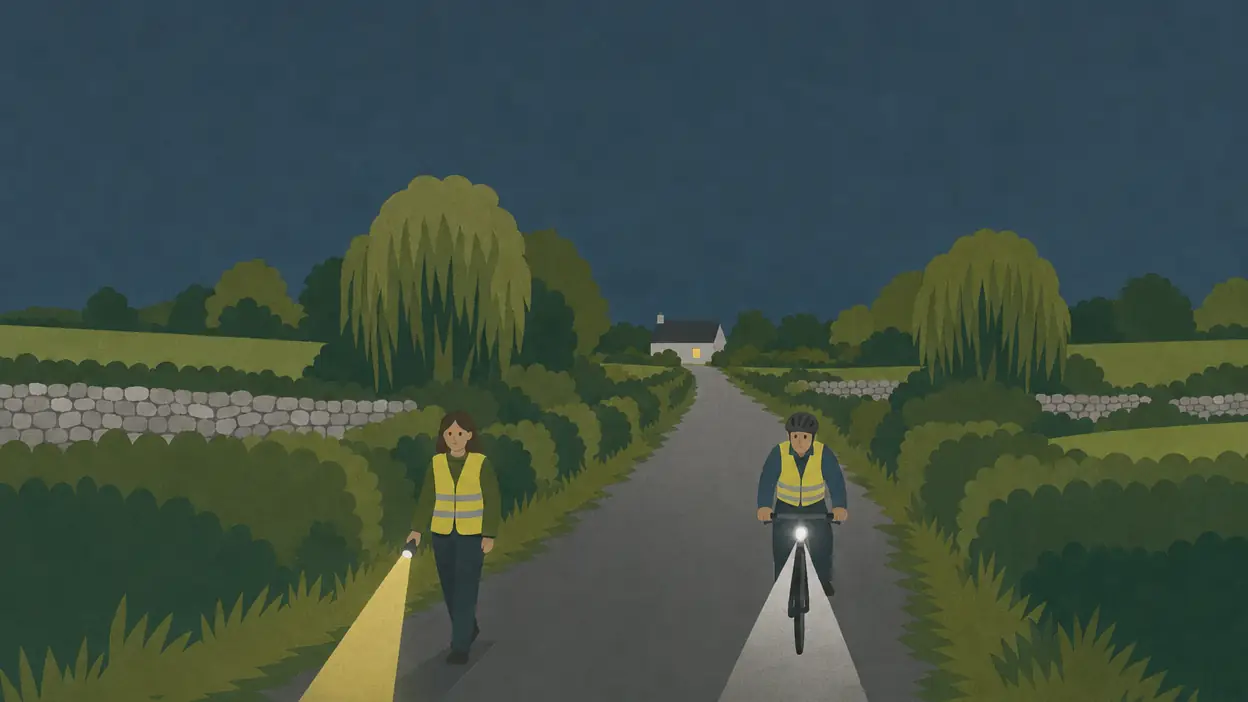
Pedestrian deaths and serious injuries rise every year from October to December. RSA figures published in October 2026 show that 38% of pedestrian deaths happen between October and December.[1] Most of what keeps you safe costs nothing: where you walk, when your lights go on, and being seen.
The scene this guide is for
It is 5.15pm in late November and already dark. You cycle home from work on a regional road with no street lights. Someone else is walking the dog on a country lane with no footpath. A child waits for the school bus at 7.50am, before sunrise. A runner heads out at 6am. A group walks home from the pub along the main road.
Drivers see all of them late. The rules below are what lets them be seen in time.
The law on bike lights
The rules come from the Road Traffic (Lighting of Vehicles) Regulations 1963, as amended. Citizens Information sets them out:[2]
- A red rear reflector, always. Every bike on a public road must have one, day and night. The only exception is a child’s bike used in daylight.
- Lights during lighting-up time. That runs from half an hour after sunset to half an hour before sunrise the next morning. During those hours you must have, and use:
- one front light showing white or yellow, visible for a reasonable distance; and
- one rear light showing red, visible for a reasonable distance.
- Flashing lights are legal, front and rear, under S.I. 487 of 2009.
- You do not need them lit when you are stopped in traffic, or when you wheel the bike on foot close to the left-hand edge of the road.
The penalty: no front or rear light during lighting-up hours is a fixed charge offence. The fine is €40. If it is not paid within 28 days it goes up by 50%, and after 56 days it goes to court.[3]
How bright? The law says “a reasonable distance”. The RSA’s cycle safety booklet gives a target: other road users should see your front light from 150 metres and your red tail light from 180 metres.[4] Pedal reflectors, where fitted, must be amber.[4]
Your bike must also have a bell that can be heard from a reasonable distance, and front and rear brakes.[3]
Helmets and hi-vis on a bike
There is no law in Ireland that says you must wear a helmet or hi-vis while cycling. The RSA advises wearing both.[3] If you buy them, the RSA booklet lists the standards to look for: EN 1078 for a helmet, EN ISO 20471:2013 for an adult hi-vis vest, EN 1150 for a child’s vest, and EN 13356 for armbands and Sam Browne belts.[4] More on riding safely is in the cycling safety guide.
Walking on a road with no footpath
The RSA’s rules for walking beside or along a road:[5]
- If there is a footpath, you must use it.
- If there is none, you must walk as close as you can to the right-hand side of the road, facing oncoming traffic.
- On a narrow or busy road, walk in single file, and never more than two side by side.
- At night, wear reflective clothing and carry a torch. By day, wear bright clothing.
- A group of more than 20 people should walk on the left, with the traffic.
The RSA’s rule is bright clothing by day and reflective clothing at night. It says reflective armbands, hi-vis belts and vests and other reflective clothing help you be seen from a distance, especially at night.[5]
In fog, the RSA adds one more: do not wear earphones, because you need to hear traffic.[6]
Hi-vis from the RSA
The RSA offers hi-vis materials to anyone who wants some.[5] Its order site lists adult and children’s reflective armbands, vests, running bibs and rucksack covers. Stock is released each month, so if something is out of stock, try again the first week of the next month.[7] We did not see a price on the order pages.
Order RSA hi-vis online only. The RSA asks people not to phone or email for it.[7]
Children walking to school or the bus
The RSA says children cannot deal safely with traffic on their own until about 12 years old, because their sense of speed and distance is still developing. Before that age they need an adult to help them walk on and cross the road.[5]
In December the morning bus stop is in the dark. The RSA order site lists children’s reflective armbands, so a child waiting for the bus can be seen.[7]
Walking home after a night out
The RSA says never to walk on the road after drinking, at any time of day or night. Before you go out, arrange how you will get home.[5] The RSA and Gardaí warned before the October 2026 bank holiday that winter is when pedestrian deaths rise, and asked walkers and cyclists to wear hi-vis.[1]
Runners and dog walkers
The same rules apply: the right-hand side facing traffic where there is no footpath, reflective clothing and a torch at night.[5] A head torch keeps both hands free (kit options: Head torch).
If you have low vision
At pedestrian lights, there may be an audible bleep or a vibrating panel on the push button to tell you when it is safe to cross.[5] Vision Ireland, the national organisation for people with sight loss, is the place to ask for more help.[8]
E-scooters
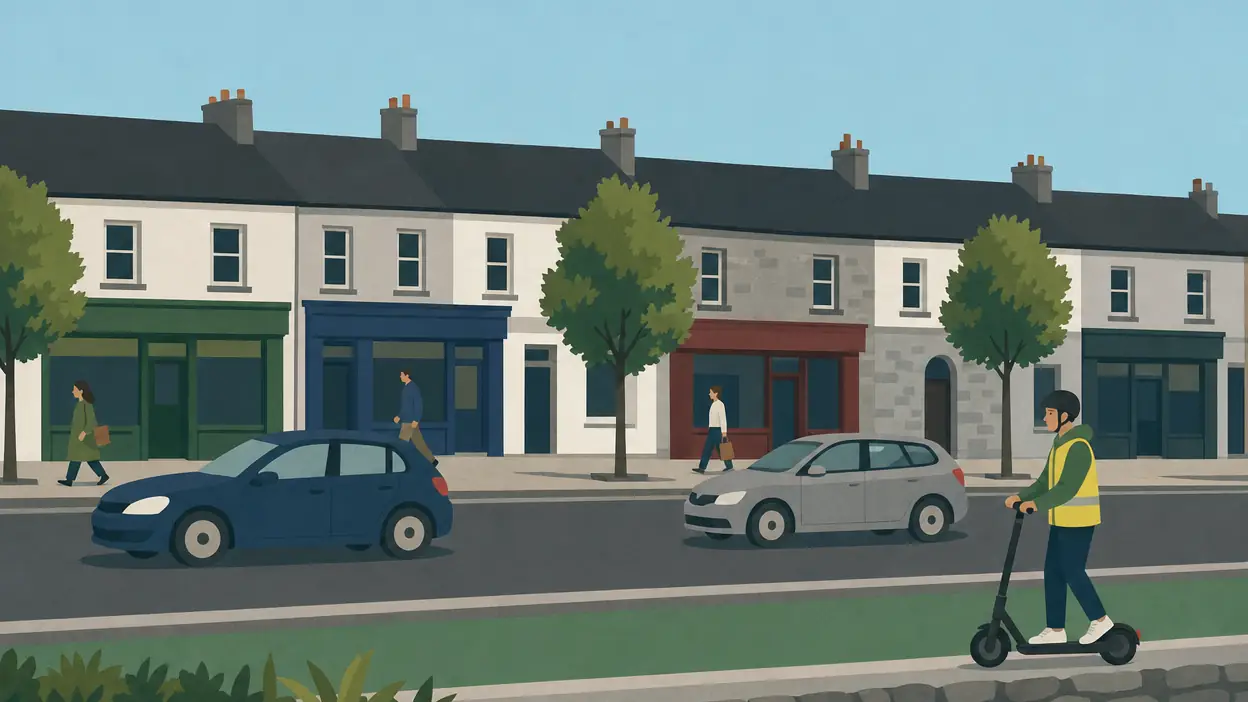
E-scooters have their own rules, and two changed in autumn 2026. From 4 September 2026 riders must wear a helmet and hi-vis covering the front and back of the torso. From 2 October 2026 the minimum age is 18.[9]
An e-scooter must also have lights, reflectors, a bell and brakes. Riders must not use the footpath, hold a phone or listen to music. Riding without proper lights and reflectors carries a fixed charge of €50.[9] The full rules are in E-scooters and e-bikes.
For drivers
The RSA and Gardaí ask drivers to use dipped headlights during the day in winter, especially if the car has no daytime running lights.[1] When you overtake a cyclist, Citizens Information says the recommended gap is 1.5 metres where the limit is above 50 km/h, and one metre below that. Overtaking a cyclist dangerously is a fixed charge offence of €120 with three penalty points.[3]
If something happens
If you are hit, or you find someone hurt on the road, call 112 or 999.
Cannot make a voice call? Text 112.
The emergency text service can be used by "anyone who is not able to make a voice call due to a speech or hearing impairment or other situations where a voice call might not be possible". It works "from any Irish registered mobile phone (either pre-pay or bill pay) on all the Irish Mobile networks". If you can talk, ring instead: a text is slower.
Your text needs four things:
- Which service: Ambulance, Coastguard, Fire or An Garda Síochána.
- What the problem is.
- County you are texting from.
- Where help is needed: town, road, Eircode or a landmark.
Wait for a reply: "an SMS/Text 'Delivery Report' does not mean your message has been received". If no reply comes within 3 minutes, send another message straight away. It does not work from a foreign phone, or from an Irish phone roaming abroad, including in Northern Ireland.
No registration is needed. 112.ie says: "There is no preparation or registration required to use either Emergency SMS, or RTT when contacting the ECAS." If you might need to text one day, you can choose to give the service your address, access details and a next of kin in advance at 112.ie/register. Most smartphones can also use Real-Time Text to type during a call to 112 or 999: turn on RTT in your phone’s accessibility settings.
Source: 112.ie, emergency text service, sending a text to 112, SMS questions and answers, emergency SMS terms and conditions and Real-Time Text pages, checked 1 November 2026.
For the Government’s advice, see Road safety from Be Emergency Ready (gov.ie).
Common questions
What lights does a bike need in Ireland at night?
From half an hour after sunset to half an hour before sunrise, a bike must show a white or yellow front light and a red rear light. It must carry a red rear reflector at all times, and flashing lights are legal.[2]
What is the fine for cycling without lights in Ireland?
No front or rear light during lighting-up hours is a fixed charge offence with a €40 fine. It rises by 50% if not paid within 28 days.[3]
Which side of the road should I walk on if there is no footpath?
The RSA says you must walk as near as possible to the right-hand side of the road, facing oncoming traffic. Groups of more than 20 should walk on the left.[5]
Is it the law to wear a helmet or hi-vis on a bike in Ireland?
No, neither is required by law for cyclists, but the RSA advises wearing both. E-scooter riders are different: since 4 September 2026 they must wear a helmet and hi-vis.[3][9]
Can I get hi-vis from the RSA?
Yes, the RSA offers hi-vis materials to anyone who wants some, ordered through its order website. Stock is released each month, so try again the following month if an item is out.[5][7]
Data sources (9), all checked 2026-11-01
Footnotes
-
Road Safety Authority and An Garda Síochána, Pedestrian warning for the October bank holiday weekend (22 October 2026). RSA research 2021 to 2025: 38% of pedestrian deaths between October and December; dipped headlights by day. Checked 1 November 2026. ↩ ↩2 ↩3
-
Citizens Information, Lighting of bicycles in Ireland. Page edited 30 June 2025. Rear reflector, lighting-up time, front and rear lights, flashing lights. Checked 1 November 2026. ↩ ↩2
-
Citizens Information, Laws on cycling in Ireland. Fixed charge offences and the €40 fine, bell and brakes, helmets and hi-vis, overtaking distances. Checked 1 November 2026. ↩ ↩2 ↩3 ↩4 ↩5 ↩6
-
Road Safety Authority, Cycle safety booklet. Light visibility of 150 and 180 metres, amber pedal reflectors, helmet and hi-vis standards. Checked 1 November 2026. ↩ ↩2 ↩3
-
Road Safety Authority, Pedestrian safety. Walking beside or along a road, hi-vis materials, children under 12, pedestrian lights. Checked 1 November 2026. ↩ ↩2 ↩3 ↩4 ↩5 ↩6 ↩7 ↩8 ↩9
-
Road Safety Authority, Severe weather advice for road users (April 2009). Earphones in fog. Checked 1 November 2026. ↩
-
Road Safety Authority, High visibility orders. Items listed, monthly stock, online orders only. Checked 1 November 2026. ↩ ↩2 ↩3 ↩4
-
Vision Ireland, the national organisation for people with sight loss. Checked 1 November 2026. ↩
-
Road Safety Authority, E-scooters. Helmet and hi-vis from 4 September 2026, minimum age 18 from 2 October 2026, equipment, fixed charges. Checked 1 November 2026. ↩ ↩2 ↩3
prepared.ie is independent public information. It is not affiliated with the Government of Ireland, the RSA or any agency. In an emergency, call 112 or 999.