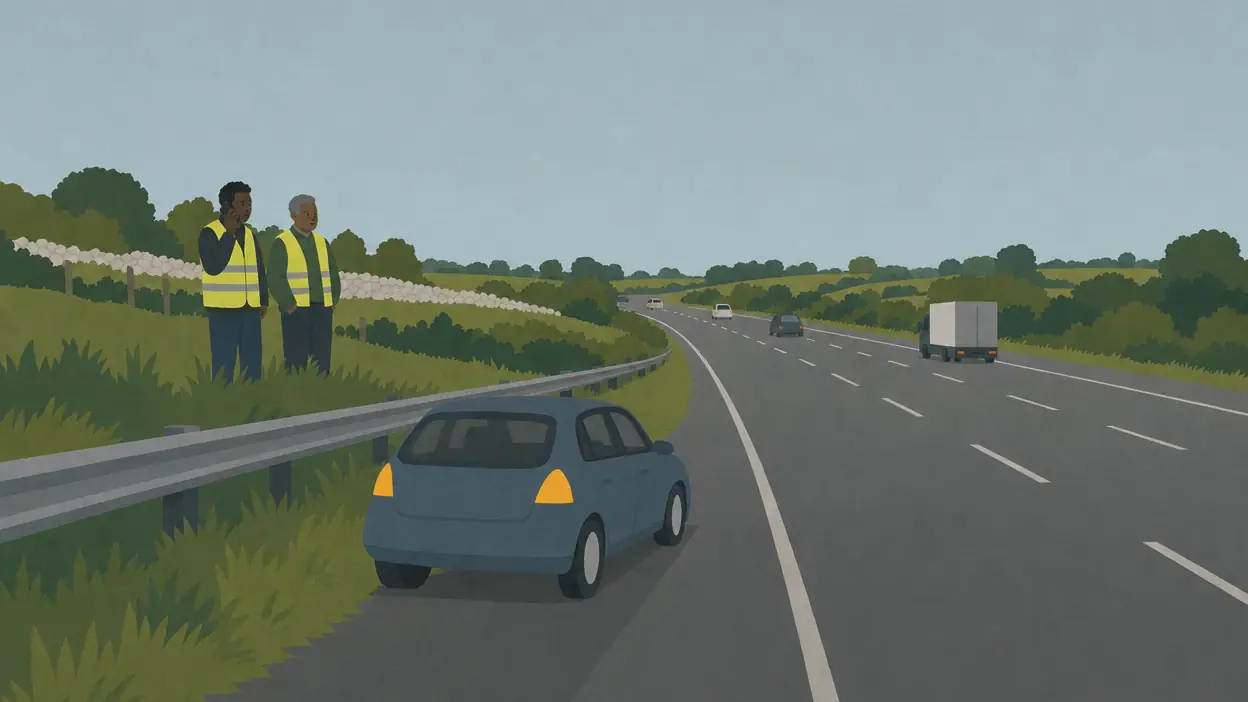
The Road Safety Authority (RSA) says motorways are statistically the safest way to move large volumes of traffic, but there are still risks.[1] AA Ireland, a motoring organisation, calls the hard shoulder one of the most dangerous places on any road, so the aim is to spend as little time on it as you can, and none of it standing beside the car.[2]
The scene this guide is for
It is 5.40pm on the M50, in the rain, and the rear tyre goes. Traffic is moving at 100 km/h a metre from your door. In the back are a baby in a car seat and a dog.
Or the engine cuts out in lane two of a dual carriageway at night and you cannot reach the side. Each case has a plan, and the plan is set by the RSA.
First, can you get off the motorway?
If the car is still moving, look out for the marked parking areas the RSA mentions, or get off at the next exit.[1] AA Ireland, a motoring organisation, says the hard shoulder is one of the most dangerous places on any road and is for real emergencies only. It says to drive to a safer place off the motorway if you can.[2]
If you have to stop on the hard shoulder
The RSA’s steps, from its motorway booklet:[1]
- Move onto the hard shoulder and park as far to the left as you can. If you cannot reach it, switch on your hazard lights to warn other drivers.
- Turn the wheels to the left and keep your sidelights on as well in poor weather.[3]
- Do not place a warning triangle or any warning device on the motorway. The RSA says it may be too dangerous.
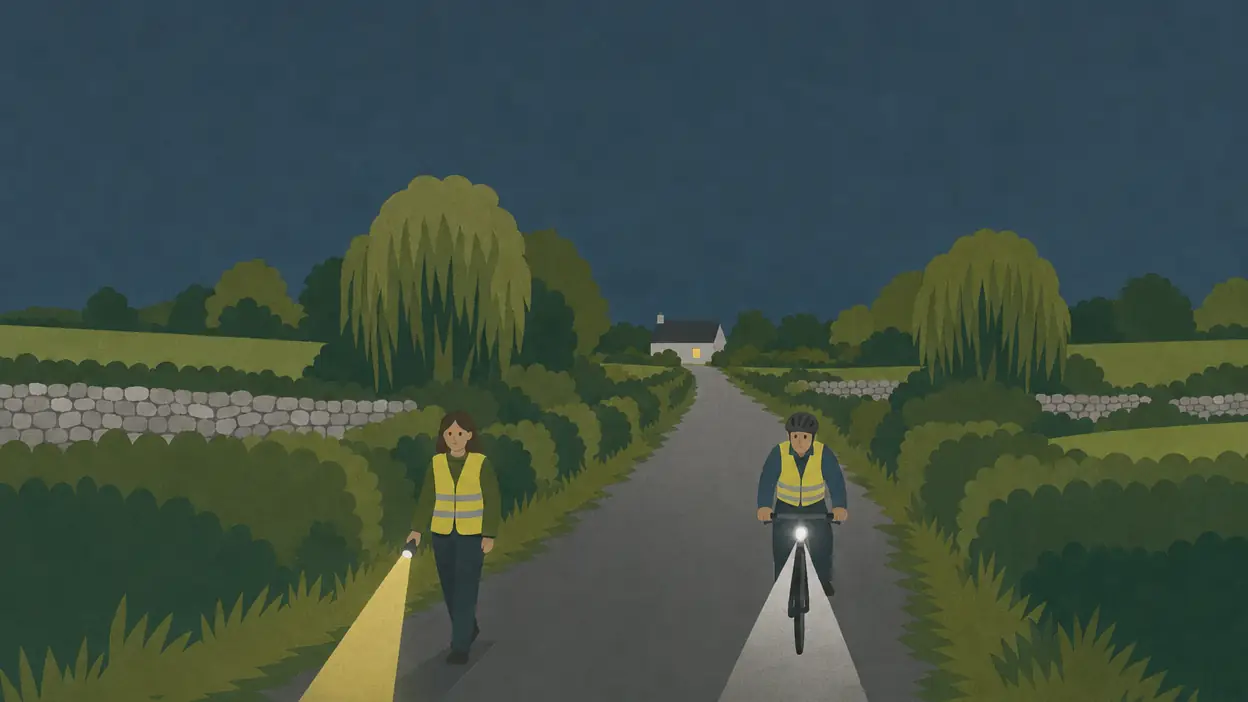
- Put on a hi-vis vest. Carry at least one in the car, and preferably one for each passenger.
- Get out by the left-hand door, and make sure your passengers do the same. Do not walk on the motorway.
- Wait on the embankment side, well behind the crash barrier, away from the lanes and the hard shoulder. Keep children under control.
“If for some reason you are unable to follow the above advice, you should stay in your vehicle with your safety belt securely fastened and switch on your hazard lights.”[1]
Who to call
Motorway Traffic Control Centre (MTCC): 0818 715 100. TII runs this helpline for anyone in difficulty on a motorway.[5]
- The roadside emergency phone tells the control centre exactly where you are, so use it if you have stopped beside one.[1] Otherwise ring from your mobile once you are behind the barrier.
- Use the phone on your side of the road. AA Ireland says to follow the arrows on the posts at the back of the hard shoulder and never to cross the carriageway to reach one. It says the phone is free, and to face oncoming traffic while you use it.[2]
- From a mobile, read out the nearest location sign or the marker painted on the hard shoulder (see below).[1]
- If anyone is hurt, the car is on fire, or you are stuck in a live lane, call 112 or 999.
- Your breakdown provider next, once you are behind the barrier.
Cannot make a voice call? Text 112.
The emergency text service can be used by "anyone who is not able to make a voice call due to a speech or hearing impairment or other situations where a voice call might not be possible". It works "from any Irish registered mobile phone (either pre-pay or bill pay) on all the Irish Mobile networks". If you can talk, ring instead: a text is slower.
Your text needs four things:
- Which service: Ambulance, Coastguard, Fire or An Garda Síochána.
- What the problem is.
- County you are texting from.
- Where help is needed: town, road, Eircode or a landmark.
Wait for a reply: "an SMS/Text 'Delivery Report' does not mean your message has been received". If no reply comes within 3 minutes, send another message straight away. It does not work from a foreign phone, or from an Irish phone roaming abroad, including in Northern Ireland.
No registration is needed. 112.ie says: "There is no preparation or registration required to use either Emergency SMS, or RTT when contacting the ECAS." If you might need to text one day, you can choose to give the service your address, access details and a next of kin in advance at 112.ie/register. Most smartphones can also use Real-Time Text to type during a call to 112 or 999: turn on RTT in your phone’s accessibility settings.
Source: 112.ie, emergency text service, sending a text to 112, SMS questions and answers, emergency SMS terms and conditions and Real-Time Text pages, checked 1 November 2026.
TII also lists an email address for the control centre, info@mtcc.ie.[6] In an emergency, text 112 rather than email.
How to say where you are
- Location signs stand on the verge, usually every 500 metres. Each has three lines: the road (for example M7), the direction (N, S, E or W) and the distance from the start of the route.[1]
- Markers painted on the hard shoulder every 100 metres give the same details. They also point to the nearest emergency phone.[1]
Read all three lines out exactly. That is faster than a junction name.
If you cannot get out, or should not
Some people cannot leave the car quickly: a wheelchair user, someone with a baby asleep in a fixed seat, an older passenger, someone who is unwell. The RSA does not give separate advice for this. Its rule for anyone who cannot follow the steps is the one quoted above: stay in, belt on, hazards on.[1]
AA Ireland says the same for anyone whose disability stops them following the usual advice: stay in the car with the hazard lights on, call the emergency services and be ready to say where you are.[2] Tell the control centre if you have specific needs.[2]
If you stop in a live lane because you could not reach the hard shoulder, switch on the hazard lights. If everyone can get out on the side away from traffic and get clear of the carriageway safely, do that and wait behind the barrier.[1][2] If you cannot, stay in with seatbelts fastened and the hazards on.[1] Either way, call 112 or 999.
Animals stay in the car. Only in an emergency should you take them out, and then keep them under control on the verge.[1]
If you feel at risk from another person while waiting, AA Ireland says to get back in by a left-hand door, lock the doors, and get out again when the danger has passed.[2]
Busy roads without a hard shoulder
On a national road or dual carriageway with no hard shoulder, the rules are similar but you have less room:[3]
- Get as far off the road as you can, switch on the hazards, and keep sidelights on in poor weather.
- Put hi-vis on everyone before anyone gets out, and get out by the left-hand side, away from other vehicles.
- A warning triangle goes 45 metres behind the car, says an RSA leaflet from June 2009. Be careful doing this, and do not try it if it is not safe.
- If you think another vehicle could hit you, get everyone out of the car and clear of the traffic.
The RSA says a car that blocks traffic or is likely to cause a crash should be towed at once to the nearest safe place, at no more than 32 km/h.[4]
In a tunnel
In a motorway tunnel, the RSA’s steps are different:[1]
- Switch on the hazard lights.
- Switch off the engine and leave the key in the ignition.
- Go to the emergency station and use its phone.
- Follow instructions on the FM radio and the electronic signs.
- If your engine is on fire, switch it off and leave the vehicle at once.
Getting going again
Before you rejoin the motorway, build up speed on the hard shoulder and wait for a safe gap. Watch for other vehicles stopped on the hard shoulder ahead.[1]
A car coming the wrong way
If you meet a vehicle driving against the traffic, the RSA says: stay calm, avoid sudden moves, and make as much space as you can. When it is safe, leave the motorway and call 112 or 999. Give the motorway, your direction of travel and a description.[7]
If you realise you are the one going the wrong way, pull onto the hard shoulder at once and stop. Do not turn, reverse or carry on. Get out on the side away from traffic if it is safe, or stay in with your belt on and hazards flashing, and call 112 or 999.[7]
Do you already have breakdown cover?
Check before you pay for anything. The Competition and Consumer Protection Commission (CCPC) says some car insurance policies include a recovery service and emergency breakdown help, but it is not always standard, and the age of the car can matter.[8] Read your policy documents, then decide whether you need separate cover. Motoring organisations such as AA Ireland sell it, and so do others.
What to keep in the car
The no-cost part is knowing the number. Save 0818 715 100 in your phone today.[5]
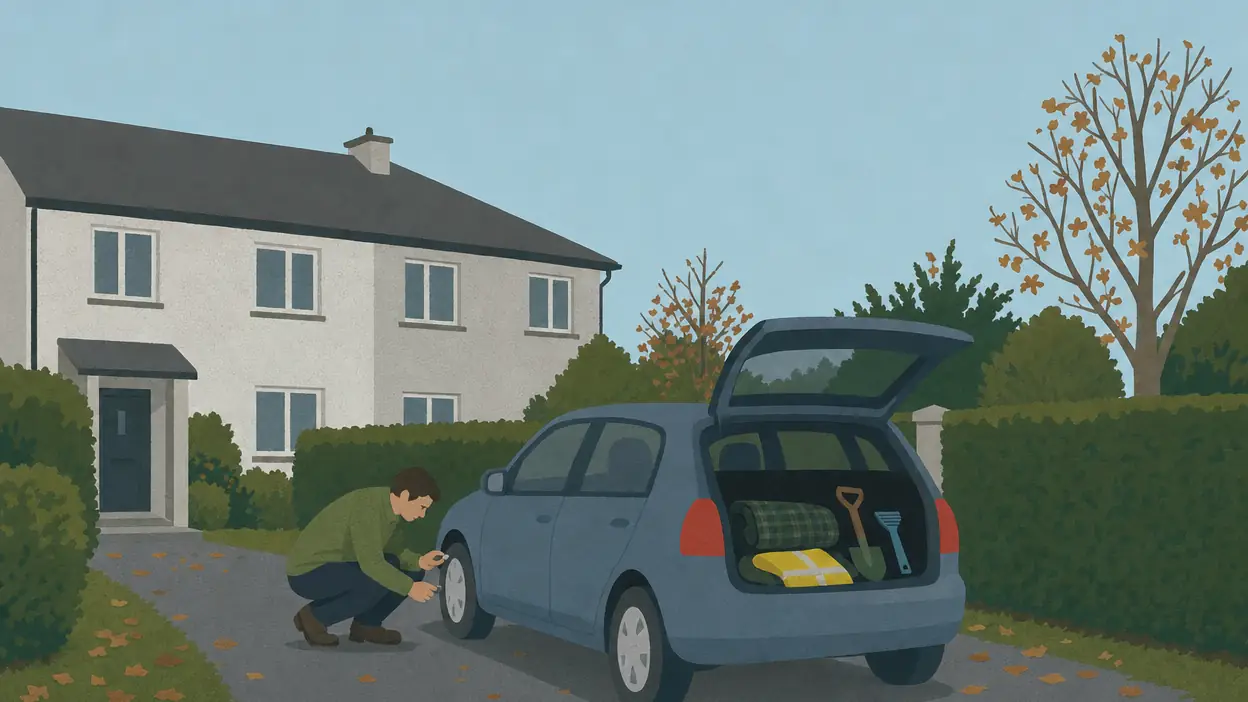
For the hard shoulder you need a hi-vis vest for everyone who travels with you.[1] A torch helps you be seen in the dark (kit options: Head torch), and a charged phone and power bank let you make the call (kit options: Phone bank). A warning triangle is for ordinary roads only, never a motorway.[1][3] The full list is in the car kit table.
For tyre and winter checks before a long drive, see Tyres and winter checks for your car, and for bad weather on the way, Driving in fog, black ice and heavy rain.
For the Government’s advice, see Road safety from Be Emergency Ready (gov.ie).
Common questions
What number do I ring if I break down on a motorway in Ireland?
Ring the Motorway Traffic Control Centre on 0818 715 100, or use the roadside emergency phone on your side of the road, which tells them where you are. If anyone is hurt or in danger, call 112 or 999.[5][1]
Should I put a warning triangle out on the motorway?
No. The RSA says not to place a triangle or any warning device on a motorway because it may be too dangerous.[1]
Should I stay in the car or get out on the hard shoulder?
Get out by the left-hand door and wait well behind the crash barrier if you can do it safely. If you cannot, the RSA says to stay in the car with your seatbelt fastened and your hazard lights on.[1]
Can I change a wheel on the hard shoulder?
No. The RSA says not to replace or repair a tyre on the motorway: park near the embankment, switch on the hazards and call a recovery operator.[4]
Where do I put a warning triangle on an ordinary road?
An RSA leaflet from June 2009 says 45 metres behind the car, and not to try it if it is not safe.[3]
Data sources (8), all checked 2026-11-01
Footnotes
-
Road Safety Authority, Motorway driving booklet (2018). Breakdown steps, no warning device on a motorway, hi-vis, left-hand door, waiting behind the barrier, the stay-in rule (quoted), location signs and markers, tunnels and rejoining. Checked 1 November 2026. ↩ ↩2 ↩3 ↩4 ↩5 ↩6 ↩7 ↩8 ↩9 ↩10 ↩11 ↩12 ↩13 ↩14 ↩15 ↩16 ↩17 ↩18 ↩19 ↩20
-
AA Ireland (a motoring organisation, not an authority), How to stay safe if you break down on a motorway, published 23 July 2021. Emergency phones, disability, feeling at risk. Checked 1 November 2026. ↩ ↩2 ↩3 ↩4 ↩5 ↩6 ↩7
-
Road Safety Authority, Towing a trailer or caravan leaflet (June 2009). Wheels to the left, sidelights in poor weather, hi-vis before getting out, triangle 45 metres behind, getting clear of traffic. Checked 1 November 2026. ↩ ↩2 ↩3 ↩4
-
Road Safety Authority, Wheel and tyre maintenance. Punctures on the motorway and at the roadside, towing at no more than 32 km/h. Checked 1 November 2026. ↩ ↩2 ↩3
-
Transport Infrastructure Ireland, Motorway emergency service call 0818 715 100. Checked 1 November 2026. ↩ ↩2 ↩3
-
Transport Infrastructure Ireland, Road maintenance. Motorway service helpline and the info@mtcc.ie address. Checked 1 November 2026. ↩
-
Road Safety Authority, Emergency advice: encountering a vehicle travelling in the wrong direction. Checked 1 November 2026. ↩ ↩2
-
Competition and Consumer Protection Commission, Car insurance. Recovery service and emergency breakdown assistance. Checked 1 November 2026. ↩
prepared.ie is independent public information. It is not affiliated with the Government of Ireland, the RSA, TII or any agency. In an emergency, call 112 or 999.