Tyres are the only part of the car that touches the road.[1] They are also the main reason cars fail the NCT. In the 12 months before October 2026, 193,232 cars failed on tyre condition, and 45,395 of those had tread below the legal 1.6 mm.[2]
The scene this guide is for
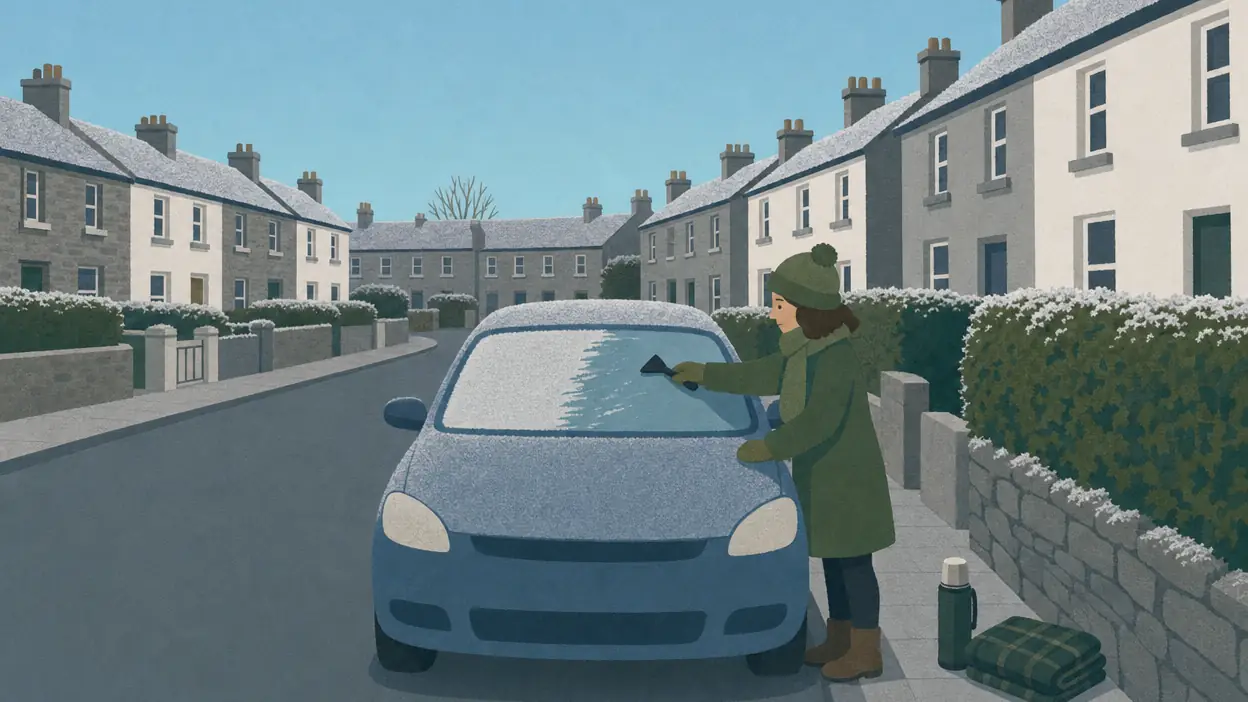
The first frost is forecast for the weekend. You are driving to see family for Christmas, two hours each way. Or the car is an older one that sits in the drive for a week at a time, and the spare has not been looked at since it was bought.
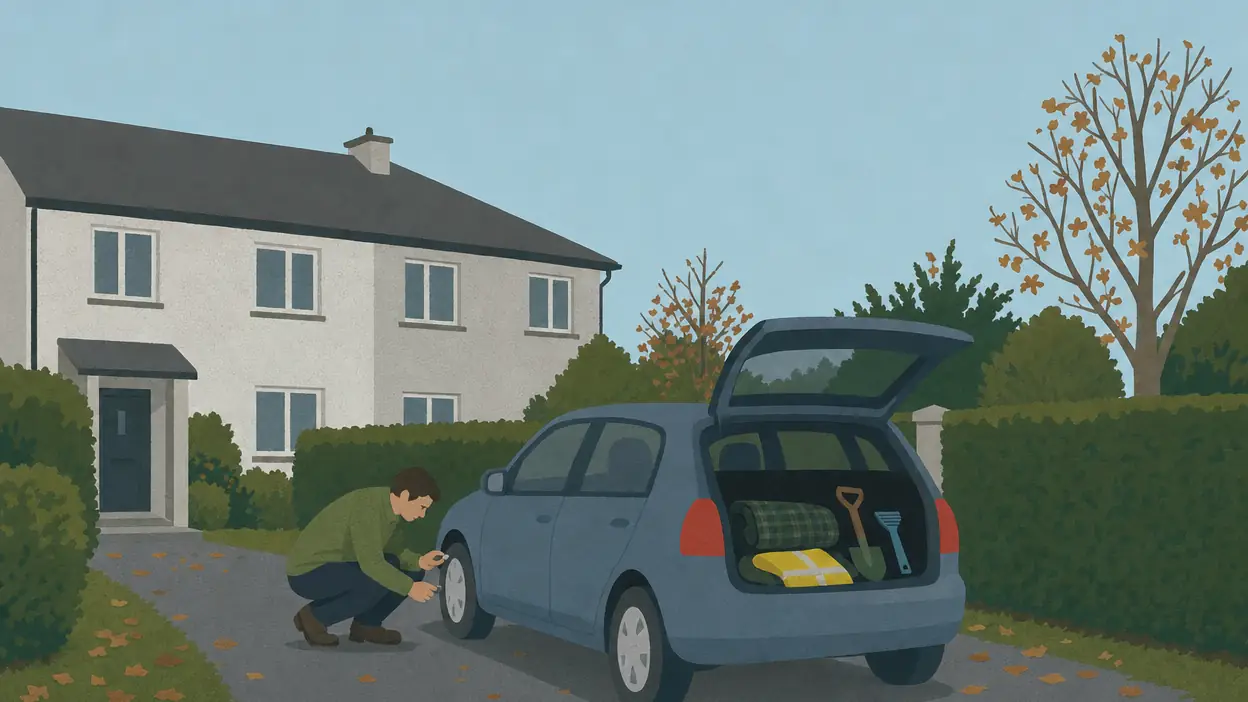
Ten minutes in the drive, with the car’s handbook and a €1 coin, covers most of what matters.
The tyre law, and the advice
| Tread depth | What it means |
|---|---|
| 8 mm | Most new tyres.[3] |
| 3 mm | The RSA’s advice: change the tyre before it gets below this.[3][4] |
| 1.6 mm | The legal minimum, across the central three-quarters of the tread.[3] |
A tyre with 3 mm in the centre and 1.6 mm at the edges is still legal, because the law looks at the central three-quarters.[3] The RSA still advises changing it at 3 mm. Worn or poor tyres can take up to twice the normal distance to stop, and they are more likely to aquaplane.[1] The RSA says to allow double the braking distance on wet roads.[2]
It is an offence to drive with defective or worn tyres.[3] Driving with defective or worn tyres is a fixed charge offence: €80 and 2 penalty points if you pay within 28 days, or €120 within the next 28 days. If it goes to court, it carries 4 penalty points and a larger fine.[5][6]
Motorbikes have a different limit: at least 1 mm across the whole tread.[1][2]
Check the tread for free
You do not need a gauge. The RSA’s method:[3]
“You can check your tyre tread depth by running a €1 coin along the centre of the wheel as illustrated. If the gold part of the coin is not visible, then the tyre tread is ok. However, if it is visible, your tyre could be approaching the minimum legal depth so you should get them checked.”
Every tyre also has small tread wear indicator blocks moulded into the grooves at 1.6 mm. If the tread is level with them, or below, the tyre is at the legal limit.[1]
The Irish Tyre Industry Association (ITIA) lists certified dealers who will check pressures and inspect tread, wear and damage.[3] During Irish Road Safety Week in October 2026, ITIA members offered these checks free.[2]
Pressures
The right pressure is in the car’s handbook, and often on a sticker on the driver’s door pillar or inside the fuel flap.[1] Check it regularly at a service station against that figure. The RSA says pressures vary with the model and the load being carried, so check the figure for a loaded car before a long trip.[1]
If your car has a tyre pressure warning light (TPMS), check and inflate all four tyres when it comes on. Reset the system only once the pressures are correct, following the handbook.[3][1] The RSA says you must not disable it.[3]
Age, damage and the spare
- Look for cuts, bulges, cracks and grazes each time you drive.[2]
- Check the age. A four-digit code on the sidewall gives the week and year it was made: 1223 means week 12 of 2023. Signs of ageing can start at six years.[1] At the NCT a tyre over six years old gets a pass advisory, not a fail.[3]
- Check the spare, or the inflation kit if your car has one instead. The RSA says to make sure the spare is in good condition and fully inflated, and that you know how to use the kit.[7]
- Space savers are for emergencies only. Never go over the speed rating marked on them.[3]
- Two tyres on the same axle must be the same size and type, or the car fails its test.[3]
Winter tyres, snow socks and chains
Irish law does not require winter tyres, and does not ban them.[1][8] If you fit them, the RSA says to fit a full set of four, and to swap back to all-season or summer tyres once the risk of snow has passed. The soft rubber wears faster in warmer weather.[1]
Most cars in Ireland run on summer tyres. The RSA says the name does not mean summer only: it just separates them from winter tyres.[1] All-season tyres sit between the two. Most carry a 3PMSF mark (a mountain with a snowflake) for severe snow.[1]
M+S is not the same as winter. A winter tyre has the mountain and snowflake symbol as well as M+S. A tyre with M+S alone may be a summer tyre.[8]
Snow chains, socks and studs: there is no law against them. They must be fitted to the tyre as the manufacturer says.[8] We do not recommend a pick. In heavy snow, the RSA’s advice is to stay off the road if you can.[9]
The 10-minute winter routine
The Office of Emergency Planning (OEP) lists what you can check yourself before winter. Get the car serviced as well.[10]
- Oil. Check the dipstick, and look for leaks on the ground under the car.[10]
- Electrics. Check the dashboard before and after starting. Listen for a weak battery and replace it if needed.[10]
- Tyres. Tread, pressure and the spare, as above.[10]
- Fuel. In winter, keep the tank as full as you can.[10]
The RSA’s shorter version is POWDER: petrol, oil, water, damage, electrics and rubber.[7] For snow and ice it adds two more: have the strength of the coolant measured, and use an engine oil suited to cold weather.[9]
The battery
A battery has to work harder in the cold. AA Ireland, a motoring organisation, says a car struggling to start is usually a sign of a weak battery, and that batteries generally need replacing about every five years.[11] If yours is near that age, have it tested before the first frost. If you ever need to jump-start the car, follow the steps in its handbook.
What it costs
The checks themselves cost nothing but ten minutes. Garage air pumps are generally a courtesy, and the RSA says garages are not required to keep them to an industry standard, so do not rely on the pump’s own reading alone.[3] Tyres are the expense. The RSA’s booklet works through an example: a €30 part-worn tyre with 3.6 mm of tread costs more per millimetre of usable tread than an €80 new one with 8 mm.[1] If you buy part-worn, check it is under six years old and has an E-mark.[1]
For the car kit to carry in winter, including the scraper and de-icer, see the car kit list. For driving on ice, in fog and in heavy rain, see Driving in fog, black ice and heavy rain.
For the Government’s advice, see Road safety from Be Emergency Ready (gov.ie).
Common questions
What is the legal tyre tread depth in Ireland?
The legal minimum is 1.6 mm across the central three-quarters of the tread. The RSA advises at least 3 mm for safety, and most new tyres have 8 mm.[3]
How do I check my tyre tread with a coin?
Run a €1 coin along the centre of the tyre: if the gold part is hidden, the tread is fine. If you can see the gold, get the tyres checked, because they may be near the legal limit.[3]
Do I need winter tyres in Ireland?
No, there is no law requiring or banning them. If you fit them, the RSA says to fit all four and change back once the risk of snow passes.[1]
Will my tyres fail the NCT if they are more than six years old?
Not if they have at least 1.6 mm of tread and no defects such as cuts or bulges. A tyre over six years old gets a pass advisory, which is not a failure.[3]
Are snow chains and snow socks legal in Ireland?
Yes, there is no law against them, but they must be fitted to the tyre as the manufacturer says.[8]
Data sources (11), all checked 2026-11-01
Footnotes
-
Road Safety Authority, Your guide to tyre safety. Dangers of poor tyres, tyre types and winter tyres, date codes and ageing, tread wear indicators, pressures, TPMS, part-worn example, motorcycle limit. Checked 1 November 2026. ↩ ↩2 ↩3 ↩4 ↩5 ↩6 ↩7 ↩8 ↩9 ↩10 ↩11 ↩12 ↩13 ↩14 ↩15
-
Road Safety Authority, RSA, An Garda Síochána and ITIA launch Tyre Safety Day (5 October 2026). NCT failure figures for the previous 12 months, free ITIA checks during Irish Road Safety Week, wet-weather braking, tyre tips. Checked 1 November 2026. ↩ ↩2 ↩3 ↩4 ↩5
-
Road Safety Authority, Wheel and tyre maintenance. 1.6 mm, 3.0 mm and 8.0 mm; central three-quarters; €1 coin test (quoted); ITIA dealers; offence; six-year pass advisory; TPMS; space savers; axles; garage air. Checked 1 November 2026. ↩ ↩2 ↩3 ↩4 ↩5 ↩6 ↩7 ↩8 ↩9 ↩10 ↩11 ↩12 ↩13 ↩14 ↩15 ↩16
-
Road Safety Authority, Severe weather campaign: is your vehicle ready for winter? Checked 1 November 2026. ↩ ↩2
-
Citizens Information, Driving offences, page edited 24 August 2026. Defective or worn tyres: fixed charge, penalty points and court. Checked 1 November 2026. ↩
-
Road Safety Authority, Types of penalty point offences. “Using a vehicle with defective or worn tyres”: 2 or 4 points, €80, €120 or €160. Checked 1 November 2026. ↩
-
Road Safety Authority, Severe weather advice for road users (April 2009). POWDER checks, washer fluid, spare wheel and inflation kit. Checked 1 November 2026. ↩ ↩2 ↩3
-
Road Safety Authority, Buying tyres. Winter tyres, traction devices, M+S and the winter symbol. Checked 1 November 2026. ↩ ↩2 ↩3 ↩4
-
Road Safety Authority, Top 10 safety tips for driving in snow and ice. Spare bulbs, coolant strength, engine oil for cold, stay at home in extreme weather. Checked 1 November 2026. ↩ ↩2 ↩3
-
Office of Emergency Planning, Road safety guide, last updated 26 August 2026. Is your vehicle winter ready, and fuel in winter. Checked 1 November 2026. ↩ ↩2 ↩3 ↩4 ↩5 ↩6 ↩7 ↩8
-
AA Ireland (a motoring organisation, not an authority), 12 vital checks to get your car winter ready, published 5 November 2021. Battery age and cold starts. Checked 1 November 2026. ↩
prepared.ie is independent public information. It is not affiliated with the Government of Ireland, the RSA, the NCTS or any agency. In an emergency, call 112 or 999.