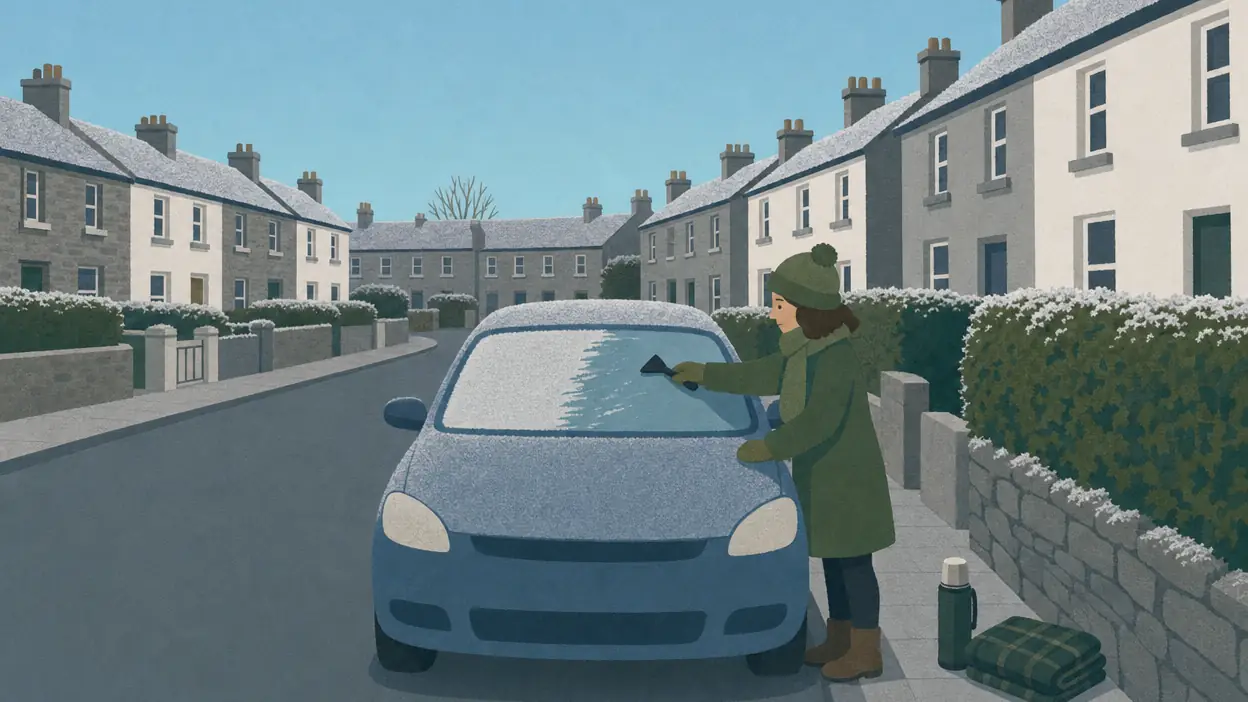
The Road Safety Authority (RSA) puts it in one line: in extreme weather, it is best not to drive unless the journey is necessary.[1][2] If you do go, the rules below are what change.
The scene this guide is for
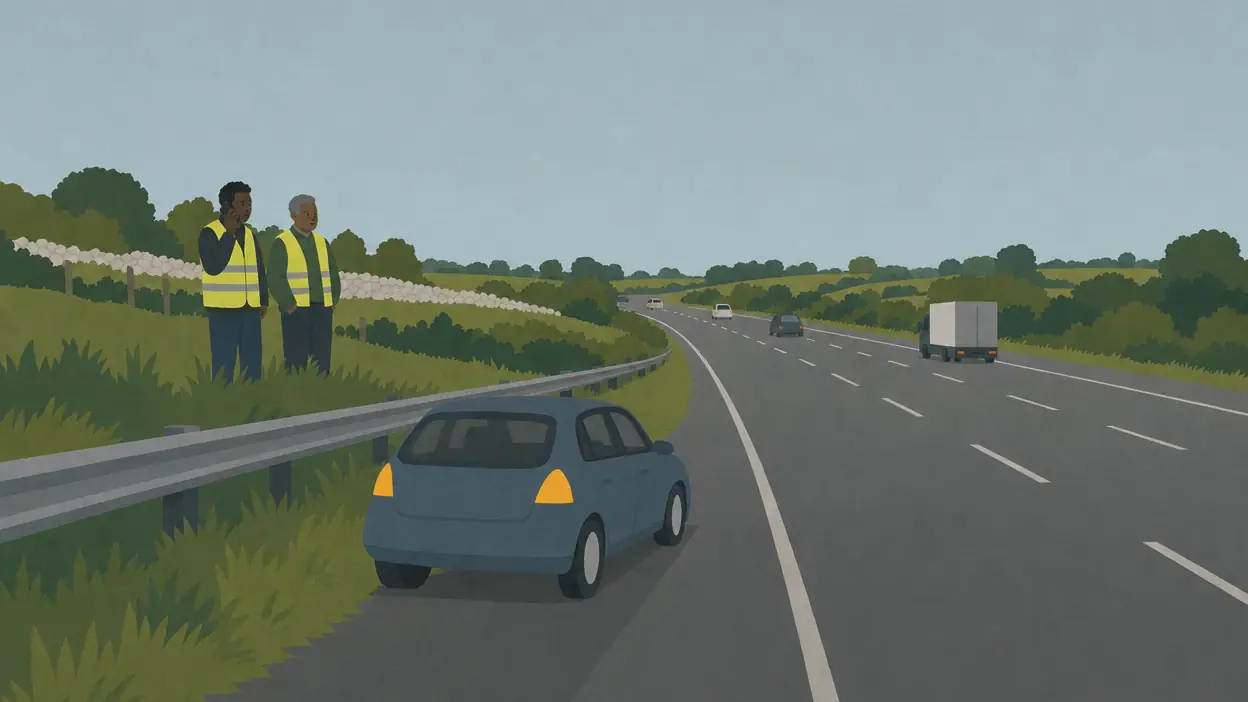
It is a Tuesday in November, 6.30am, on the M7. Fog sits in the hollows, so the road clears and closes again every few kilometres. You know the route well, which is the problem: your foot wants the usual speed.
The same week brings a frosty morning on a back road under trees, and an evening of standing water on a dual carriageway. Each one needs a different habit. This guide takes them in turn.
Before you set off
Read the warning first. Met Éireann issues warnings for fog and for low temperature and ice, as well as for rain, wind and snow:[3]
| Level | What Met Éireann tells you to do | Fog | Low temperature or ice |
|---|---|---|---|
| Yellow | Be aware. Do not take any avoidable risks. | Dense fog over a wide area, or pockets of freezing fog | Air minimum of minus 3 or minus 4 °C over a wide area |
| Orange | Prepare. Check your activity and delay or cancel as appropriate. | Dense or freezing fog lasting over a wide area and causing a significant driving hazard on national primary routes | Air minimum of minus 5 to minus 10 °C over a wide area |
| Red | Take action. Follow instructions from the authorities under all circumstances. | Exceptional | Minus 10 °C or below for three nights or more, with daytime highs of minus 2 °C |
Decision rule at Orange, ask whether the trip can wait. If it can, wait. The RSA says the best thing in extremely bad weather is to stay off the road, which leaves the emergency services free for real emergencies.[4]
If you still need to go:
- Check the route. TII’s traffic site covers motorways and national roads. Garda updates, your council and local radio cover the rest. Do not use your phone while driving.[2]
- Tell someone your route and when you expect to arrive, and charge your phone.[1]
- Clear every window and mirror, and all the snow on the roof. Roof snow can slide onto the windscreen when you brake.[1]
- Never use hot water on the windscreen. It can crack the glass.[1]
- Fill the screen wash with screen wash, not washing-up liquid.[1]
The RSA’s quick check before any bad-weather drive is POWDER: petrol, oil, water, damage, electrics and rubber (the tyres).[1] The tyres and winter checks guide goes through it in ten minutes.
Fog
The fog light rule, in the RSA’s words:
“Do not use fog lights, front or rear, unless visibility is reduced to less than 100 metres, roughly the length of a football pitch.”[1]
And once it clears: “While it is important to use fog lights it is equally important to turn them off once visibility has improved. This is because they can dazzle other drivers.”[1]
What else the RSA says to do in fog:[1][5]
- Use dipped headlights, not sidelights, whenever visibility is poor. Dipped lights shine down onto the road and help others see you.
- Do not use full beam. The RSA says it cuts your own line of sight and dazzles other drivers.
- Slow down as you enter fog. Check your mirrors and touch the brake lightly so your brake lights warn the driver behind.
- Do not follow the tail-lights ahead. It gives a false sense of security and pulls you into tailgating.
- In heavy fog, turn off the radio and open your window a little, so you can hear other traffic.
- Expect it to be patchy. A clear stretch does not mean the fog has gone.
On a motorway, the speed tempts you most. A crash in dense fog can quickly involve many vehicles, and the RSA says the greatest risk of a multiple pile-up is on motorways and dual carriageways.[5] Its rule of thumb: if you can clearly see the lights of the vehicle in front, you are probably too close.[1]
Black ice
Black ice is almost transparent. The RSA says it often looks like a harmless puddle, or the road just looks polished or glossy.[4] One sign you are on it is a sudden drop in tyre noise.[1]
Where to expect it: sheltered and shaded stretches, under trees, and beside high walls.[1][4] AA Ireland, a motoring organisation, notes that motorways, national and regional roads are more likely to be gritted than local roads. Narrow local roads are often more shaded by trees, so ice can last longer there, and night and early morning are the coldest times.[6]
- Leave far more room. On ice and snow, allow up to 10 times the normal distance for braking.
- Use the highest gear you can without the wheels spinning.
- Go downhill in a low gear, especially through bends.
- To stop, change down earlier than usual, let the speed fall, and brake gently.
- Move gently. No harsh braking, accelerating or steering.
If the car skids: take away the cause gently, whether that is too much braking, steering or acceleration. If it slides sideways, steer in the same direction as the skid and ease off the accelerator. Be ready for a second skid.[1]
ABS (anti-lock brakes): the RSA’s rule is “Step, Stay and Steer”. Step on the pedal, stay on it while it pulses, and steer round the obstacle.[4] Without ABS, press the brake until the wheels stop turning, release just enough for them to roll, and repeat quickly.[4]
Grip is shared between braking, steering and accelerating. The more you ask of one, the less is left for the other two.[1]
Heavy rain and spray
Double the gap. The two-second gap you leave in the dry becomes four seconds in bad weather.[1][5] At 120 km/h the RSA says to leave a gap of at least 102 metres in the dry, and at least 169 metres in the wet.[5]
To count four seconds, pick a lamp post or sign. When the car ahead passes it, say “only a fool breaks the two second rule” twice. If you reach the post before you finish, you are too close.[5]
Hold back from lorries. Goods vehicles throw up a lot of spray. Stay far enough back to see their mirrors.[1]
Aquaplaning happens when the tread fills with water and cannot clear it. The RSA warns about it on roads with 100 and 120 km/h limits.[1] The steering suddenly feels light. The RSA says:
- keep the wheels straight;
- ease off the accelerator;
- do not brake; and
- stay calm. The car slows, the water clears and grip returns.[1]
Surface water: you cannot see how deep it is or what is in it. If a road ahead is flooded, take another route.[1][7] After driving through water, drive slowly with your foot lightly on the brake for a short distance to dry the brakes.[1] For water across the road, read what to do on a flooded road.
Low winter sun can be dazzling. Keep sunglasses in the car.[4]
Walking, cycling and motorbikes
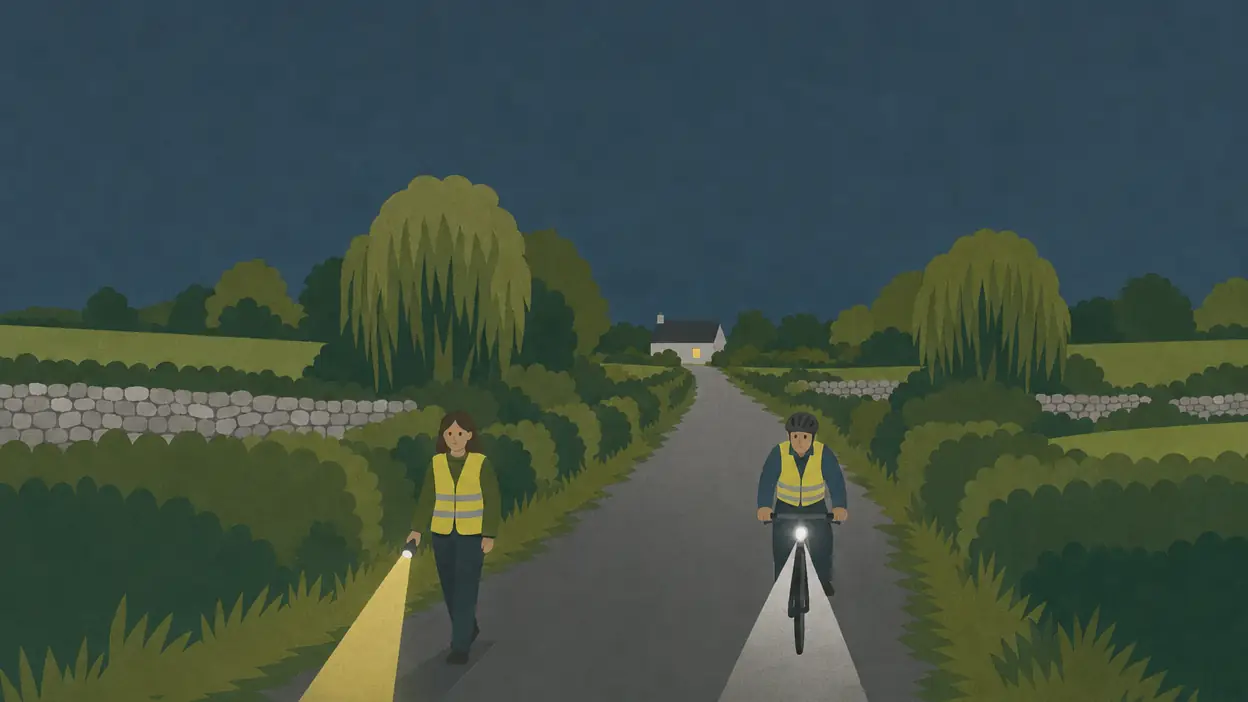
If you are not in a car, the RSA advice is about being seen and heard:[1][2]
- Walk on the footpath. Where there is none, walk on the right, facing oncoming traffic.
- Wear bright clothing with reflective armbands or a reflective belt, and carry a torch.
- In fog, do not wear earphones: you need to hear traffic.
- Motorcyclists should not wear a dark visor in poor light.
The walking and cycling in the dark guide covers bike lights and the law.
If you get into trouble
If you crash, slide off the road or get stuck, and anyone is hurt or in danger, call 112 or 999. What to do next, including the carbon monoxide rule if you run the engine, is in Stranded in a car in snow, flood or breakdown.
Cannot make a voice call? Text 112.
The emergency text service can be used by "anyone who is not able to make a voice call due to a speech or hearing impairment or other situations where a voice call might not be possible". It works "from any Irish registered mobile phone (either pre-pay or bill pay) on all the Irish Mobile networks". If you can talk, ring instead: a text is slower.
Your text needs four things:
- Which service: Ambulance, Coastguard, Fire or An Garda Síochána.
- What the problem is.
- County you are texting from.
- Where help is needed: town, road, Eircode or a landmark.
Wait for a reply: "an SMS/Text 'Delivery Report' does not mean your message has been received". If no reply comes within 3 minutes, send another message straight away. It does not work from a foreign phone, or from an Irish phone roaming abroad, including in Northern Ireland.
No registration is needed. 112.ie says: "There is no preparation or registration required to use either Emergency SMS, or RTT when contacting the ECAS." If you might need to text one day, you can choose to give the service your address, access details and a next of kin in advance at 112.ie/register. Most smartphones can also use Real-Time Text to type during a call to 112 or 999: turn on RTT in your phone’s accessibility settings.
Source: 112.ie, emergency text service, sending a text to 112, SMS questions and answers, emergency SMS terms and conditions and Real-Time Text pages, checked 1 November 2026.
Tell the Gardaí about debris on the road. Never stop on a motorway to move it yourself.[1]
What it costs
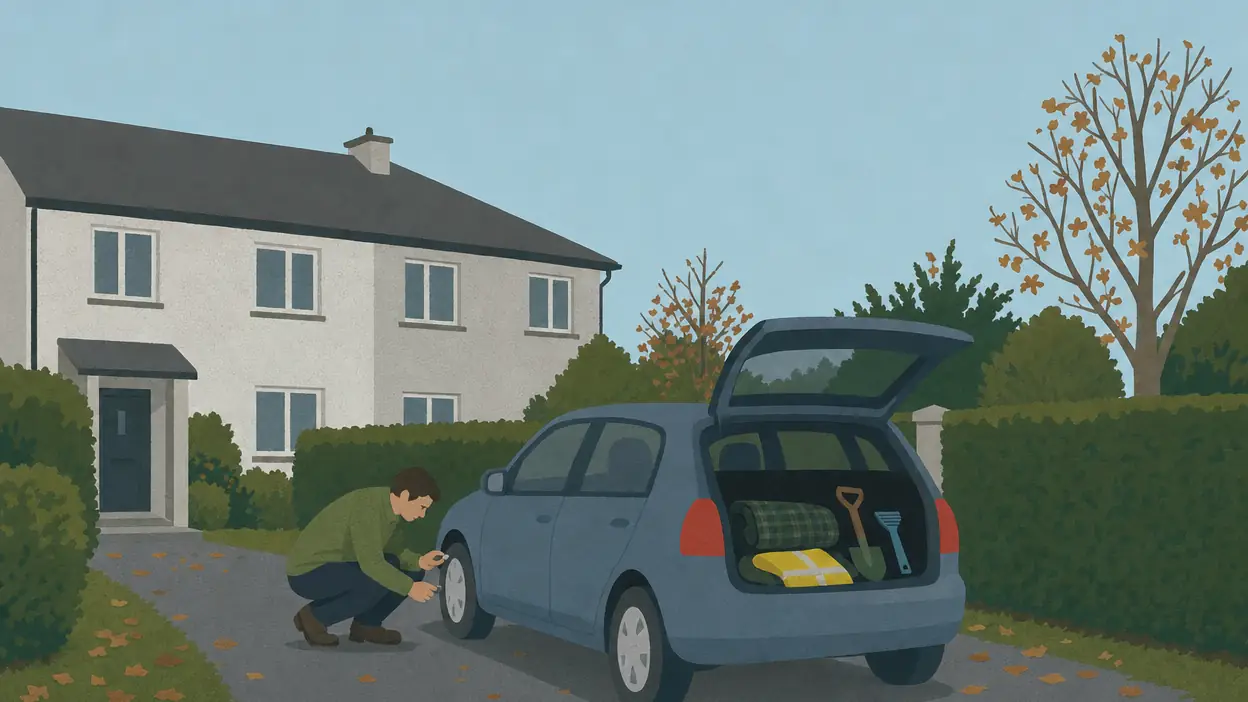
Most of this is free: leaving earlier, leaving more room, and not going at all when the warning is Orange. The kit the RSA asks you to carry is a scraper and de-icer, a hi-vis jacket and a torch.[1] The full car kit list, essential and useful, is in the car kit list.
For the Government’s advice, see Road safety from Be Emergency Ready (gov.ie).
Common questions
When can I use fog lights in Ireland?
Only when visibility is less than 100 metres, roughly the length of a football pitch, says the RSA. Switch them off once it improves, because they can dazzle other drivers.[1]
How much longer does it take to stop on ice?
The RSA says to allow up to 10 times the normal distance for braking on ice and snow. Slow down and use the highest gear you can without wheel spin.[5][1]
What should I do if my car aquaplanes?
Keep the wheels straight, ease off the accelerator and do not brake. The car slows, the water clears and grip returns.[1]
Where does black ice usually form?
On sheltered and shaded stretches, under trees and beside high walls. A sudden drop in tyre noise is one sign you are on it.[1]
Should I drive when there is an Orange weather warning?
Met Éireann’s instruction at Orange is to check your activity and delay or cancel as appropriate. The RSA says that in extreme weather it is best not to drive unless the journey is necessary.[3][1]
Data sources (7), all checked 2026-11-01
Footnotes
-
Road Safety Authority, Severe weather advice for road users (April 2009). Fog light rule, dipped lights, black ice, skids, four-second gap, aquaplaning, drying brakes and pedestrian advice quoted or summarised from this document. Checked 1 November 2026. ↩ ↩2 ↩3 ↩4 ↩5 ↩6 ↩7 ↩8 ↩9 ↩10 ↩11 ↩12 ↩13 ↩14 ↩15 ↩16 ↩17 ↩18 ↩19 ↩20 ↩21 ↩22 ↩23 ↩24 ↩25 ↩26 ↩27 ↩28 ↩29
-
Road Safety Authority, Severe weather campaign. Is your journey necessary; useful links for TII, Garda, council and local radio; advice for pedestrians, cyclists and motorcyclists. Checked 1 November 2026. ↩ ↩2 ↩3
-
Met Éireann, Warning system explained. Fog and low temperature or ice criteria for Yellow, Orange and Red. Checked 1 November 2026. ↩ ↩2
-
Road Safety Authority, Top 10 safety tips for driving in snow and ice. Black ice, Step, Stay and Steer, cadence braking, low sun, stay at home. Checked 1 November 2026. ↩ ↩2 ↩3 ↩4 ↩5 ↩6 ↩7
-
Road Safety Authority, Motorway driving booklet (2018). Up to 10 times the braking distance on ice and snow; 102 metres and 169 metres at 120 km/h; two and four second gaps; fog and pile-ups. Checked 1 November 2026. ↩ ↩2 ↩3 ↩4 ↩5 ↩6 ↩7
-
AA Ireland (a motoring organisation, not an authority), Driving in icy conditions, published 26 January 2021. Gritting on main roads and the coldest times of day. Checked 1 November 2026. ↩
-
Road Safety Authority, Top tips for road users in wet, flooded and windy conditions. Checked 1 November 2026. ↩
prepared.ie is independent public information. It is not affiliated with the Government of Ireland, the RSA, Met Éireann or any agency. In an emergency, call 112 or 999.