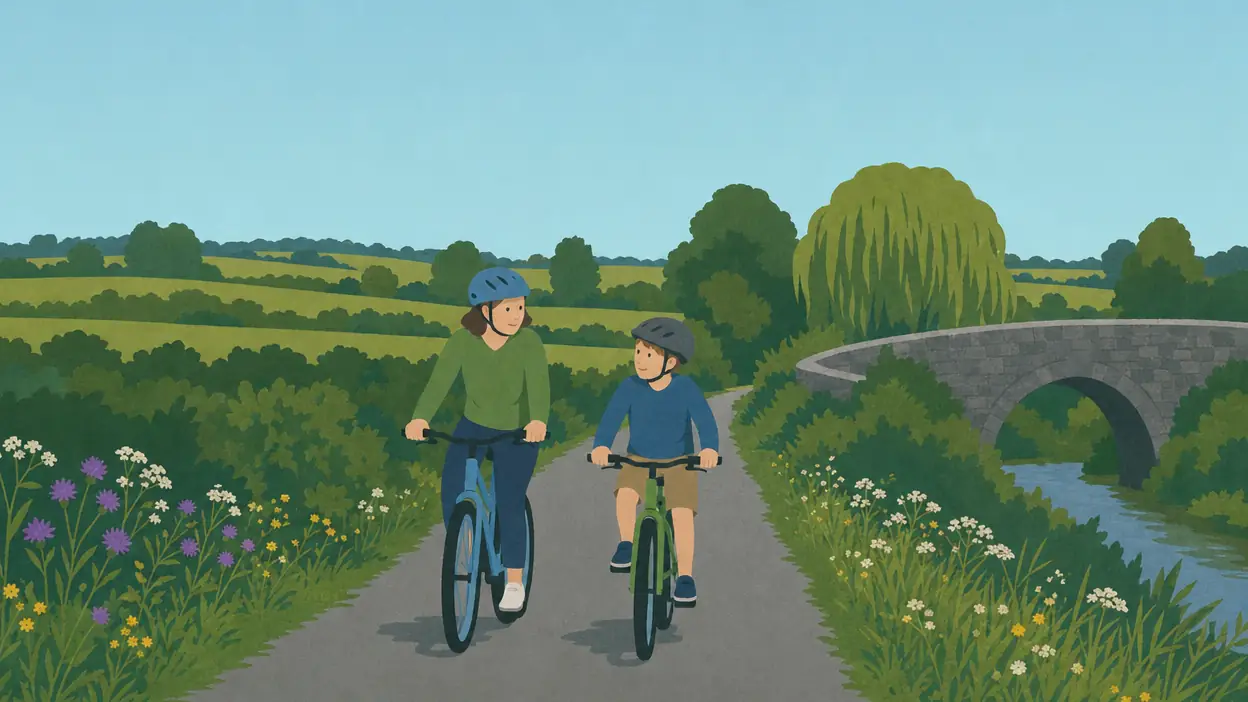
Cyclists are vulnerable road users, says the RSA: you share the road with vehicles that are bigger, faster and much more dangerous.[1] Most of what keeps you safe is free: the rules, where you ride, and a two-minute check before you go. Being seen after dark has its own guide: bike lights and hi-vis on winter roads.
The scene this guide is for
You are cycling to work through town. A bus pulls in ahead, a lorry is turning left at the next junction, and someone in a parked car is about to open the door. Later, a parent is deciding whether a 10-year-old is ready to cycle to school.
The rules
These are the law, or fixed charge offences, as Citizens Information and the RSA set them out:[2][3]
- Keep left, with the flow of traffic.[1]
- Stop at red lights, including cycle lights, at stop signs, and for school wardens.
- Stay off the footpath unless there is a cycle track on it, or you are going into or out of a property.
- Use the cycle track where it is part of a pedestrianised street, or is a contra-flow track on a one-way street.[1]
- Never ride more than two abreast, except when overtaking.
- Never hold on to a moving vehicle.
- Have a bell, front and rear brakes, and a red rear reflector. Lights after dark (see the bike lighting rules).
- Not under the influence. If a Garda suspects you cannot control the bike because of alcohol or drugs, you can be arrested without a warrant.
The fixed charge for most cycling offences, including red lights and no lights, is €40. Failing to stop for a school warden is €80.[3][4]
The RSA also says never to wear earphones, listen to music or use a phone while cycling.[1]
Where to ride
The RSA’s advice on road position:[1]
- Ride well clear of the kerb. Drivers see you sooner, your pedal will not hit the kerb, and you have room if something passes too close.
- Ride a straight line past parked cars instead of weaving in and out, and leave room for a door opening.
- Move towards the centre of the lane (the RSA calls it the primary position) to see junctions ahead, to be seen where a driver’s view is blocked, and before you turn, join a roundabout or change lanes. Look and signal first.
- Keep well back from vehicles in case they brake.
- Look, signal and look again before you start, stop, turn or change lanes.
Drivers overtaking you should leave 1.5 metres where the limit is above 50 km/h, and one metre below that. Dangerous overtaking of a cyclist is an offence for the driver.[2]
Junctions, lorries and buses
Most of the danger is at junctions. The RSA says:[1]
- Never cycle between a left-turning vehicle and the kerb. Stay behind it and let it go.
- Never pass a vehicle on the inside when it may turn left. Keep well clear of buses and lorries near junctions.
- If you cannot see the driver, the driver cannot see you. Large vehicles have blind spots in front, behind and on both sides.
- Turning right is where many collisions happen. Plan it early: look back, signal, look back again, and move to the right of the lane only if it is safe. If you are not confident, the RSA says stay well in to the left as you enter the lane. If you are not confident, it may be safer to get off and walk across.[1]
- Advanced stop lines (the box at the front with a bike symbol) let you wait ahead of traffic at red lights. Be careful: the lights may change.
- Tram tracks are slippery, especially when wet or icy. Cross them at a right angle and do not brake on them.
Check the bike before you ride
Two minutes, from the RSA booklet:[1]
- Brakes: both work. Replace worn blocks and cables.
- Tyres: pumped to the pressure printed on the side. Replace worn tyres.
- Chain: at the right tension, clean and oiled.
- Lights and bell: working. The bell is the law.
- Handlebars, saddle and wheels: tight, and the wheels spin freely.
If something is not working, do not ride until it is fixed.[1] Both your feet should touch the ground when you sit on the saddle; a bike that is too big or too small is dangerous.[1]
Helmets
There is no law in Ireland that says a cyclist must wear a helmet. The RSA advises one, and says it should be CE marked and meet EN 1078, fit snugly now (not one to “grow into”), and be replaced after a crash even if you cannot see damage.[1][2] On an e-scooter a helmet is the law; see e-scooter and e-bike rules.
Children learning to cycle
The RSA advises that children younger than 12 should not ride bicycles in any type of traffic. It also says to know how to control your bike before you cycle in traffic.[1]
Cycle Right is the national standard for cycle training. It is run by Cycling Ireland with the Department of Transport and the RSA. Stage 1 is for 3rd to 6th class, Stage 2 for teenagers, and Stage 3 for adults with no experience needed.[5] Ask your school whether it takes part.
Carrying a child: a child seat must be fit for purpose and fitted by a competent person, with foot straps so feet cannot reach the spokes. Never leave a child in a bike seat or carrier without an adult holding the bike.[1]
Wind, ice and flooded paths
- In strong wind, take extra care: a sudden gust can push you into the path of traffic.[6]
- On ice and snow, the RSA says cyclists should not risk it: cancel the journey or use other transport.[6]
- Flooded road or path: try not to cross it. Wait for the water to drop or use another route.[6]
- Check the forecast and any Met Éireann warning before you go. Driving in fog, black ice and heavy rain explains the warning levels.
Stop your bike being stolen
Garda crime prevention advice:[7]
- Spend 10% to 20% of the bike’s value on two locks.
- Lock it tightly to something that cannot be moved, and keep the lock off the ground.
- Lock it indoors or somewhere well lit if you can.
- Photograph the bike and note the serial number. Email them to yourself so you have a record.
If you crash or are hit
If anyone is hurt, call 112 or 999. Report the collision to the Gardaí and swap details with the driver, including insurance.[8]
Cannot make a voice call? Text 112.
The emergency text service can be used by "anyone who is not able to make a voice call due to a speech or hearing impairment or other situations where a voice call might not be possible". It works "from any Irish registered mobile phone (either pre-pay or bill pay) on all the Irish Mobile networks". If you can talk, ring instead: a text is slower.
Your text needs four things:
- Which service: Ambulance, Coastguard, Fire or An Garda Síochána.
- What the problem is.
- County you are texting from.
- Where help is needed: town, road, Eircode or a landmark.
Wait for a reply: "an SMS/Text 'Delivery Report' does not mean your message has been received". If no reply comes within 3 minutes, send another message straight away. It does not work from a foreign phone, or from an Irish phone roaming abroad, including in Northern Ireland.
No registration is needed. 112.ie says: "There is no preparation or registration required to use either Emergency SMS, or RTT when contacting the ECAS." If you might need to text one day, you can choose to give the service your address, access details and a next of kin in advance at 112.ie/register. Most smartphones can also use Real-Time Text to type during a call to 112 or 999: turn on RTT in your phone’s accessibility settings.
Source: 112.ie, emergency text service, sending a text to 112, SMS questions and answers, emergency SMS terms and conditions and Real-Time Text pages, checked 1 November 2026.
For the Government’s advice, see Road safety from Be Emergency Ready (gov.ie).
Common questions
Is it illegal to cycle on the footpath in Ireland?
You are not allowed to cycle on a footpath unless there is a cycle track on it or you are going into or out of a property. It is not a specific fixed charge offence, but you could still be fined for cycling without reasonable consideration.[2]
Do I have to wear a helmet on a bike in Ireland?
No, the law does not require it, but the RSA advises a CE marked helmet that meets EN 1078.[2][1]
Can cyclists ride two abreast in Ireland?
Yes, but never more than two side by side, except when overtaking where it does not endanger or obstruct other traffic.[2]
What is the fine for breaking a red light on a bike?
Failing to stop at a red traffic light or cycle light is a fixed charge offence with a €40 fine.[3]
How do I stop my bike being stolen?
Gardaí advise two locks worth 10% to 20% of the bike’s value, locked tightly to something fixed and off the ground. Photograph the bike and note its serial number.[7]
Data sources (8), all checked 2026-11-01
Footnotes
-
Road Safety Authority, Cycle safety booklet. Bike parts check, helmets, sharing the road, junctions, blind spots, tram tracks, cycle tracks, road position, children under 12, child seats. Checked 1 November 2026. ↩ ↩2 ↩3 ↩4 ↩5 ↩6 ↩7 ↩8 ↩9 ↩10 ↩11 ↩12 ↩13 ↩14
-
Citizens Information, Laws on cycling in Ireland. Footpaths, two abreast, holding on to vehicles, helmets, overtaking distances, alcohol and drugs. Checked 1 November 2026. ↩ ↩2 ↩3 ↩4 ↩5 ↩6
-
Road Safety Authority, Fixed charge notices for bicycles and e-bikes. €40 and €80 fines. Checked 1 November 2026. ↩ ↩2 ↩3
-
S.I. No. 227 of 2024, Road Traffic Act 2010 (Part 3) (Fixed Charge Offences) Regulations 2024, Schedules 5 and 8. Failing to stop a bicycle for a school warden stop sign is in Schedule 5 (€80). Checked 1 November 2026. ↩
-
Cycle Right, about the programme. National standard for cycle training, run by Cycling Ireland with the Department of Transport and the RSA. Checked 1 November 2026. ↩
-
Road Safety Authority, Severe weather advice for road users (April 2009). Wind gusts, icy and snowy conditions. Checked 1 November 2026. ↩ ↩2 ↩3
-
An Garda Síochána, Bike theft. Crime prevention advice. Checked 1 November 2026. ↩ ↩2
-
Citizens Information, E-scooters: if you are in a crash. Steps given for e-scooter riders hit by a vehicle. Checked 1 November 2026. ↩
prepared.ie is independent public information. It is not affiliated with the Government of Ireland, the RSA, An Garda Síochána or any agency. In an emergency, call 112 or 999.