You know your own needs best. The point of a plan is that the people around you know them too, before a storm or a power cut, not during one. At the National Disability Authority’s 2026 conference, the keynote speaker from the European Disability Forum put it this way: the higher risk comes “not because of disability itself”, but because warnings, communication, evacuation and shelter “are often not designed to be accessible or inclusive”.[12] A plan closes some of that gap from your side.
This guide is for disabled people, and for family, carers, personal assistants and neighbours. It builds on Who is at higher risk and, if you rely on powered medical equipment, Medical equipment in a power cut.
The scene this guide is for
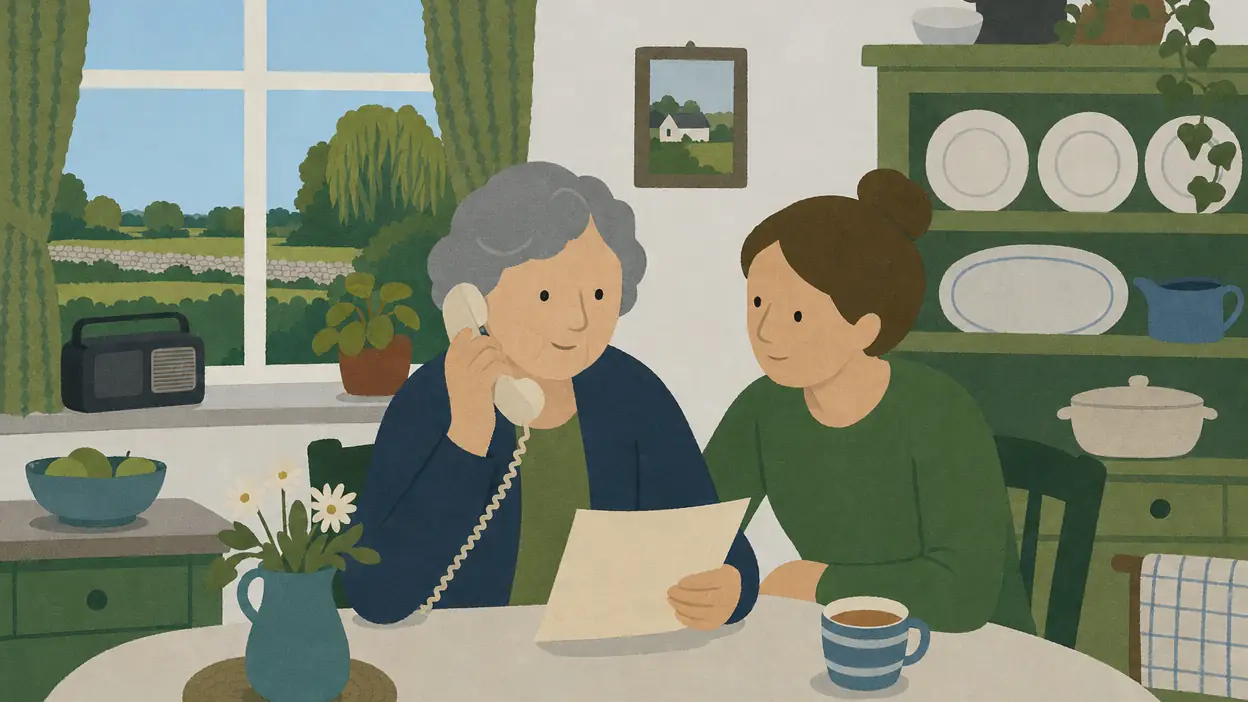
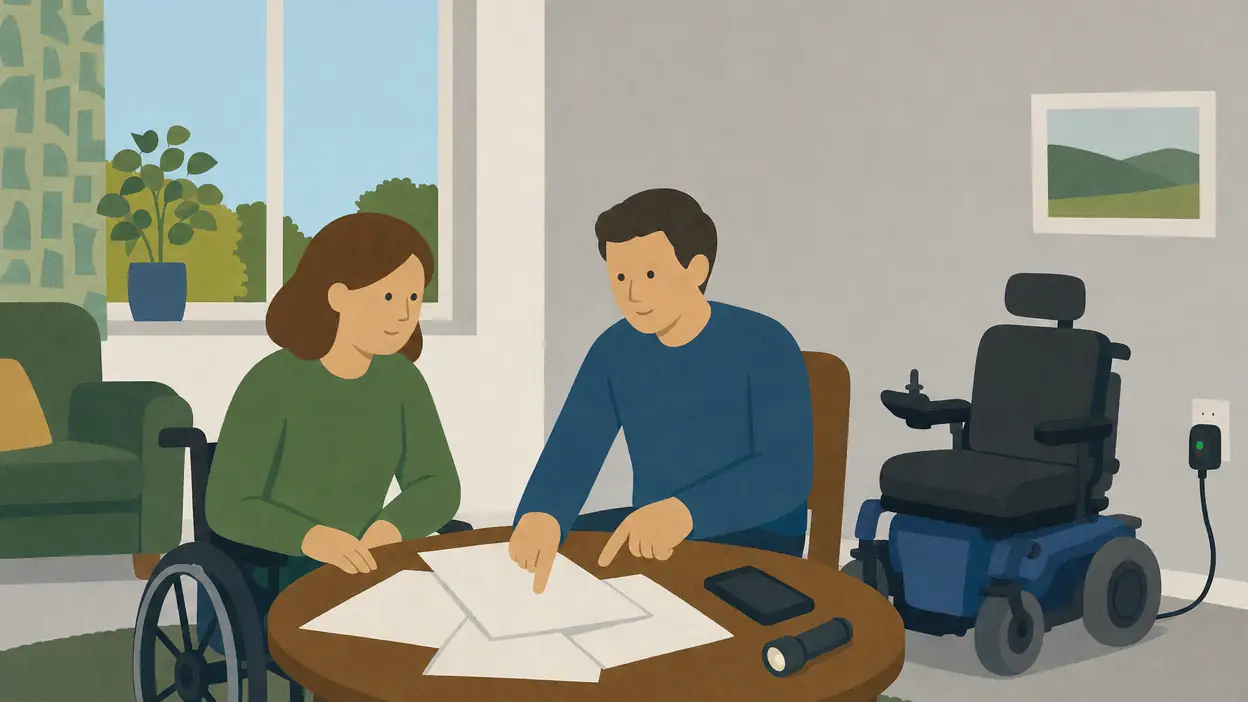
It is a Sunday afternoon in October. A woman and her teenage son sit at the kitchen table with a printed page between them. Her power wheelchair is charging by the wall. The page lists her supplier’s number, who calls in if the power goes, where the spare charger is, and what to say if she has to text 112. It takes half an hour, and they stick it on the fridge.
Step 1: write down what you need
Start with three questions. Keep the answers short.
- How will I hear about a warning? Radio, a text, an app, a neighbour knocking? If you are Deaf or blind, which of these actually reaches you?
- What needs power or water? A wheelchair, hoist, bed, ventilator, fridge medicine, hearing aid charger, phone.
- How would I get out, and who would help? At home, at work, at college.
Then add names and numbers: two people who will check on you, your supplier, your GP, your care or home support provider, and your personal assistant if you have one.
The official Be Winter Ready booklet asks you to keep the phone numbers of relatives and neighbours on a list or saved in your phone, and to plan for winter weather disrupting your home care service.[1]
Step 2: get on the free registers
These are free. They do not cost you anything to join, and you can register yourself.[2]
| Register with | Who it is for | What it gets you |
|---|---|---|
| Your electricity supplier (the company on your bill) | People critically dependent on electrically powered equipment, and people particularly vulnerable to disconnection in winter because of advanced age or physical, sensory, intellectual or mental health reasons.[2] | Your supplier tells ESB Networks. In an outage you get priority 24/7 support on 1800 372 999, advance notice of planned outages, and text updates if the power will be off overnight.[3] |
| Your gas supplier | The same groups.[2] | Extra protections and communication from your supplier.[2] |
| Uisce Éireann, Special Services Register | People aged 66 or over, blind or vision impaired, Deaf or hard of hearing, with mobility difficulties, an intellectual disability or a mental health difficulty.[4] | A text or call for unplanned water cuts likely to last more than four hours, or if water is unsafe to drink, and at least two days’ notice of planned work.[4] |
| Uisce Éireann, Priority Services Register | People critically dependent on water because of a medical condition.[4] | Contact at least two days before planned work, and for unplanned cuts likely to last more than four hours.[4] |
Register with Uisce Éireann online, or on 1800 278 278. Its text relay number for Deaf and hard of hearing customers is 1800 378 378.[4] You can name a family member or neighbour to get the messages too.[3][4]
Be clear about what registering does not do. ESB Networks says faults can and will occur in extreme weather.[3] Being registered does not mean your power comes back first. Plan for the cut anyway.
Step 3: warnings you can actually receive
- Met Éireann’s website is accessible. Vision Ireland points blind and vision impaired people to it for the local forecast.[5] Warnings are on met.ie/warnings.
- Your energy supplier and Uisce Éireann will text you once you are registered (Step 2).
- A person. Ask a neighbour to knock or text you when a Red warning is issued. The Be Winter Ready booklet asks relatives and neighbours to call on disabled people and offer help in severe weather.[1]
Smoke alarms for Deaf and hard of hearing people. An alerting unit connects to a smoke or heat alarm and wakes you with a strobe light and a vibrating pad. If you cannot afford one, your local fire authority may give you one free under the Community Smoke Alarm Scheme.[6] Ring your county council’s fire service and ask. Chime, the national organisation for Deaf and hard of hearing people, has hearing and technology services.[7]
Step 4: contacting 112 if you cannot make a voice call
You do not need to register to text 112 or to use Real-Time Text.[8] Both reach the same emergency call answering service as a voice call to 112 or 999.
Real-Time Text (RTT) shows each letter as you type, during a call to 112 or 999. Turn it on before you need it:[8]
- Android: Settings, Accessibility, Hearing, RTT.
- iPhone: Settings, Accessibility, RTT/TTY, then switch on Software RTT.
The Irish Deaf Society has an ISL video that shows how to turn RTT on.[9]
Write your text now. 112.ie suggests saving a message with your home address as a draft or template, ready to send. If you do, lock your phone with a PIN.[10] Use plain letters without fadas: special characters may not display properly for the operator.[10]
Give the service your details in advance. Older advice, including the Be Winter Ready booklet, tells you to register to text 112.[1] That is no longer needed. But 112.ie says you can still give it your address, access details and a next of kin at 112.ie/register, so it has them if you ever text.[8]
Cannot make a voice call? Text 112.
The emergency text service can be used by "anyone who is not able to make a voice call due to a speech or hearing impairment or other situations where a voice call might not be possible". It works "from any Irish registered mobile phone (either pre-pay or bill pay) on all the Irish Mobile networks". If you can talk, ring instead: a text is slower.
Your text needs four things:
- Which service: Ambulance, Coastguard, Fire or An Garda Síochána.
- What the problem is.
- County you are texting from.
- Where help is needed: town, road, Eircode or a landmark.
Wait for a reply: "an SMS/Text 'Delivery Report' does not mean your message has been received". If no reply comes within 3 minutes, send another message straight away. It does not work from a foreign phone, or from an Irish phone roaming abroad, including in Northern Ireland.
No registration is needed. 112.ie says: "There is no preparation or registration required to use either Emergency SMS, or RTT when contacting the ECAS." If you might need to text one day, you can choose to give the service your address, access details and a next of kin in advance at 112.ie/register. Most smartphones can also use Real-Time Text to type during a call to 112 or 999: turn on RTT in your phone’s accessibility settings.
Source: 112.ie, emergency text service, sending a text to 112, SMS questions and answers, emergency SMS terms and conditions and Real-Time Text pages, checked 1 November 2026.
Irish Sign Language interpreting. The Irish Remote Interpreting Service (IRIS) gives a video link to an ISL interpreter. It is a booked service with opening hours, so it is not a way to reach 112 in an emergency.[11] Use text or RTT for that. IRIS is useful for planning conversations with your council, supplier or GP.
Step 5: power, charging and supplies
The Irish Wheelchair Association’s advice before a storm is short:[13]
- Make sure you are registered with your electricity supplier as a priority customer.
- Charge your mobile phone and equipment batteries.
- Have a torch near you.
- Have enough food in for the next day.
- Tie down loose items in the garden.
The Be Winter Ready booklet adds: keep enough prescription medicine and fuel, and if you use medical equipment or a powered mobility device every day, make sure you always have access to a power supply.[1] For a long cut, that means knowing where you would go to charge.
A charged power bank keeps a phone going (kit options: Phone bank). A head torch leaves your hands free for a chair or a cane (kit options: Head torch). Neither replaces the plan. For powered medical equipment, agree your backup with your care team: see Medical equipment in a power cut.
If you have an assistance dog, keep it indoors and warm in severe weather, with a blanket to rest on.[1]
Step 6: getting out of a building
If you work, study or live in a building with other people, ask for a Personal Emergency Evacuation Plan (PEEP). The National Disability Authority publishes a free PEEP template and a guide for the people who run buildings. It says those responsible for a building must plan safe evacuation for everyone who uses it.[14]
A PEEP sets out how you will be warned, the route you will take, and who helps. Ask your employer, college or landlord to write it with you, and to practise it.
At home, think through which exit you would use, and whether a ramp needs gritting in icy weather.[1]
Step 7: going out in bad weather
Vision Ireland’s advice for blind and vision impaired people in ice and snow:[5]
- Check the weather, plan your route and give yourself extra time.
- Wear bright, reflective clothing so drivers can see you.
- Snow muffles sound. Avoid ear flaps and ear muffs so you can hear traffic.
- Snow covers landmarks like the edge of the path. Use taller ones, such as fences and sign posts.
- Bring your phone and charger, and tell someone your route and when you expect to be back.
- In very bad weather, only travel if you must.
For wheelchair users, the Be Winter Ready booklet says to check your mobility device can grip an icy surface.[1]
Step 8: who checks on you
Agree this in advance with two people. Say how they should contact you (text, call, a knock) and what they should do if you do not answer. The Be Winter Ready booklet asks neighbours to arrange regular visits or calls so disabled people are not isolated, and to ask the Gardaí or local health and social services for help if they have any doubt about someone’s safety.[1] See Check on a neighbour.
What councils are doing
Local authorities co-ordinate the response to severe weather, including the evacuation of residents.[17] In 2026 the National Disability Authority highlighted Wicklow County Council’s work on a county-wide plan to make emergency responses respect the rights of disabled people. It was described as a first in Ireland.[12] It is fair to ask your own council what its emergency plans say about disabled people, and to ask in an accessible format.
If you are refused a service, or treated less favourably because of your disability, the Equal Status Acts protect you. The Irish Human Rights and Equality Commission explains your rights. Complaints go to the Workplace Relations Commission, with strict time limits.[15] That applies to a rest centre as much as to a shop. Speak to the person in charge first.
Where to get more help
- Disability Federation of Ireland: brings together disability organisations as its members, and can point you to one for your disability.[16]
- Irish Wheelchair Association: iwa.ie.[13]
- Vision Ireland InfoLine: 1800 911 250.[5]
- Irish Deaf Society and Chime, for Deaf and hard of hearing people.[9][7]
- National Disability Authority: guidance on evacuation planning.[14]
Common questions
Do I need to register to text 112?
No. 112.ie says no preparation or registration is needed for emergency SMS or Real-Time Text.[8] You can choose to give the service your address and a next of kin in advance at 112.ie/register.[8]
Will being on the vulnerable customer register get my power back first?
No. Registering gets you priority phone support, notice of planned outages and text updates, but ESB Networks says faults can and will occur in extreme weather.[3]
Can I get a free smoke alarm if I am Deaf or hard of hearing?
You may be eligible for a free alerting unit with a strobe light and vibrating pad under the Community Smoke Alarm Scheme. Contact your local fire authority.[6]
What is a PEEP?
A Personal Emergency Evacuation Plan sets out how a disabled person will get out of a building in an emergency, and the National Disability Authority publishes a free template.[14]
Data sources (17), all checked 2026-11-01
All checked 2026-11-01. All Irish. The Irish Wheelchair Association, Vision Ireland, the Irish Deaf Society, Chime and the Disability Federation of Ireland are disability organisations, not public bodies; their advice is cited as theirs. The registers and 112 rules come from the CRU, ESB Networks, Uisce Éireann and 112.ie.
- Office of Emergency Planning, Be Winter Ready booklet, People with Disabilities.
- Commission for Regulation of Utilities, Vulnerable customers.
- ESB Networks, Vulnerable customers.
- Uisce Éireann, Register a vulnerable customer.
- Vision Ireland, Staying safe during the cold snap.
- National Directorate for Fire and Emergency Management (Fire Ireland), Smoke and heat detection.
- Chime, the national organisation for Deaf and hard of hearing people.
- 112.ie, Real-Time Text: how to turn it on, no registration, and giving details in advance.
- Irish Deaf Society, Emergency Real-Time Text service, with ISL video.
- 112.ie, SMS questions and answers.
- Sign Language Interpreting Service, Irish Remote Interpreting Service (IRIS).
- National Disability Authority, annual conference on disability-inclusive responses to extreme weather and other emergencies.
- Irish Wheelchair Association, Red weather warning notice (Storm Éowyn, January 2025).
- National Disability Authority, Safe Evacuation for All, with PEEP template.
- Irish Human Rights and Equality Commission, Disability and services.
- Disability Federation of Ireland.
- Citizens Information, Severe weather.
prepared.ie is independent public information, published by Gallan Software. It is not affiliated with the National Disability Authority, the Disability Federation of Ireland, the Irish Wheelchair Association, Vision Ireland, the Irish Deaf Society, Chime or any public body named here. In an emergency call 112 or 999, or text 112.