Why it matters, and why it usually does not
Asbestos was used in Irish buildings “from the 1940s until around 2000”, the HSE’s health protection centre says. It is now banned, but material already in place can stay there.[1][3]
The same centre says asbestos “in good condition and left undisturbed” does “not generally pose a risk to health”. The danger starts when it is “damaged, disturbed or deteriorate[s]” and fibres get into the air and are breathed in.[1]
The diseases are asbestosis (scarring of the lung), mesothelioma (a cancer of the lining of the lung) and lung cancer. They usually appear 15 to 60 years after exposure.[1] Smoking “substantially increases” the lung cancer risk for anyone exposed.[1]
So the risk is not living in an older house. The risk is a weekend job that turns old material into dust.
In good condition and left alone it is a very low risk. Drilling, sanding, breaking or sweeping it can release fibres that cause lung disease 15 to 60 years later.[1][2] Do not disturb it, do not remove it yourself, have a competent asbestos surveyor check a suspect material, and use a specialist contractor and a permitted waste collector for anything that must go.[3][4][5]
Where it hides in an Irish house
Ireland’s local government and Environmental Protection Agency (EPA) guidance lists these places, among others:[2]
Inside
- Textured coatings on walls and ceilings, such as Artex
- Vinyl floor tiles
- Ceiling tiles and partition walls made of asbestos insulating board
- Panels in fire doors
- Lagging on boilers and pipes, and board around boilers
- Rope seals and gaskets
- Toilet seats and cisterns
- Loose-fill insulation
- Cement water tanks in the attic
Outside
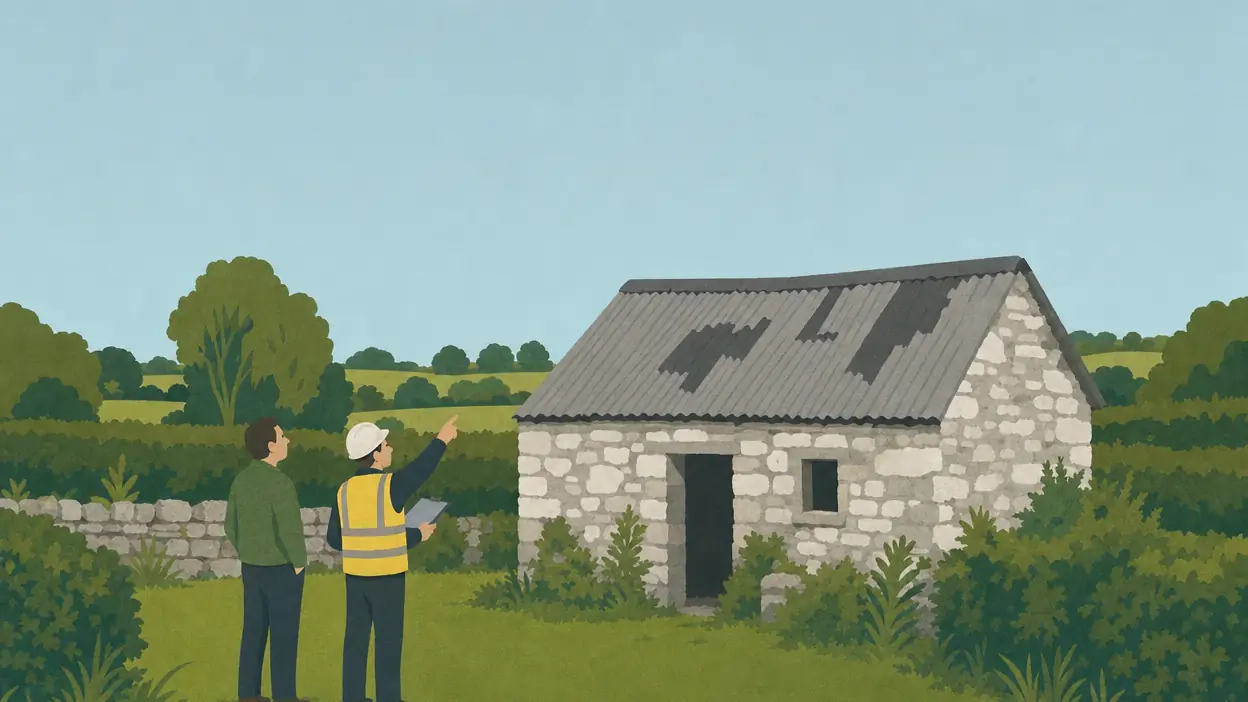
- Cement roofs, often on garages, sheds and farm buildings
- Cement panels, gutters and downpipes
- Soffits
- Cement flues
The guidance says buildings put up between 1940 and 1985 most often contain some asbestos, and buildings from after 2000 are unlikely to.[2] The Health and Safety Authority (HSA) goes further: it says asbestos can be found in any building, homes included, “built or refurbished before the year 2004”. Treat a house refurbished in the early 2000s with care too.[3]
You cannot tell by looking. The HSE centre says “It is not possible to confirm that a material contains asbestos by looking at it alone.”[1]
If in doubt, don’t
If you think you have found asbestos, the HSE centre’s advice is: “Do not drill, cut, sand, break, sweep or otherwise disturb the material. Seek advice from a competent asbestos professional.”[1]
In practice, before you:
- put downlights, a fan or a curtain pole into an old textured ceiling,
- lift old floor tiles, or the black adhesive under them,
- take down a shed, or cut or power-wash a cement roof,
- replace an old boiler, flue or hot water cylinder,
- knock a wall or take out a fire door,
stop and find out what the material is. That costs far less than cleaning up after it.
Painting. The guidance says material in good condition can often be left alone, and minor damage can be repaired or sealed, but only by a specialist. Do not sand before painting.[2][1]
Getting a suspect material checked
The HSA says “The sampling and analysis of materials suspected to containing asbestos must only be undertaken by a competent person or company.” Do not take a sample yourself: breaking a piece off is exactly the disturbance to avoid.[3]
For building work on a home built before 2000, the HSA says a refurbishment and demolition asbestos survey should be done by a competent person “well in advance” of the work. It applies to domestic jobs as much as commercial ones. Homeowners commissioning building work count as “clients” in the law.[6]
Who may remove it
Not you, and not a general builder without asbestos training. The HSA says: “ALL asbestos removal or abatement work must be carried out by competent persons who have sufficient training, experience and knowledge appropriate to the nature of the work.” It adds: “An asbestos awareness course is not sufficient.”[7]
There is no licence to check. The HSA says it does “not issue licenses to asbestos removal contractors”, and the EPA and local government guidance confirms “There is no licensing regime for asbestos contractors in the Republic of Ireland”.[7][2] Instead, ask the contractor for the evidence the law expects them to have:[7][2]
- Their safety statement and a risk assessment for your job
- Training certificates for the workers
- Medical certificates and face-fit certificates for their masks
- Proof of relevant experience and insurance
- Confirmation that they will notify the HSA
Most asbestos removal must be notified to the HSA.[7] For high-risk material such as lagging and insulating board, notice goes in 14 days before work starts, and an independent analyst checks the air before you move back in and issues a clearance certificate.[6] Keep every certificate with the house papers.
Masks. A dust mask from the hardware shop does not make this a DIY job. The HSE centre says “Ordinary face coverings may not protect against asbestos fibres”, and specialist protection “is only effective if correctly fitted and used”.[1] That is why we do not list any kit for this guide.
Getting rid of it
Asbestos waste is hazardous. The HSA says it must be collected, carried and disposed of “only” by “an authorised waste collection permit holder” and sent to “an appropriately authorised facility”.[8]
- Do not put it in a skip, your bin or a general waste collection.
- Do not take it to a recycling centre without checking first. Dún Laoghaire-Rathdown County Council, for example, says asbestos “cannot be accepted at Ballyogan Recycling Park or any other Council facility”.[5]
- Find a collector with the right permit through the National Waste Collection Permit Office. The EPA points householders there.[4]
Dún Laoghaire-Rathdown also reminds you that “it is an offence to hand over waste to an unauthorised waste collector”, and that many permitted collectors are not allowed to take asbestos. Ask to see the permit.[5]
Which situation are you in?
A 1970s house, an Artex ceiling and a plan for downlights. Do not drill. Have the coating checked by a competent surveyor first.[3][1]
A cracked garage roof. Leave it alone and do not power-wash it. If it must come off, a competent contractor removes it and a permitted collector takes it away.[7][8]
A boiler replacement in an older house. Ask your installer whether the old flue, lagging or boiler board has been checked for asbestos before they start.[2][6]
A shed demolition. A cement roof and wall panels are common. Get them checked before anyone swings a hammer.[2]
A flood soaked old floor tiles. Do not lift or break tiles you suspect are vinyl asbestos. Tell your insurer and the contractors doing the clean-up.[1][2] See Flooding and After the storm.
You already broke a piece. Stop. Do not sweep or vacuum. Keep children and pets away and get advice from a competent asbestos professional. The HSE centre says the risk from a single short exposure “is generally considered to be low”.[1]
A fire or storm damage nearby
After a fire in a building with asbestos, follow the local authority’s advice. The HSE centre says to stay indoors with windows and doors closed if you smell smoke, and not to “touch, move, sweep, vacuum or pressure-wash suspected asbestos debris”.[1] If you have symptoms such as coughing or breathlessness, contact your GP.[1]
Common questions
How do I know if my house has asbestos?
You cannot tell by looking, so if your home was built or refurbished before 2004, have a suspect material checked by a competent asbestos surveyor.[3][1]
Can I remove asbestos myself in Ireland?
No: the HSA says all asbestos removal must be done by competent people with the right training, and an awareness course is not enough.[7]
Is an Artex ceiling dangerous?
Left alone and in good condition it is a very low risk, but drilling or sanding a textured coating that contains asbestos can release fibres.[1][2]
Where can I dump asbestos?
Use a collector with an asbestos waste collection permit, because many council recycling centres will not take it.[5][8]
Does a dust mask make it safe?
No: ordinary face coverings may not protect against asbestos fibres, and specialist protection only works when correctly fitted and used.[1]
Data sources (9), all checked 2026-11-01
Footnotes
-
Health Protection Surveillance Centre (HSE), Asbestos. Health effects, what to do if you find asbestos, masks, incidents and fires; quoted verbatim. Checked 2026-11-01. ↩2 ↩3 ↩4 ↩5 ↩6 ↩7 ↩8 ↩9 ↩10 ↩11 ↩12 ↩13 ↩14 ↩15 ↩16 ↩17 ↩18
-
Local Government Ireland and the EPA, Best practice guidance for handling asbestos, 2023. Where asbestos is found, management in place, choosing a contractor, licensing. Checked 2026-11-01. ↩2 ↩3 ↩4 ↩5 ↩6 ↩7 ↩8 ↩9 ↩10 ↩11
-
Health and Safety Authority, Asbestos FAQs. Where asbestos is found, the ban, surveys and sampling. Read in a browser; checked 2026-11-01. ↩ ↩2 ↩3 ↩4 ↩5 ↩6
-
Environmental Protection Agency, Asbestos: who to contact. Checked 2026-11-01. ↩ ↩2
-
Dún Laoghaire-Rathdown County Council, Asbestos. Disposal and waste collection permits; quoted verbatim. Checked 2026-11-01. ↩ ↩2 ↩3 ↩4
-
Health and Safety Authority, Management of asbestos-containing materials on demolition and refurbishment sites, safety alert, 2022. Checked 2026-11-01. ↩ ↩2 ↩3
-
Health and Safety Authority, Asbestos removal. Competence, contractor evidence, notification and licensing quoted verbatim. Checked 2026-11-01. ↩ ↩2 ↩3 ↩4 ↩5 ↩6
-
Health and Safety Authority, Other agencies with responsibility for asbestos. Asbestos waste. Checked 2026-11-01. ↩ ↩2 ↩3
-
112.ie, SMS questions and answers. Checked 2026-11-01. ↩
prepared.ie is independent and is not affiliated with the Government of Ireland, the HSA, the HSE, the EPA or any agency. In an emergency, call 112 or 999.[9]