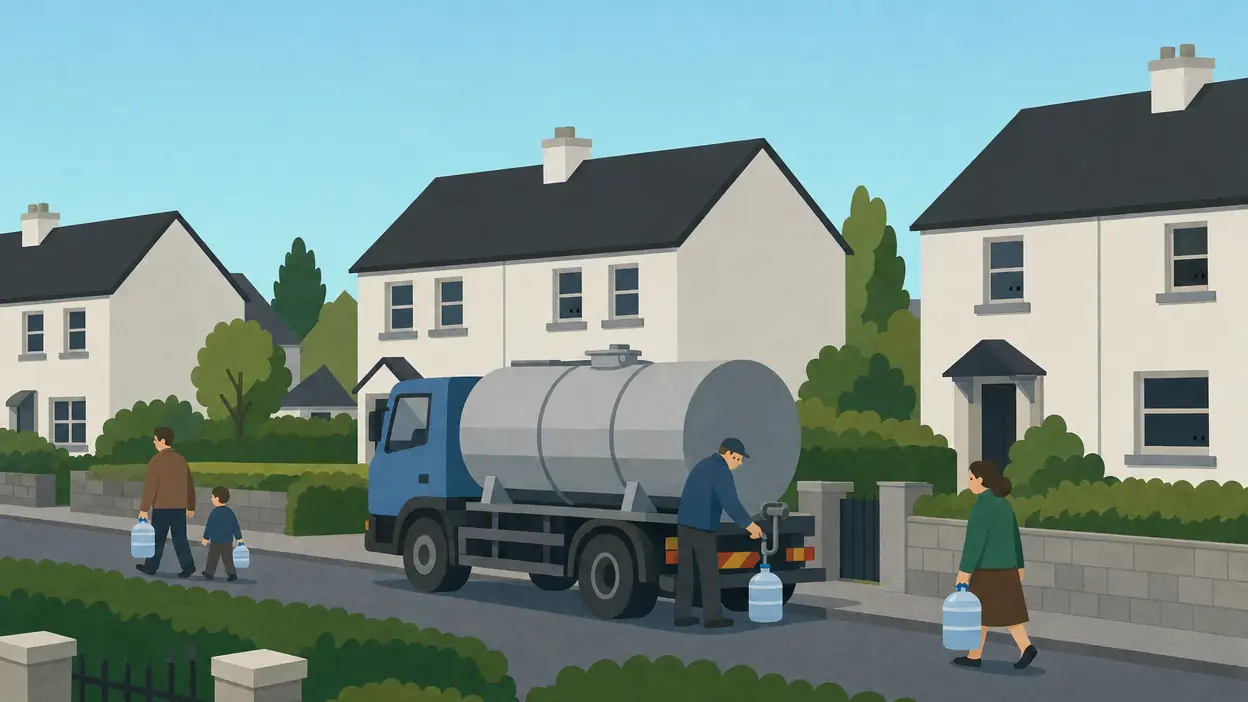
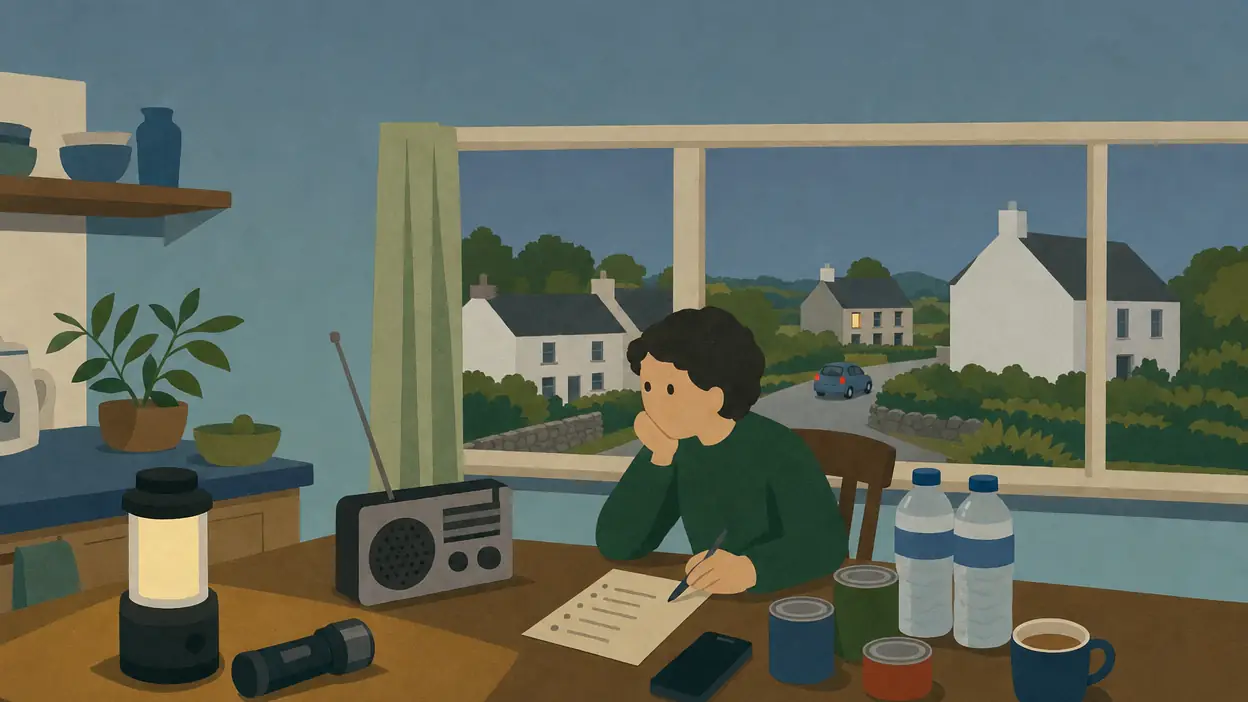
A well with an electric pump needs a water plan as well as a power plan. Keep drinking water before severe weather.[11] If floodwater covers the well, or its water changes smell, colour or taste, treat the supply as unsafe and contact the council or HSE for advice.[2][4] The EPA recommends testing household wells at least once a year.[1] Have an electrician arrange any generator connection to the fixed installation.[9]
The scene this guide is for
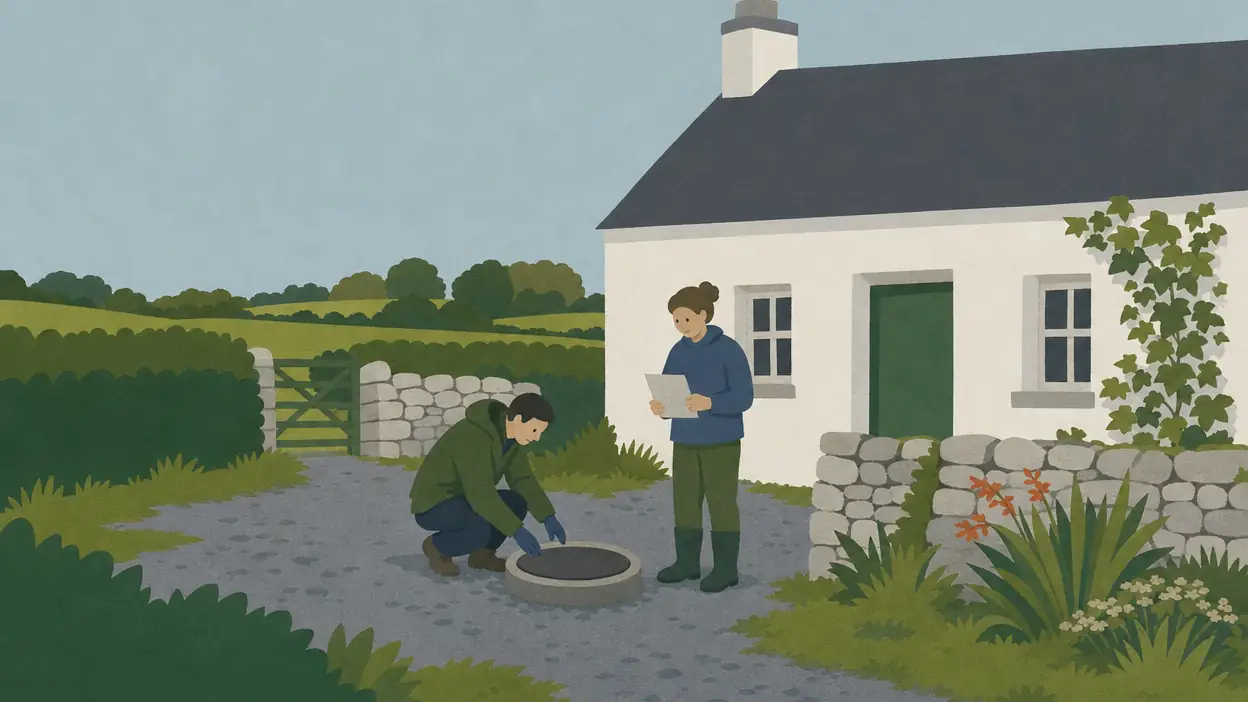
The lights go out during a storm. The tap still runs, so you fill the kettle and assume the well is fine. Later the pressure disappears. Next morning the low corner of the garden is under water, including the little concrete cover over the well.
There are now two separate questions: can you get water out, and is it safe? Restoring the pump answers only the first. The HSE’s flooding advice treats a well covered by floodwater as unsafe to consume.[2]
Know what supplies your tap
Write the answer on your household emergency sheet:
| Supply | Your first contact |
|---|---|
| Your own well | Your pump contractor for equipment; council environment section or HSE Environmental Health for water quality.[1][3] |
| Group water scheme | The scheme’s own manager or emergency contact.[6] |
| Public mains | Uisce Éireann; see Water outages and boil water notices. |
Group schemes can take water from a private source or buy it from the public supply. In either case, the scheme maintains its own distribution network and supplies its members. Uisce Éireann says it has no responsibility for private group water schemes.[6]
For a household well, the EPA says protecting the source is your responsibility.[1] Keep the contractor’s number, latest test report and location of the well together. A visiting plumber cannot inspect a wellhead nobody can find beneath vegetation.
Before a power cut: store water you can actually use
The HSE recommends keeping a container available for drinking water and preparing before severe weather.[11] Our practical checklist is:
- Keep drinking water separately from water for flushing. Label containers so a visitor or child cannot confuse them.
- Choose food that needs little added water, alongside the HSE’s suggested long-lasting foods.[11]
- Include medicines, baby feeding and carers in the plan. If treatment depends on a reliable water supply, agree the fallback with the care team: Medically dependent at home in a power cut in Ireland.
- Ask the contractor which taps, if any, still work without the pump. Your system may have some stored water available, but do not count on a particular amount without checking.
- Identify a safe alternative supply before the warning. Agree who can help if you cannot carry containers.
This guide gives no universal number of hours a well will keep flowing after power fails. Storage, pressure and plumbing differ. Fill the household planning gap now, rather than discovering it when the last toilet cistern empties.
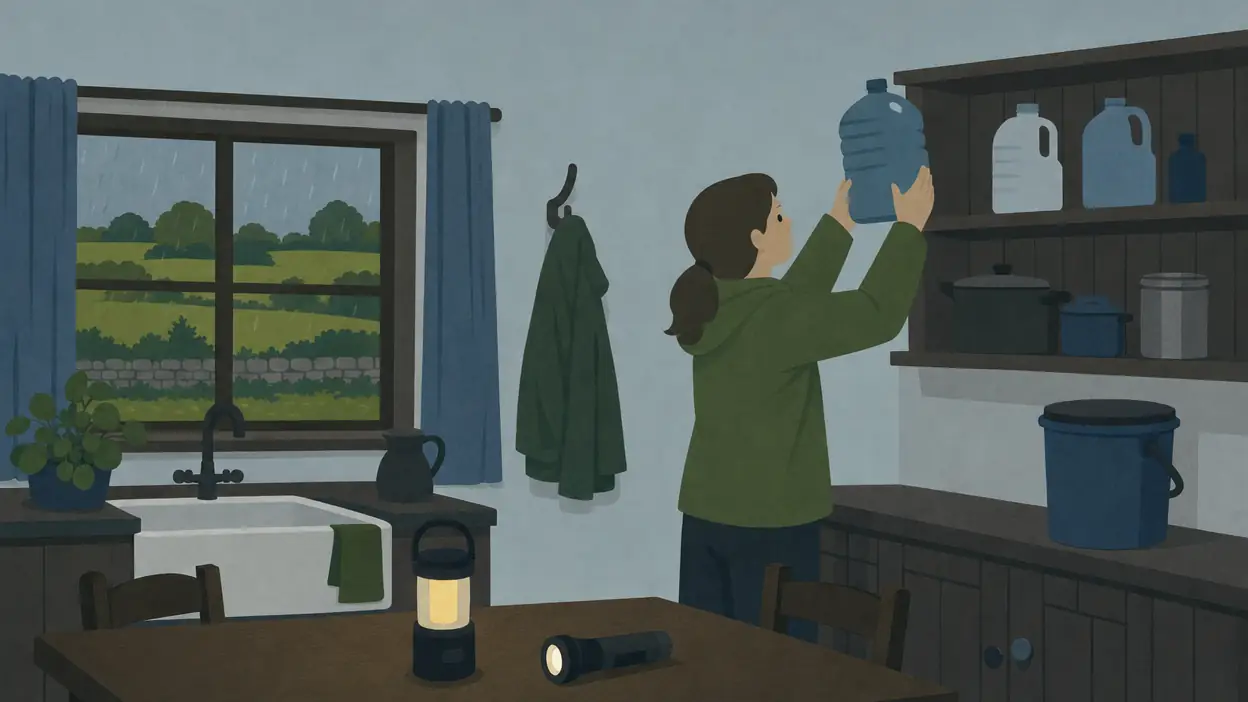
When the pump stops
Make the distinction between an outage and an equipment fault:
- If the whole property has lost power, use the stored water and follow Power cuts in Ireland: what to do.
- If the house has power but the pump does not work, call the pump contractor. Tell them whether the pump is silent, runs without delivering water, or repeatedly stops.
- If the pump house or electrical equipment is flooded, keep clear. The HSE says wet electrical systems must be checked before being switched on again.[2]
Ask your contractor to leave a written restart procedure for your particular pump and treatment equipment. Do not repeatedly reset a fault or open electrical enclosures to try to persuade the system to run. Repairs belong with the appropriate contractor.
Floodwater at the well: stop using the supply
The HSE says to consider well water unsafe if the well has been covered by floodwater or if smell, colour or taste changes.[2] Its advice for water considered unsafe after flooding is broader than drinking: do not use it for washing food, dishes or hands, showering, bathing, making ice or preparing baby formula.[2]
Use bottled water or another confirmed safe supply and contact the local authority or HSE Environmental Health. Tell them whether floodwater reached the well, whether there was sewage nearby, and whether heating oil or agricultural chemicals may have escaped.[2][3]
Do not walk through floodwater to lift the cover, operate a pump switch or take a sample. Hidden holes and electrical hazards are among the HSE’s warnings.[2] A water test can wait until access is safe; drinking-water precautions cannot.
Decision rules:
- Bacteria confirmed, with boiling advised: follow the boiling advice while the cause is corrected.[4]
What boiling can, and cannot, settle
For confirmed bacterial contamination, the EPA advises boiling well water used for drinking and cooking until it is safe again.[4] It also advises boiling for brushing teeth, preparing food and making ice where infectious contamination is suspected.[4]
That is different from assuming every flooded well can be made safe in the kettle. The EPA directs people with chemical contamination to their local authority.[4] Use an alternative supply while getting that advice; do not treat boiling as permission to drink suspected oil-contaminated water.
Where a boil-water instruction applies, Uisce Éireann’s public guidance says bring water to a vigorous boil for one minute, cool it and store it somewhere cool in a container.[5] Handle hot water carefully and keep children away. Ordinary household filters do not guarantee safety under a boil notice.[5]
For infant feeding, use the specific HSE advice carried on the notice, or ready-to-use formula that needs no added water.[5] See Water outages and boil water notices rather than improvising a different mixing method.
Testing: book the right sample, at the right time
The EPA recommends annual testing for germs and testing for chemical contamination every three years. Heavy rainfall is a useful time to test because contamination can be at its highest.[3]
When booking:
- Ask the council environment section or HSE Environmental Health for a suitable laboratory.[3]
- Describe the problem. Include flooding, nearby farming, recent work or any change in the water.
- Ask what to test for. The EPA prioritises tests for germs that indicate contamination, with other tests chosen for local risks.[3]
- Get the laboratory’s sampling instructions before collecting anything. Use its required bottle and delivery arrangements.
- Ask someone qualified to explain failures and the retesting plan. Keep the report with the well records.
Good taste and clear appearance do not establish safety. The EPA notes that some contamination does not discolour the water.[4]
Fix the route contamination used
The EPA recommends protecting the surrounding area, sealing the well top, disinfection and appropriate treatment where needed.[1][3] It warns that a one-off disinfection cannot replace a treatment system where contamination keeps recurring.[4]
Ask the contractor to inspect how surface water could enter, the well cover and nearby pollution sources. Ask how to check treatment equipment after flooding or a loss of power. This guide does not reproduce a bleach recipe: the EPA says existing filters or other treatment can affect its disinfection procedure, so consult the supplier first.[4]
Backup power is an installation job
Have a registered electrical contractor and pump contractor agree what a generator must run, including treatment equipment. The Health and Safety Authority requires proper switching between the electricity network and a generator supplying permanent wiring, and notification to ESB Networks.[9]
A changeover switch selects one supply while keeping it separated from the other. Never feed a generator into a household socket. A borrowed generator still needs a compatible, safely installed connection. Follow Power cuts in Ireland: what to do for the wider plan.
Keep generators outdoors. The HSE warns against running them in garages or enclosed spaces because of carbon monoxide.[12] A pump shed is not a safe shortcut.
Group schemes and help with improvements
Save the scheme’s local emergency number. Ask how outage notices reach members, whether pumps and treatment have backup power, and where alternative water would be available. The National Federation of Group Water Schemes, 047 72766, offers scheme advice through regional offices.[7] Its accounts of Storm Éowyn show that obtaining a generator did not by itself resolve access and capacity problems.[8]
For an individual domestic well, Citizens Information and Local Government Ireland list grants of 85% of approved repair costs, capped at €3,000, or 85% for a new well, capped at €5,000, plus water-quality treatment funding of 100%, capped at €1,000.[10][13] Eligibility includes a normal residence at least seven years old, inadequate water quality or quantity, and inability to connect to a public or group scheme. Previous grants also affect eligibility.[10]
Contact the council’s rural water section before commissioning work. Ask it to confirm eligibility and the approval process; do not assume an emergency repair or generator purchase qualifies.
Sources (13), all checked 2026-10-29
All checked 2026-10-29. All Irish. NFGWS is the sector’s representative body.
- EPA, household wells.
- HSE HPSC, flooding advice.
- EPA, testing and protecting drinking water.
- EPA, drinking-water frequently asked questions.
- Uisce Éireann, boil water notice.
- Uisce Éireann, group water schemes.
- NFGWS, contacts.
- NFGWS, Storm Éowyn scheme accounts.
- HSA, fire, electricity and chemicals.
- Local Government Ireland, well grant.
- HSE, preparing for severe weather.
- HSE, carbon monoxide poisoning.
- Citizens Information, water supply and well grants.
prepared.ie is independent public information, published by Gallan Software. It is not affiliated with the Government of Ireland or any agency. In an emergency call 112 or 999.