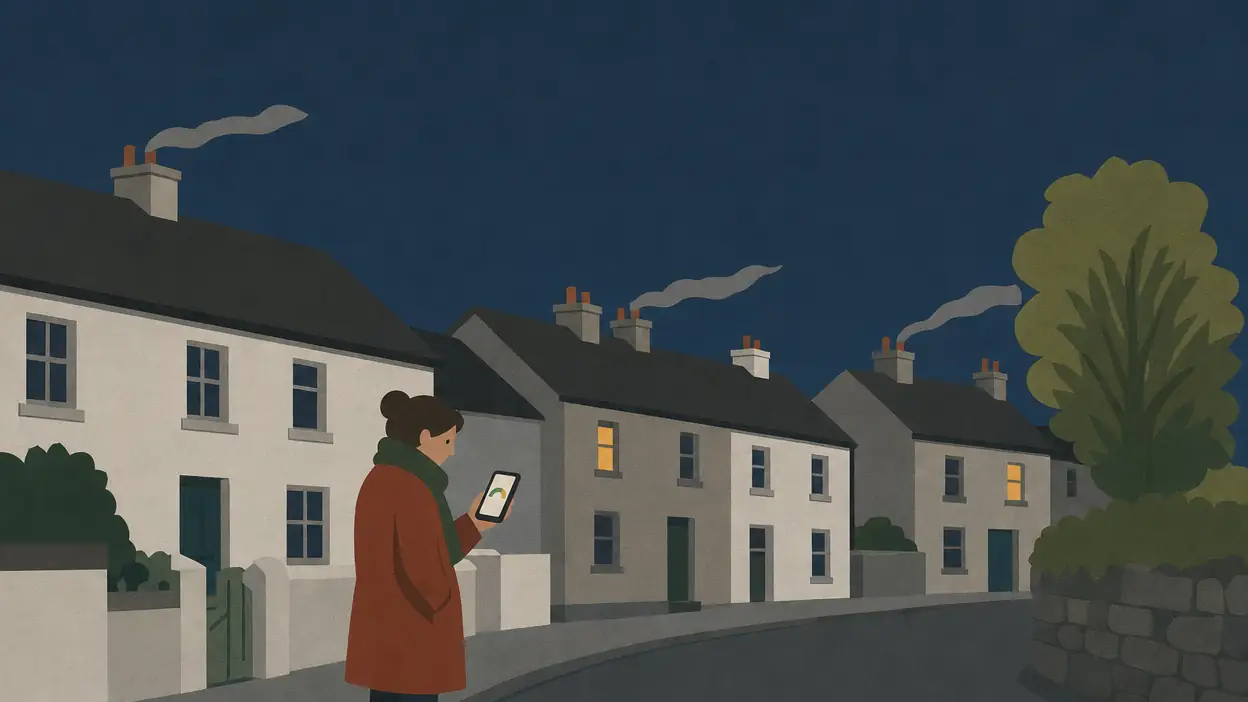
Air quality in Ireland is generally good, says the EPA, but smoke from home fires and traffic still harms health. It links about 1,500 early deaths a year in Ireland to air pollution.[1] In towns and villages the main local source of fine particles is solid fuel burned at home: coal, wood and turf.[2][1][3] It is worst in winter, on cold, still evenings.[2]
The scene this guide is for
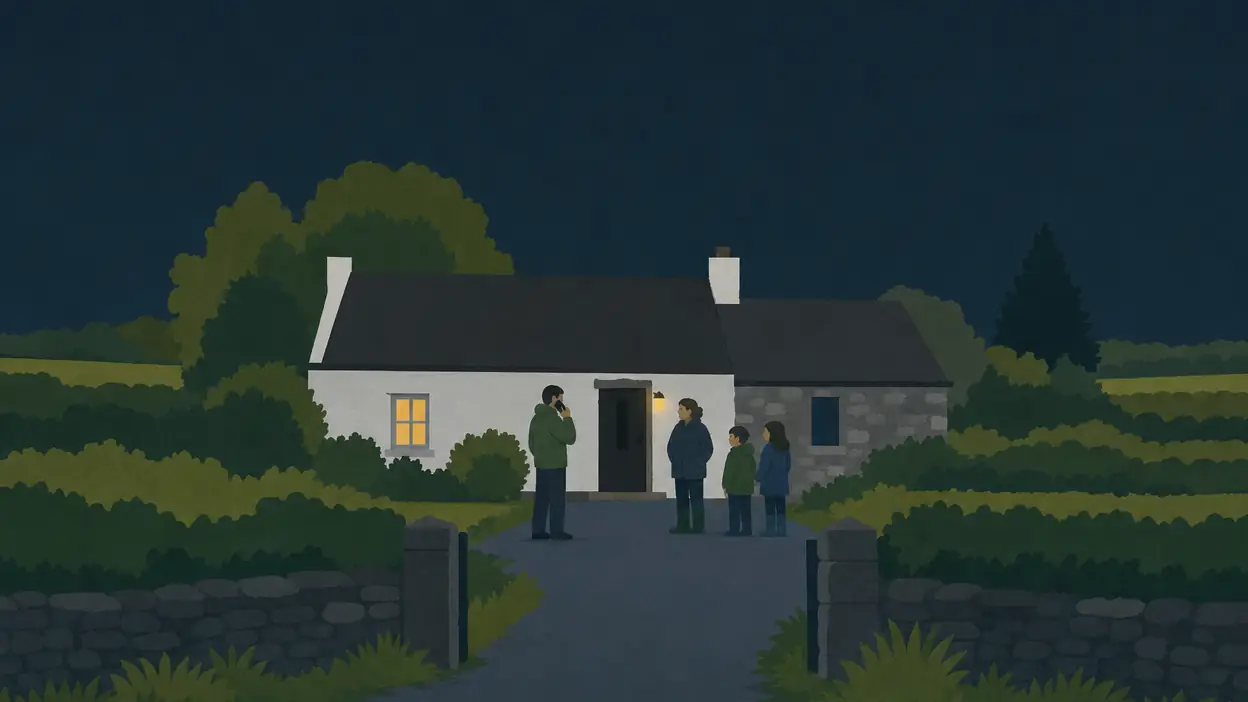
It is a frosty evening in a small town with no wind. Chimneys are going on every roof and the street smells of smoke. A parent wonders whether to bring the baby out in the buggy. A neighbour with asthma checks an app that says “moderate” while another says “poor”.
How to check the air where you are
- Go to airquality.ie and pick the monitoring station closest to your home.[4] The map updates at least once an hour.[5]
- Read the number and the band. The Air Quality Index for Health (AQIH) runs from 1 to 10 in four bands: Good (1 to 3), Fair (4 to 6), Poor (7 to 9) and Very Poor (10).[4]
- Check the forecast on the same site. It covers today, tomorrow and the day after, so you can plan a walk, a match or a school run.[5]
- A blue station does not update automatically: its samples go to a laboratory first. A grey station has no information at the moment.[5]
The EPA says air quality is fair, poor or very poor on 20 to 30 days a year in Ireland. In towns it is poor or very poor on about 10 days a year, most often in cold, still weather.[2]
What each band means for you
This is the EPA’s health advice for each band, word for word:[4]
| Band | Most people | People at higher risk |
|---|---|---|
| Good (1 to 3) | “Enjoy your usual outdoor activities.” | “Enjoy your usual outdoor activities.” |
| Fair (4 to 6) | “Enjoy your usual outdoor activities.” | “Adults and children with lung problems, and adults with heart problems, who experience symptoms, should consider reducing strenuous physical activity, particularly outdoors.” |
| Poor (7 to 9) | “Anyone experiencing discomfort such as sore eyes, cough or sore throat should consider reducing activity, particularly outdoors.” | “Adults and children with lung problems, and adults with heart problems, should reduce strenuous physical activity, particularly outdoors, and particularly if they experience symptoms. People with asthma may find they need to use their reliever inhaler more often. Older people should also reduce physical exertion.” |
| Very Poor (10) | “Reduce physical exertion, particularly outdoors, especially if you experience symptoms such as cough or sore throat.” | “Adults and children with lung problems, adults with heart problems, and older people, should avoid strenuous physical activity. People with asthma may find they need to use their reliever inhaler more often.” |
In words: when the air is good, carry on as normal. When it is fair, people with heart or lung problems who notice symptoms should take it easier outdoors. When it is poor or very poor, anyone with symptoms should do less outdoors. People at higher risk should cut down on strenuous activity when it is poor, and avoid it when it is very poor.[4]
Who is most at risk
The EPA says adults and children with heart or lung conditions, including asthma, are at higher risk. Some people who are very sensitive notice symptoms even when the air is good.[2] Older people are more likely to have heart and lung problems, so it makes sense for them to keep an eye on the air too.[5] The Government’s clean air page also names children as most at risk.[3]
Babies and children. The EPA says children who are well usually do not need to stay off school or out of games because of air pollution. Children with asthma should have their usual medicines with them on days when pollution is higher than usual.[5] If you are worried about a baby, check the reading first. On a very poor evening, a shorter trip or a different time may suit better, and your GP or public health nurse can advise.
What to do on a bad air day
- Do the hard exercise another time or somewhere else. A run or a match can wait for better air or move indoors.[4]
- Do not change heart medicines because of the index. Speak to your GP or pharmacist if you need advice.[6]
- Think twice before lighting a fire. The Government’s advice is to check the air before you light one. If the air quality is very poor, think twice, particularly on still days with no wind to clear the smoke.[3]
- Look after the air indoors. The HSE says to keep rooms well aired, use only the recommended fuel for your fire or stove, and keep flues and chimneys clear so the smoke goes out.[7]
- Have a carbon monoxide alarm wherever you burn fuel. See carbon monoxide alarm kit options: Carbon monoxide alarm and what to do if it sounds.
Asthma attack: follow the HSE steps. Sit upright, do not lie down, and take slow, steady breaths. Take 1 puff of your reliever inhaler every 30 to 60 seconds, up to 10 puffs, using a spacer if you can. “If you do not feel better after 10 puffs, call 112 or 999 and ask for an ambulance.” If your symptoms do not improve after 10 minutes, take the puffs again in the same way. If the ambulance has not arrived, call 112 or 999 again straight away.[8] For a child, follow the HSE’s asthma in babies and children advice.
Cannot make a voice call? Text 112.
The emergency text service can be used by "anyone who is not able to make a voice call due to a speech or hearing impairment or other situations where a voice call might not be possible". It works "from any Irish registered mobile phone (either pre-pay or bill pay) on all the Irish Mobile networks". If you can talk, ring instead: a text is slower.
Your text needs four things:
- Which service: Ambulance, Coastguard, Fire or An Garda Síochána.
- What the problem is.
- County you are texting from.
- Where help is needed: town, road, Eircode or a landmark.
Wait for a reply: "an SMS/Text 'Delivery Report' does not mean your message has been received". If no reply comes within 3 minutes, send another message straight away. It does not work from a foreign phone, or from an Irish phone roaming abroad, including in Northern Ireland.
No registration is needed. 112.ie says: "There is no preparation or registration required to use either Emergency SMS, or RTT when contacting the ECAS." If you might need to text one day, you can choose to give the service your address, access details and a next of kin in advance at 112.ie/register. Most smartphones can also use Real-Time Text to type during a call to 112 or 999: turn on RTT in your phone’s accessibility settings.
Source: 112.ie, emergency text service, sending a text to 112, SMS questions and answers, emergency SMS terms and conditions and Real-Time Text pages, checked 1 November 2026.
Smoke from a gorse or forest fire nearby is a different situation. Follow the gorse and wildfire guide.
The solid fuel rules
The Solid Fuel Regulations (S.I. No. 529 of 2022) have applied nationwide since 31 October 2022. They control what can be sold and distributed for home heating.[9][3]
- Smoky coal is off the market. Bituminous coal such as “Polish” or “Columbian” coal can no longer be sold. Coal products and manufactured fuels must give off less than 10 grams of smoke an hour.[3][10][11]
- Wood must be dry. Since 1 September 2026, wood sold in units of 2 cubic metres or less must have a moisture content below 20%. It was 25% until then.[12][10]
- Bigger loads of wood (more than 2 cubic metres) must come with a notice telling you the wood is not ready to burn until it has dried to 20% moisture or less, and to store it in a bright, well-aired place until then.[9][12]
- Turf cannot be sold online, in shops, garages, fuel yards, pubs or other public places. People with turf-cutting rights can still cut it, burn it, give it away, and sell it to someone directly. The rules do not stop anyone burning turf.[9][13]
- Check the bag. Approved fuel must be labelled “contents comply with the Air Pollution Act Regulations” and show the producer’s EPA registration number.[13]
- Buying from outside the State is your responsibility, and it is an offence to transport fuel that is not approved.[13]
“Ready to Burn” is an English label, set up for the UK Government’s environment department. It is not the Irish legal test. In Ireland, look for the compliance wording and the EPA registration number.[14][13]
Your local council enforces the rules. If you think a seller is breaking them, contact the council’s environment section.[3]
Why apps give different readings
Two apps can show different numbers for the same street at the same time. Each may be measuring a different thing, over a different time:
- Different time periods. The EPA index uses a 24-hour average for fine particles (PM2.5 and PM10).[4] The European index uses hourly figures, and by default it shows the picture from 3 hours ago.[15] A short burst of smoke moves an hourly number much more than a daily average.
- Measured or modelled. The European index fills gaps with a modelled estimate for each 1 km square, so a reading can be a forecast rather than a measurement.[15]
- Different scales. The European index has six bands, from Good to Extremely poor.[15] Some apps use the US index, which runs from 0 to over 300 in six categories, so a “moderate” there is not the same as a “fair” on the EPA index.[16]
- Distance from the station. The EPA advises using the station closest to your home.[4]
For decisions about health in Ireland, use the EPA index on airquality.ie. Its health advice was written by public health doctors with the EPA.[6][2]
Common questions
How do I check the air quality where I live?
Go to airquality.ie and pick the EPA monitoring station closest to your home; the map updates at least once an hour. The site also has a forecast for today, tomorrow and the day after.[4][5]
What do the air quality numbers mean?
The EPA’s Air Quality Index for Health runs from 1 to 10: 1 to 3 is good, 4 to 6 fair, 7 to 9 poor and 10 very poor. Each band has health advice for most people and for people at higher risk.[4]
Is it safe to bring a baby out when the air is smoky?
The EPA says children who are well usually do not need to stay away from school or games because of air pollution. Check the reading first, and ask your GP or public health nurse if your baby has a heart or lung condition.[5][2]
Is smoky coal banned in Ireland?
Since 31 October 2022 smoky coal cannot be sold anywhere in Ireland. Wood sold in small loads must now have less than 20% moisture.[3][12]
Why do air quality apps show different readings?
They use different averaging times, scales and sometimes modelled estimates. The EPA index uses a 24-hour average for fine particles, while the European index uses hourly figures from 3 hours ago.[4][15]
Data sources (16), all checked 2026-11-01
Footnotes
-
EPA, Ireland’s air quality is generally good, benefitting people’s health, 21 October 2026. About 1,500 premature deaths a year; solid fuel and traffic. Checked 1 November 2026. ↩ ↩2
-
EPA, For health professionals. Who is at higher risk, days of fair, poor and very poor air, solid fuel in towns. Checked 1 November 2026. ↩ ↩2 ↩3 ↩4 ↩5 ↩6
-
Department of Climate, Energy and the Environment, Clean Air (last updated 22 August 2025). Who is most at risk, check before lighting a fire, the 2022 rules, enforcement by local authorities. Checked 1 November 2026. ↩ ↩2 ↩3 ↩4 ↩5 ↩6 ↩7
-
EPA, Air Quality Index for Health. Bands, averaging periods and the health advice quoted word for word. Checked 1 November 2026. ↩ ↩2 ↩3 ↩4 ↩5 ↩6 ↩7 ↩8 ↩9 ↩10
-
EPA, FAQs on air quality. Older people, children and school, map colours and hourly updates, the three-day forecast. Checked 1 November 2026. ↩ ↩2 ↩3 ↩4 ↩5 ↩6 ↩7
-
HSE Health Protection Surveillance Centre, Air quality. AQIH advice for poor and very poor air, heart medicines, development of the index. Checked 1 November 2026. ↩ ↩2 ↩3
-
HSE, Living with asthma. Air pollution, indoor air, fuel and flues. Checked 1 November 2026. ↩ ↩2
-
HSE, Asthma attacks. What to do, quoted. Checked 1 November 2026. ↩
-
S.I. No. 529 of 2022, Air Pollution Act 1987 (Solid Fuels) Regulations 2022, Regulation 3. Sale and distribution of unapproved fuel prohibited. Checked 1 November 2026. ↩ ↩2 ↩3
-
EPA, Solid Fuel Regulations. Smoke limits, moisture content of less than 20%, producer register for 2026 to 2027. Checked 1 November 2026. ↩ ↩2
-
S.I. No. 417 of 2026, Air Pollution Act 1987 (Solid Fuels)(Amendment) Regulations 2026. Temporary smoke-test arrangements for 1 September 2026 to 31 August 2027. Checked 1 November 2026. ↩
-
S.I. No. 389 of 2025, Air Pollution Act 1987 (Solid Fuels, Moisture Content) (Amendment) Regulations 2025. Moisture limit below 20% from 1 September 2026. Checked 1 November 2026. ↩ ↩2 ↩3
-
Department of Climate, Energy and the Environment, FAQ for householders on the solid fuel regulations. Labelling, buying outside the State, turf. Checked 1 November 2026. ↩ ↩2 ↩3 ↩4
-
Ready to Burn, run by HETAS and Woodsure for the UK Department for Environment, Food and Rural Affairs under the English regulations. Checked 1 November 2026. ↩
-
European Environment Agency, European Air Quality Index. Six bands, hourly figures, 3 hours ago by default, modelled 1 km layer. Checked 1 November 2026. ↩ ↩2 ↩3 ↩4
-
US Environmental Protection Agency, Air Quality Index basics. Six categories, values from 0 to 301 and higher. Checked 1 November 2026. ↩
prepared.ie is independent public information. It is not affiliated with the Government of Ireland, the EPA, the HSE or any agency. In an emergency, call 112 or 999.